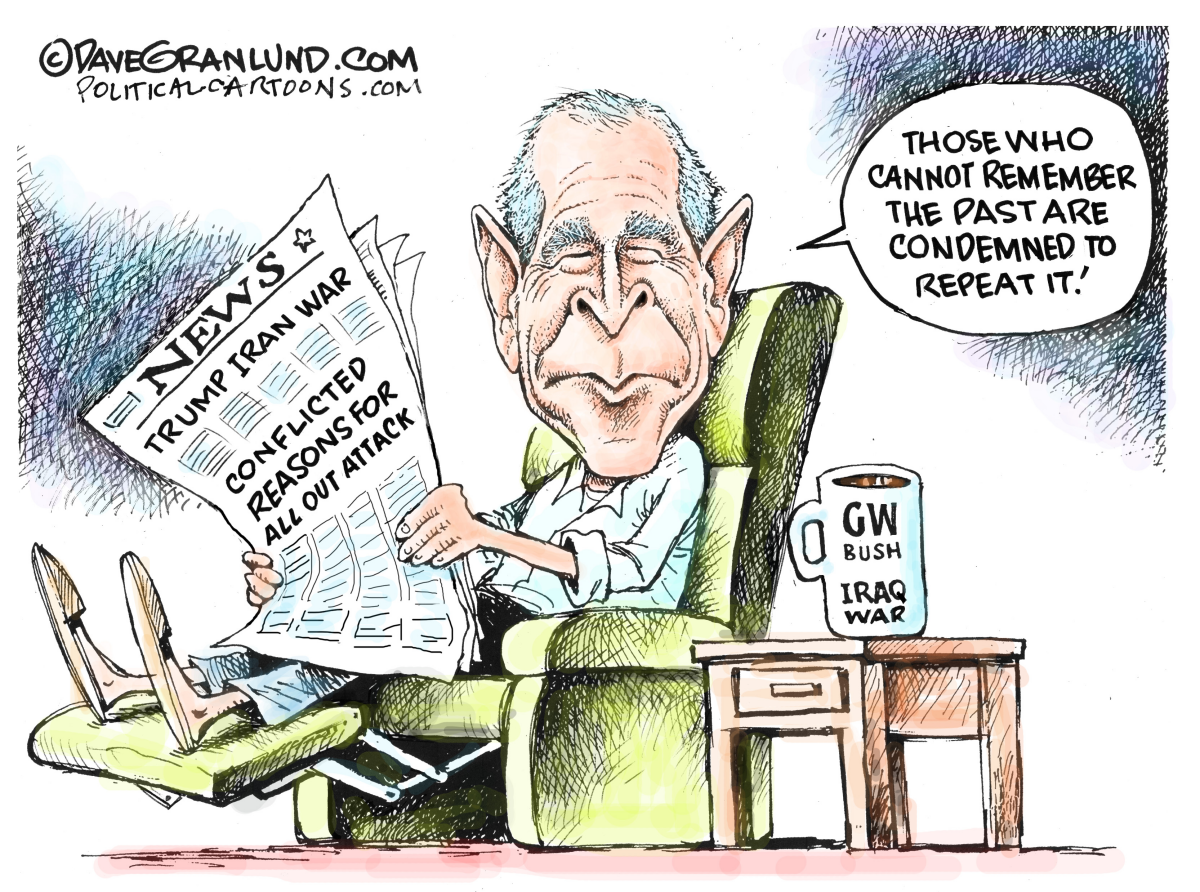
A cartoon of former President George W Bush who led the war against Iraq The Iraq War (2003–2011, with continued involvement) lasted nearly nine years, with estimated total U.S. costs exceeding $3 trillion
Four weeks in, the promised revolt never came—proving this war like the war on Iraq was built on illusion, not intelligence. Where was the CIA
By: Ya Libnan Editorial Board , Op.Ed
Four weeks into the war with Iran, one reality is becoming impossible to ignore: the promised internal uprising has not materialized. Not even a flicker.
This raises a fundamental question—one that should have been asked before a single missile was launched: how can a nationwide uprising occur without leadership?
Revolutions are not spontaneous miracles. They require organization, coordination, and above all, credible leadership. In Iran today, there is no identifiable figure rallying the population, no unified opposition structure, and no visible chain of command capable of transforming public discontent into a national movement. The expectation that bombing alone would trigger regime collapse was not strategy—it was wishful thinking.
Reports that Mossad chief David Barnea may have assured Benjamin Netanyahu—who in turn convinced Donald Trump—that war would spark an uprising should alarm every American taxpayer. If true, it suggests that a superpower may have entered a war based not on verified intelligence, but on assumptions shaped by another nation’s strategic interests.
This leads to an even more troubling issue: where was the Central Intelligence Agency?
The United States possesses the most sophisticated intelligence apparatus in the world. Yet if Washington relied heavily on external assessments to justify a war of this magnitude, it represents not just a failure of judgment—but a failure of responsibility. Wars are not theoretical exercises; they are paid for in blood, stability, and trillions of taxpayer dollars.
The parallels to the Iraq War are difficult to ignore. Then, as now, the case for war rested on claims that did not withstand scrutiny—most notably the assertion by former Prime Minister Ariel Sharon that Iraq possessed weapons of mass destruction. Then, as now, policymakers assumed that removing—or weakening—a regime would quickly lead to a better alternative.
History proved otherwise.
Today, the same flawed logic appears to be unfolding. Iran’s regime, whatever its internal challenges, has shown resilience in the face of external pressure. Nationalism often strengthens governments under attack rather than weakens them. Bombing campaigns rarely inspire democratic uprisings—they more often unite populations against a foreign enemy.
And while the strategic objectives remain unclear, the costs are already mounting. The United States risks being drawn into another prolonged conflict in the Middle East—one that could drain resources, destabilize the region further, and burden future generations with yet another multi-trillion-dollar legacy.
The American people deserve better than wars built on assumptions.
They deserve clear objectives, credible intelligence, and above all, accountability.
If the central premise of this war—that it would ignite an internal uprising—has already proven false, then continuing down this path is not strength. It is denial.
Time to end this war—before it becomes another Iraq or Afghanistan.
If backchannel talks are already underway between Donald Trump’s team and Tehran, then the outcome is clear: this war will end not in victory, but in a ceasefire. No regime change. No strategic breakthrough. Just losses on all sides—proving once again that wars built on illusion deliver nothing but costly failure.
History will not judge how this war started—but how long it was allowed to continue after its failure became clear.
