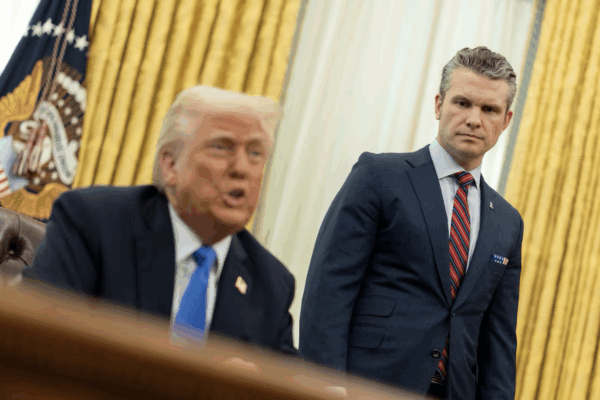
File Photo : U.S. Defense Secretary Pete Hegseth looks on, as President Donald Trump delivers remarks, in the Oval Office at the White House, in Washington, D.C., U.S., March 21, 2025. REUTERS/Carlos Barria/
The request, which has not yet been submitted to Congress, is already encountering some resistance. It is in line with Mr. Trump’s plans to drastically expand military spending to $1.5 trillion next fiscal year.
The Pentagon has asked for $200 billion in funding for the war in Iran, according to a military official and an administration official, a significant sum adding to the costs of an already divisive campaign.
The request has been sent to the White House, the military official said, which will review it before any request for funds is formally submitted to Congress. The officials spoke on condition of anonymity to discuss the proposal. The request was reported earlier by The Washington Post.
“Obviously, it takes money to kill bad guys,” Defense Secretary Pete Hegseth said when asked about the request during a news conference on Thursday, adding: “As far as the $200 billion, I think that number could move.”
On Capitol Hill, the sum — nearly a quarter of the country’s entire annual defense budget — is already raising eyebrows among some moderate Republicans who would be key to approving the funds.
“It’s considerably higher than I would have guessed, but I don’t know how it’s broken down,” Senator Susan Collins, Republican of Maine and the head of the chamber’s Appropriations Committee, told reporters Wednesday evening. The White House had not passed along any request to Congress, she said.
Senator Lisa Murkowski, Republican of Alaska and a key swing vote, said that the Trump administration would have to make a more concerted effort to engage Congress on the war before such a request could be approved.
“You just can’t come up here with an invoice and say, you know, ‘pay this’ and expect to have great cooperation going forward,” she told reporters on Wednesday.
Last week, Pentagon officials told lawmakers that the first six days of the war against Iran had cost more than $11.3 billion. Since then, President Trump has threatened to escalate the fighting, and has floated the idea of putting American troops on the ground even as he suggested that the United States might conclude its military campaign soon.It was not immediately clear how long the Pentagon intended for the $200 billion for the Iran war to last, or what operations it would cover. But the figure suggests that the U.S. military is preparing for a significant engagement.
In 2014, the Congressional Research Service calculated that the United States had spent $815 billion in direct costs for the war in Iraq over 13 years. A recent report from the Council on Foreign Relations, compiled from official government figures, found that the United States had dedicated $188 billion in aid to shore up Ukraine’s war effort since Russia invaded in early 2022.
The funds for those wars were not approved as lump sums, but meted out over several appropriations cycles after extended, and oftentimes heated, debate about mounting costs.
On Capitol Hill, lawmakers have already spent weeks fighting about the prudence and the legality of the war in Iran, with nearly all Democrats voting to advance resolutions to curtail the U.S. military’s involvement there, and nearly all Republicans voting to allow the president to continue as he sees fit.
But a $200 billion funding request could shift that balance.
The White House frequently submits funding requests to Congress, which can then choose what to honor. Lawmakers have frequently diminished and even augmented budgets for parts of the executive branch when they disagree with an administration’s objectives, or simply can’t muster enough votes to support the requests.
Democrats responded to the news of the $200 billion request with outrage.
“Donald Trump and Republicans enacted the largest cuts in history to Medicaid and SNAP because the nation simply ‘couldn’t afford’ them,” Representative Donald S. Beyer Jr., Democrat of Virginia, wrote on social media. “Now, the Trump Administration is seeking $200 billion to pursue their illegal, poorly planned war of choice against Iran. Absolutely not.”
“That’s money that we don’t have,” said Senator John Hickenlooper, Democrat of Colorado, adding: “With that kind of money, we can fund universal pre-K in every state in this country. We can get to universal health care coverage. We could have free school meals for every child.”
Within the Republican Party, a hefty bill for the Iran war could further exacerbate tensions between defense hawks and budget hawks, many of whom have objected in the past to spending billions on foreign wars — as Mr. Trump himself did on the campaign trail. It is unclear whether Republicans who vocally opposed such ventures under President Joseph R. Biden Jr. might justify an overseas military campaign launched by Mr. Trump.
Neither Senator John Thune of South Dakota, the majority leader, nor Speaker Mike Johnson, of Louisiana, committed on Thursday to seeing the Pentagon’s request through, but they indicated support for additional funding for the war.
“I’m sure it’s not a random number, so we’ll look at that,” Mr. Johnson told reporters. “But obviously, it’s a dangerous time in the world, and we have to adequately fund defense.”
“The operations that are being undertaken now in Iran cost money,” Mr. Thune told reporters. “And we have to recognize that.”
The request is in line with Mr. Trump’s plans to drastically expand military spending to $1.5 trillion next fiscal year.
The U.S. national debt surpassed $39 trillion this week, marking the fastest trillion-dollar increase outside the COVID-19 pandemic. The surge comes just weeks into the U.S.-Israeli war in Iran, which has already cost over $12 billion, and follows major spending on defense, immigration enforcement, and tax cuts. At the current pace, experts warn the debt could hit $40 trillion before the fall elections, intensifying concerns over borrowing costs, inflation, and future fiscal flexibility.
Fiscal watchdogs warn that sustained borrowing will force Americans into tougher economic tradeoffs , from higher interest payments to reduced public investment. Interest costs alone are projected to reach $1 trillion,
The New York Times
