
The US funds its own growing military presence in the Iran war while also providing billions in military aid to Israel. In effect, the United States is financing a war whose long-term objectives are not its own.
As Iran and Israel pursue long-term dominance, U.S. taxpayers risk footing the bill for a conflict they did not choose
By: Ya Libnan, Op.Ed.
The United States stands at a dangerous crossroads in the Middle East—one where the line between supporting an ally and being drawn into an open-ended war is becoming increasingly blurred.
At the heart of this conflict are two ambitious powers, Iran and Israel, each pursuing long-term strategies aimed at shaping the region to their advantage. Iran has spent decades building influence across the Arab world through proxies and asymmetric warfare. Israel, backed by unmatched military strength and close ties with Washington, has focused on neutralizing threats and maintaining regional superiority.
Today’s war is not simply about immediate security concerns. It is about who will dominate the Middle East for decades to come.
But where does that leave the United States?
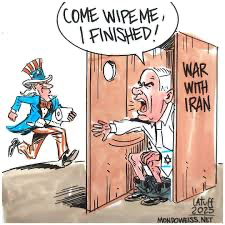
American taxpayers are already deeply invested in this conflict. Washington funds its own growing military presence in the region while also providing billions in military aid to Israel. In effect, the United States is helping finance a war whose long-term objectives are not entirely its own.
And history suggests that the financial burden will not end when the fighting stops. When wars in the Middle East conclude, the United States is often called upon to help stabilize, rebuild, and fund recovery efforts. The same taxpayers who finance the war today may well be asked to pay for its aftermath tomorrow.
This raises a fundamental question: Is this America’s war—or is America being pulled into a broader struggle shaped by others?
To be clear, Israel is a longstanding ally, and Iran’s destabilizing role in the region is well documented. But alliances should not come at the expense of strategic clarity. Supporting a partner is one thing; drifting into a prolonged conflict with expanding objectives is another.
The United States must define its own interests—clearly and independently.
What are America’s goals in this war?
What is the desired endgame?
And how much is the nation willing to spend—financially and politically—on a conflict that risks expanding beyond its original scope?
These are not abstract questions. They go to the heart of responsible leadership.
Great powers do not allow themselves to be carried by the momentum of events or the ambitions of others. They set the terms of their engagement, establish clear limits, and act in accordance with their own national interests.
This is a moment for the United States to lead—not follow.
If Washington fails to define its own strategy, it risks becoming entangled in a long-term regional rivalry between two determined actors, each with its own vision of dominance. And in that scenario, the costs—financial, military, and political—will continue to rise.
The American people deserve better than an open-ended commitment to a war they did not choose.
They deserve a strategy.
