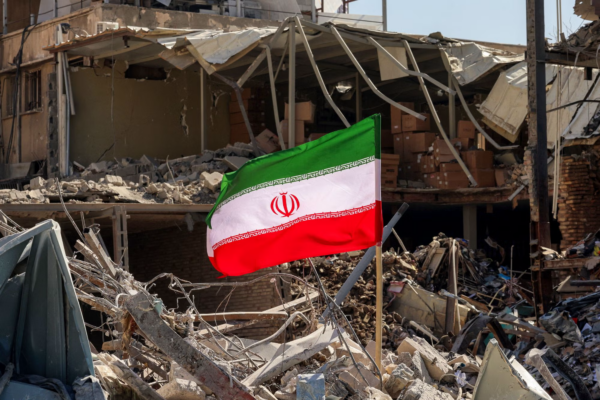
Removing leaders is one thing. Building stability in Iran afterward is the real challenge.
By : Ya Libnan, Analysis
As the war between Iran and the U.S.–Israel alliance intensifies, rhetoric is escalating as quickly as the fighting. Iran’s president, Masoud Pezeshkian, insists that the Islamic Republic will never surrender to “bullies.” Meanwhile, President Donald Trump has reportedly demanded Iran’s “unconditional surrender.”
Such maximalist rhetoric may energize domestic audiences, but it avoids the most important strategic question: what happens the day after?
Recent strikes have already decimated much of Iran’s leadership. Senior figures such as Ali Larijani and other security officials have reportedly been killed, and the death of Supreme Leader Ali Khamenei would represent the most dramatic shock to Iran’s political system since the 1979 revolution.
In response, the clerical establishment reportedly moved quickly to elevate Mojtaba Khamenei, the son of the late leader, consolidating power within the existing system. If confirmed, this transition would mark a historic shift for a regime that was born in opposition to hereditary rule.
But leadership succession alone does not resolve Iran’s deeper structural question: can the regime survive the war, or will the country face a destabilizing power vacuum?
The real power inside Iran lies not only in clerical institutions but in the vast security state built around the Islamic Revolutionary Guard Corps and its network of paramilitary forces, including the Basij. For decades, these organizations have served as the regime’s enforcement arm—suppressing protests, enforcing religious laws, and maintaining political control across cities and villages.
If the central government weakens or fractures, these forces could become the decisive political actors.
Recent history offers sobering precedents.
In Libya, the fall of Muammar Gaddafi in 2011 created a power vacuum that quickly devolved into militia rule and prolonged civil conflict. In Venezuela, the removal of Nicolás Maduro did not destroy the ruling system. Instead, the regime remained intact and power passed to another insider, allowing the state structure to survive while adjusting its external relationships.
This raises an important strategic question: could Iran follow the Venezuelan model rather than the Libyan one?
In theory, the system could remove or replace a leader while preserving the structure of the Islamic Republic. But that scenario requires a pragmatic insider capable of stabilizing relations with the outside world while maintaining internal control.
That may prove difficult in Iran’s current power structure.
The new leadership under Mojtaba Khamenei is widely viewed as closely aligned with the security establishment and the ideological foundations of the Islamic Republic. Unlike pragmatic insiders in other authoritarian systems, he is not known as a figure inclined toward political compromise with Western governments.
As a result, Iran may face a more rigid and security-driven leadership structure precisely at the moment when the country most needs political flexibility.
This leaves a troubling possibility: neither the Libyan collapse nor the Venezuelan transition may fit Iran’s reality.
Instead, the future of Iran may ultimately depend on one decisive factor—the cohesion of the country’s security apparatus.
If the Revolutionary Guard remains unified behind the new leadership, the regime could survive even severe external pressure. If it fractures, the country could face the kind of instability that has repeatedly followed abrupt regime changes across the Middle East.
For that reason, the most urgent strategic question is not whether Iran’s current leadership can survive the war.
The real question is whether the international community has any plan for what comes next if it does not.
History has repeatedly shown that wars can remove regimes faster than they can build stable replacements. The experiences of Iraq, Libya, and Afghanistan should serve as a warning.
Before demanding surrender, world leaders should answer a simple but critical question:
Who governs Iran the morning after?
If there are leaders behind Iran’s protest movements—inside the country or in exile—this is the moment for them to step forward. Nations in transition do not wait for leaders to appear; they are shaped by those courageous enough to rise and be counted.
