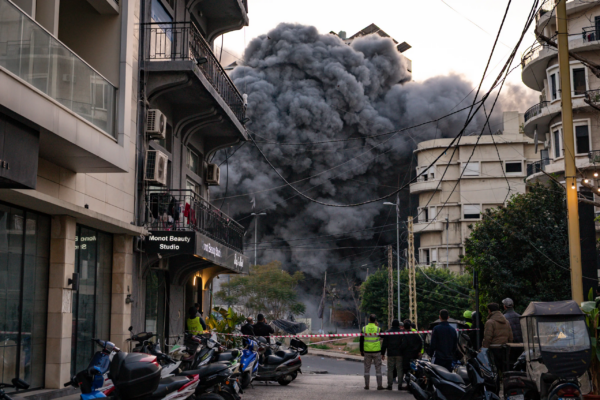
PHOTO- Smoke from a building in the center of the city which has been hit by the IDF after an evacuation order on March 12, 2026 in Beirut, Lebanon.Adri Salido/Getty Images
The Israeli military said Monday it was launching a “limited” ground offensive into new areas of southern Lebanon, raising fears of an extended occupation as the country is drawn further into the U.S.-Israeli war with Iran.
In a briefing on Monday, Nadav Shoshani, an Israeli military spokesman, said Israel expected operations against Hezbollah to continue for at least three more weeks.
The war between Israel and the Iranian-backed Shiite militia has already displaced roughly one million people in Lebanon and killed at least 886 people, according to the Lebanese health ministry.
The latest round of fighting began after Hezbollah launched rockets into Israel March 2 in retaliation for the death of Iran’s Supreme Leader Ayatollah Khamenei, who was killed Feb. 28 in U.S.-Israeli airstrikes in Tehran.
The U.K., Canada, France, Germany and Italy said in a joint statement that a significant ground offensive would have “devastating humanitarian consequences.”
“It must be averted. The humanitarian situation in Lebanon, including ongoing mass displacement, is already deeply alarming,” the statement read.
Opposition leaders in Israel also voiced anger at the plans.
“We must not allow the failure in Gaza to replicate itself in Lebanon and Iran,” Yair Golan, chairman of the center-left The Democrats party and a former chief of the military’s Northern Command, said. “We must not allow this government to lead us into an endless war there as well.”
TIME spoke to Michael Young, Senior Editor at the Carnegie Middle East Center, and Faysal Itani, adjunct professor of Middle Eastern Politics at Georgetown University and senior fellow at the Middle East Policy Council, about what they expect from Israel’s expanding military operations in Lebanon.
This interview has been condensed and edited for clarity.
What is Israel’s justification for launching a ground operation in Lebanon, and what are its ultimate aims?
FI: Israel’s justification is securing the north [of Israel] from Hezbollah attack including incursions, short range rocket fire, and anti-tank guided missiles. More broadly it wants to occupy and demilitarize south Lebanon, basically pushing the threat northwards away from civilian areas, in a forward defense posture. This also serves the purpose of displacing tens if not hundreds of thousands of Lebanese, mostly Shiite, alienating them from Hezbollah (in theory) and causing communal tensions in non-Shiite areas, thereby pressuring multiple parties to turn on Hezbollah.
MY: Essentially, I think what the Israelis want to do is create a buffer zone in South Lebanon that ensures that the towns in northern Israel are as far as possible from Hezbollah’s rockets. Some people have suggested that this buffer zone could be 10-15 kilometers deep—I have no idea. The Israelis have not made clear exactly what they intend to do. They have said that they would occupy the land south of the Litani River. But, whether that’s enough to maintain the towns of Northern Israel outside of the rocket ranges… I’m not sure.
But, I think that it’s really a two step thing that they’re trying to do at this point: to occupy south of the Litani, but also create a zone north of the Litani, which they will try to survey with probably equipment and drones to make sure that there are no attacks into the area south.
South of the Litani, my understanding is that they’re going to try to create, essentially, a free-fire zone in which there is no life. So that seems to be the immediate aim.
Now the ultimate aim, I don’t know. I would suspect that’s a much more complicated question. My belief is that they will hold on to occupied land and essentially tell the Lebanese government that “it’s up to you now to disarm Hezbollah.” Now, whether they help in that regard or not is another question.
What might the early phases of an Israeli ground operation look like?
MY: I think we see it already. They have entered into Khiam, and Khiam is a strategic town near the border, because from Khiam, they can move northeasterly direction towards the Bekaa Valley, and at least, at the very least, cut off any access from the Bekaa Valley to the south, which means that Hezbollah combatants in the south cannot be resupplied with weapons.
But, I think it’s also possible that the Israelis may move in that direction towards the southern part of the Bekaa Valley, which would allow them to connect with the Golan Heights. So we have to see. But this is pure speculation on my part.
FI: This begins with a gradual takeover of strategic hilltops and other terrain suitable for observing, attacking, and defense. It will involve armor, infantry, and a continuing air campaign.
How will Lebanese civilians be impacted?
FI: Most immediately, the population of South Lebanon, much of whom have already been displaced, will suffer under difficult conditions. Further north of the Israeli zone you can expect extended fighting, and civilian casualties from Israeli airstrikes.
MY: We are already seeing how between 850,000 and maybe a million Lebanese civilians have been displaced since the conflict began. And, of course, if [Israel does] take over the area south of the Litani, which I believe is home to about 400,000 to 500,000 people—many of them from the Shiite community—these people will very likely not be able to return. I think the Israelis basically want to ensure that that area becomes uninhabitable. I think we’re going to see a major impact on the population.
The big question mark is where will the Shiite community be able to live after this conflict? And that’s not at all clear. Already, the Israelis have displaced most inhabitants from the southern suburbs of Beirut. Many of them are living in the streets of Beirut. Where will these people go? And this is a big question mark. They’ve created a major humanitarian problem which they’re in no hurry to resolve.
Does Hezbollah have the capability to put up a fight against the Israeli army?
MY: I think we’re dealing with small groups of Hezbollah combatants who will be slowly but surely worn down by the Israeli military, which has tremendous firepower superiority in terms of artillery, in terms of aircraft, in terms of helicopters. I think what we’re going to see is significant losses in Hezbollah members south of the Litani River.
FI: Hezbollah can inflict some costs on the Israeli Army, yes, especially if there is a ground operation. On balance however Israel is the stronger party, it really comes down to political will and the ability to absorb Israeli casualties. But I think this is quite high given the mood in Israel today.
How does the Lebanese army and the Lebanese state fit into all this?
MY: The Lebanese army and state has a major problem, because, as I said, if today, the Israeli plan is to hold on to land, unless the Lebanese army disarms Hezbollah, this creates a Catch-22 for the state. If they try to disarm Hezbollah, it can create domestic conflict, which the army doesn’t want to provoke, effectively a civil war. But if it doesn’t act, “Israel would then basically say, Okay, it’s up to you. We will keep the occupied territories.” So, that’s, I think it’s a terrible choice for the Lebanese army and for the Lebanese state. I don’t know what they’re going to decide.
FI: The Lebanese Army leadership is not committed to fighting or disarming Hezbollah, despite government orders to do so, and unable to confront Israel. The government can give orders but if they are not followed, they’re pointless. That said the Lebanese Army’s entry into this war against Hezbollah would very much complicate the latter’s existence.
How do Lebanese people feel towards Hezbollah right now?
FI: Polling shows that a clear majority of Lebanese reject Hezbollah and its war. That still leaves a sizable minority who support it, but there has not been any polling since this specific war started. Anecdotally there is rising resentment against Hezbollah among its traditional Shiite base, but there is no way to gauge attitudes for sure under the circumstances.
MY: I think many people in Lebanon are quite angry that Hezbollah, or more likely, Iran directly, has taken the country into a new war against Israel, one that will be very destructive for Lebanon, and that has already been very destructive for the Shiite community.
Israel has invaded Lebanon many times in the past with similar aims. Is there any indication that this time will be any more successful? And what does success look like?
MY: Israel has invaded Lebanon many times… but not necessarily with similar aims. The Israelis did invade in the 1970s to try to create sort of these buffer zones in the south, and they essentially set up, later on, a Lebanese militia made from remnants of the Lebanese army in the south and others to sort of protect Israel’s borders.
And I think this time, we’re going to see something a little bit different. I think the buffer zone will be protected electronically, with drones. Probably they’re going to leave that area empty of any inhabitants. So that’s something to watch. Will they be more successful? I think the Israelis have learned their lesson. They’re not going to give Hezbollah an opportunity to attack them by deploying large numbers of troops inside Lebanon. They’re going to essentially use electronic means, drones, that kind of thing. They will continue to do what they’ve been doing since the ceasefire in 2024 which basically means attacking anything they see as a threat and leaving that area in a perpetual state of insecurity.
FI: I do not believe this invasion in itself will finish off Hezbollah. It will likely achieve its goal of securing the North, but create a host of new problems for Israel as well such as how to defend the new territory and absorb casualties. I believe the Israeli dream scenario is for the Lebanese to use this opportunity to go after Hezbollah everywhere else. If that happens, there is a possibility of Israel destroying Hezbollah, but it’s highly uncertain.
How does this all end?
FI: It’s not possible to know how wars end, but the immediate trajectory is towards mass displacement, continuing civilian casualties, possible Israeli targeting of civilian infrastructure, communal violence between displaced Shiite and host populations, and a new occupation of Southern Lebanon. It could end if Lebanon somehow managed to capitalize on this war against Hezbollah. It could also end if the regime in Iran collapses.
MY: Essentially I think the Israelis are going to create a situation where, as I said, they will occupy land and basically tell the Lebanese to disarm Hezbollah or else they will lose this land. The Lebanese will hesitate to disarm Hezbollah because they don’t want to enter into a civil war with the Shiite community. How do they resolve that is unclear. A lot will depend on whether Israel weakens Hezbollah or not, and at this point I don’t know what exactly Israel’s plans are.
TIME
