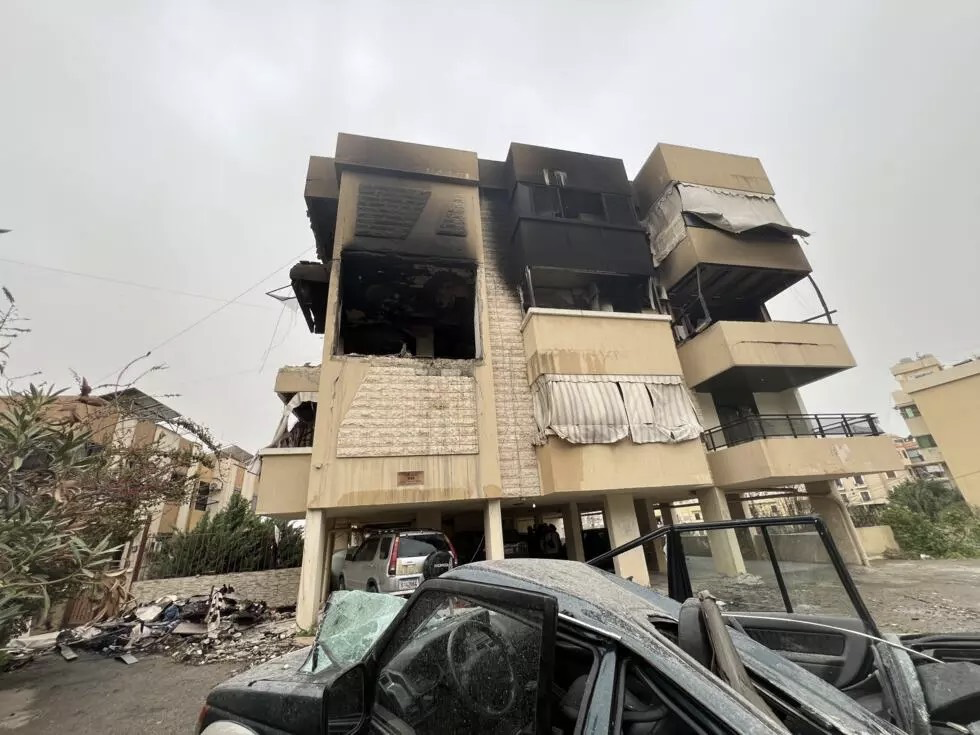
On March 14, an Israeli strike hit an apartment block in the Haret Saida neighbourhood in eastern Sidon. © Assiya Hamza, France 24
Israel’s devastating war with Hezbollah has compounded the suffering of ordinary Lebanese who were already grappling with an economy on the brink of collapse. FRANCE 24’s reporter travelled to Sidon, a coastal city south of Beirut, to visit the once-bustling alleys of the old souk that have now fallen eerily quiet.
By:
In Sidon, the old souk stretches for nearly 14 km. March 14, 2026. © Assiya Hamza, FRANCE 24
Founded by the Phoenicians more than 3,000 years ago, Sidon lies on the coast south of Beirut, a 40-minute drive from the Lebanese capital. As Israeli strikes continue to pummel the country, the ancient metropolis has become a refuge for people fleeing violence in the south.
In the city’s old souk, shopkeeper Wissam stands at the entrance to his small clothing stall, calling out to passersby.
“Tafaddalo sabaya! Tafaddalo” (“Come closer, ladies, come closer!”)
“Do you need anything? Four items for 25 dollars.”
But most people keep walking down the narrow alley of the historic market. With few customers stopping, the 43-year-old rearranges his display – unfolding and refolding shirts and sorting outfits for men, women and children.
Wissam sets up the stall for his clothes shop in the old souk of Sidon, on March 14, 2026. © Assiya Hamza, FRANCE 24
Wissam took over the shop from his father three years ago.
“Since the war started, you can feel the difference,” he says. “Displaced people do come to buy clothes, because they left their homes with almost nothing. But they don’t have much money.”
Suddenly, a scooter races through the crowded passageway. Pedestrians press against the walls as the driver speeds past and disappears into the maze of streets.
“We had prepared festive clothes for Eid al-Fitr,” Wissam says, gesturing toward the back of his shop. “But the displaced people mainly need simple things – tracksuits, everyday clothes. I had to move the holiday outfits out of sight. Maybe next week will make up for some of the losses.”
A few more people wander through the souk, but most are just looking.
“Everyone is very sad,” he adds. “Displaced families are sleeping along the seafront, schools are full, and many people who come here have nothing left.”
Fewer shoppers, quieter streets
Dania, a 50-year-old grandmother from Beirut, has come to Sidon with her five-year-old granddaughter. She cradles the child as they browse for clothes and pastries – a Sidon specialty.
She pauses to admire a glittery purple dress paired with a white faux-fur jacket – a princess outfit likely meant for Eid al-Fitr, the holiday marking the end of Ramadan. Traditionally, families buy new clothes for the celebration, especially for children.
Dania chooses a dress for her five-year-old granddaughter in the souk in Sidon. © Assiya Hamza, FRANCE 24
“I always shop here,” Dania says. “The souk is beautiful and there are always lovely things. But with the war, there are fewer people.”
Still, she says it is important to maintain normal routines.
“We have to keep our habits and stay positive,” she says.
But beyond the market, the war’s impact is impossible to ignore.
Along the waterfront, makeshift tents have sprung up. Some families are sleeping in their cars after leaving their homes behind. In recent days, airstrikes have intensified around the Sidon area.
“I wasn’t afraid to come,” Dania says. “I checked the news before leaving Beirut. But you can feel the atmosphere here is different. People come to the market quickly and leave quickly. Many have stopped working because of the war, so they aren’t buying.”
‘The season is ruined’
Mahmoud, a 63-year-old vendor who sells children’s clothing, smiles after completing a sale to Dania.
He has run his stall in the maze-like souk for five years, specialising in rhinestone-covered, glittering outfits popular with young girls.
But business this year has been disappointing.
“The season is ruined,” he says. “Usually, people start buying from the beginning of Ramadan. This time they are only just starting. People are afraid. They don’t know where they’ll have to go next. There are alerts all the time.”
He recalls how in 2024 an entire market in the southern town of Nabatieh was destroyed.
“Even here in Sidon, I had to move for a while because the building next to mine was threatened,” he says. “But losing money isn’t the most important thing. The important thing is staying alive.”
Mahmoud’s store sells clothes for children. © Assiya Hamza, France 24
Rising prices
The narrow alley opens onto a busier street where vendors shout over the sound of passing cars.
Candy, fruits, vegetables, herbs – sellers call out to customers in a constant chorus.
Khaled doesn’t need to shout – customers crowd around his vegetable stand.
For 50 years, the 64-year-old has sold produce here, following the same trade as his father and brothers.
“Even if death were close by, I couldn’t stop working,” he says. “I’m not a govern
“Thank God we’re still alive,” he adds. “But this war has affected us a lot. War is expensive. May God help Lebanon.”
He moves quickly between customers, weighing vegetables and packing bags.
Prices, he says, have risen sharply.
“Some products have gone up by 30 percent, others by 60 or even 70 percent,” he says. “Tomatoes, for example.”
Sweets on sale in the souk in Sidon. © Assiya Hamza, FRANCE 24
Tomatoes are normally grown in southern Lebanon, but Israeli strikes and the displacement of farmers have halted the harvest. Lebanon now imports them from Syria and Jordan.
“Some traders have no mercy,” Khaled says. “I sell tomatoes I bought for 160,000 Lebanese pounds (€1.56) for 170,000 (€1.65). Others sell them for 200,000 (€1.95) or even 250,000 (€2.43). I make almost no profit. I try to keep prices low for people who don’t have much.”
An economy in tatters
Ali, who fled Nabatieh ten days ago, does his shopping in the souk. He considers himself relatively fortunate as he managed to rent a house in Sidon to shelter his family.
Khaled sorts his peppers at the souk in Sidon. © Assiya Hamza, FRANCE 24
“I rented the same place we stayed in back in 2024,” he says while collecting groceries in the souk’s covered market. “But the price went from $800 to $1,500 (€696 to €1,305).”
The cost has nearly doubled but some expenses, he says, cannot be cut.
“We try to be careful with money, but not with food,” he says. “We have children.”
Around him, vendors continue shouting their offers: “Cucumbers! Tomatoes!”
Ali’s experience reflects a wider reality in Lebanon – the country is grappling with an economic crisis that predates the current conflict.
A covered market in the souk. © Assiya Hamza, France 24
Between 2018 and 2021, the Lebanese economy collapsed, and the Lebanese pound has lost about 98 percent of its value, according to the World Bank. Today, roughly 44 percent of the population lives in poverty. While many goods are priced in dollars, salaries are still paid in Lebanese pounds, leaving families struggling to keep up.
Still, for Ali and other shoppers, the souk remains a place to carry on.
Ali shrugs. “This is a popular market,” he says. “Prices are still reasonable. We’re just trying to live as normally as we can.”
France24/ AFP
