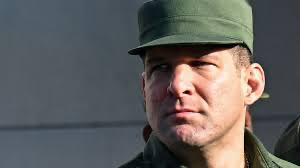
PHOTO – Raúl Guillermo Rodríguez Castro, grandson of former Cuban President Raúl Castro is leading the neotiations with the United States as the Trump administration seeks to push President Miguel Díaz-Canel from power but unlike Venezuela no military force will reportedly be used this time
As U.S. and Cuban officials negotiate over the future of the Communist-ruled and economically besieged Caribbean island, the Trump administration is seeking to push President Miguel Díaz-Canel from power, according to four people familiar with the talks.
The move would topple a key figurehead but leave in place the repressive Communist government that has ruled Cuba for more than 65 years. The Americans have signaled to Cuban negotiators that the president must go, but are leaving the next steps up to the Cubans, the people said.
The United States so far is not pushing for any action against Castro family members, who remain the country’s top power brokers, two of the people said. That is consistent with the general desire of Mr. Trump and his aides to force regime compliancerather than regime change in their foreign policy.
In the view of some Trump administration officials, removing Cuba’s head of state would allow structural economic changes in the country that Mr. Díaz-Canel, whom the officials consider a hard-liner, is unlikely to support, one of the people said.
If the Cubans agree, it would result in the first major political shake-up arising from talks between the two countries since those began a few months ago.
The ouster of the top official in Cuba’s leadership would give President Trump a symbolic win that would allow him to tell the American public that he had brought down the leader of a leftist government long opposed to the United States, as he did in Venezuela, one of the people said.
The move, though intended to show the Cuban exile community and other Americans that the Trump administration seeks political as well as economic change, would likely disappoint many conservative Cuban exiles in the United States, who want to see wholesale political transformation in Cuba. Cuban American lawmakers in Congress and politicians in Florida could also demand more action from Mr. Trump.
U.S. negotiators also want Cuba to agree to remove from power some older officials who remain committed to the ideas of Fidel Castro, the father of the communist revolution, the person said. And the Americans are pushing for the release of political prisoners, a longstanding policy goal of the United States.
From the perspective of U.S. officials, the talks are focused on having Cuba gradually open its economy to American businesspeople and companies — laying the groundwork for a client state — while getting a few symbolic political wins for Mr. Trump to announce.
condition of anonymity to discuss sensitive diplomatic matters.
The Cuban government declined to comment.
Mr. Díaz-Canel, 65, has been president of Cuba since 2018, and also serves as president of the Communist Party. He has two years left in his presidential term.
He was the first — and so far the only — person whose last name is not Castro to run Cuba since the 1959 victory of the revolution.
A former vice president and regional party official, he is widely considered a figurehead who lacks true political or economic control in Cuba. He was the handpicked successor to former Cuban president Raúl Castro, Fidel’s brother who is now 94 and still wields considerable power.
During Mr. Díaz-Canel’s presidency, Cuba saw major nationwide protests in July 2021, the largest in decades. He responded by calling his supporters to “combat” and imposing a major crackdown that involved mass arrests, prosecutions and prison sentences.
GAESA, Cuba’s military-controlled business conglomerate, manages key sectors, including tourism and retail, and is believed to have more sway in the country’s affairs than the current president.
But Mr. Díaz-Canel ’s formal stewardship of Cuba, during a period in which millions of its citizens fled the country as the country’s economic disintegration set off a humanitarian crisis, made him an obvious target to take the fall, experts say.
The Trump administration’s message that Mr. Díaz-Canel must go has not been articulated as an ultimatum, but presented as a positive step that would pave the way for productive deals, one of the people said.
The Cubans involved in the talks with the United States agreed that his presidency has been problematic, but still need to find a way to make the change without looking like Washington is telling Havana what to do, the person said.
The United States has signaled that no deal can take place with him at the helm, the person said.
The Trump administration, as part of its strategy to squeeze the Cuban government, has blocked foreign oil imports.
Raúl Guillermo Rodríguez Castro, a grandson of Raúl Castro, has been a main negotiator with the United States, speaking directly to Secretary of State Marco Rubio, the son of Cuban immigrants, and would likely continue to steer the government after Mr. Díaz-Canel’s departure, that person said.
Mr. Rodríguez Castro, known as Raulito, would nonetheless have power behind the scenes, with another figure who does not bear the Castro last name officially holding office, the person said.
In a 90-minute news conference on Friday, Mr. Díaz-Canel acknowledged the continuing talks with the U.S. government for the first time and blamed the country’s economic problems and extended blackouts on Washington’s trade embargo, and in particular the oil blockade Mr. Trump has imposed.
Cuba has had no oil imports in three months, Mr. Díaz-Canel said.
“The government isn’t to blame, the revolution isn’t to blame, our national electromagnetic system isn’t to blame,” he said Friday. “The blame lies with the energy blockade that has been imposed on us.”
On Monday, the power grid failed, and the entire country plunged into darkness.
The U.S. State Department declined to comment, referring instead to Mr. Trump’s recent statements about Cuba.
“I do believe I’ll have the honor of taking Cuba,” Mr. Trump said Monday.
When pressed, he declined to say whether that would be a diplomatic or military move, saying only “I think I can do anything I want with it.”
The Trump administration aims to do in Cuba what it did in Venezuela — remove its president — but this time without the use of military force. A military strike is considered unlikely, two of the people said.
As the U.S. conducted airstrikes in Caracas, on Jan. 3, American soldiers entered the capital and seized the country’s leader, Nicolás Maduro, who now faces drug-trafficking charges in New York. The move allowed Washington to take control of Venezuela’s oil industry and stop all of the country’s oil shipments to Cuba.
New York Times
Im
