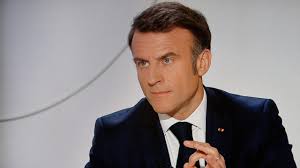
French President Emmanuel Macron said on Sunday he had asked Iranian President Masoud Pezeshkianto put an immediate end to attacks against countries in the Middle East whether directly or through proxies, including in Lebanon and Iraq.
French President Emmanuel Macron said Sunday he had told Iranian President Masoud Pezeshkian it was “unacceptable” to target French interests, after an Iranian-designed drone killed a French soldier in Iraq’s Kurdistan region.
“I called on him to put an immediate end to the unacceptable attacks that Iran is carrying out against countries in the region, whether directly or through proxies, as in Lebanon and Iraq,” Macron said on X after the strike on Thursday evening.
“I reminded him that France acts strictly in a defensive capacity to protect its interests and those of its regional partners, and to uphold freedom of navigation, and that it is unacceptable for our country to be targeted.”
I have just spoken with Iranian President Massoud Pezeshkian.
— Emmanuel Macron (@EmmanuelMacron) March 15, 2026
I called on him to put an immediate end to the unacceptable attacks Iran is carrying out against countries in the region, whether directly or through proxies, including in Lebanon and Iraq. I reminded him that France…
EU to discuss bolstering Mideast naval mission amid Iran war turmoil
European Union foreign ministers will discuss on Monday bolstering a small naval mission in the Middle East but are not expected to decide on extending its role to the choked-off Strait of Hormuz, diplomats and officials say.
The EU’s Aspides mission was established in 2024 to protect ships from attacks by Yemen’s Houthi rebel group in the Red Sea.
It currently has an Italian and a Greek ship under its direct command and can also call upon a French ship and another Italian vessel for support.
Oil prices open higher as war in Middle East rages
Oil prices kept rising as markets opened Sunday, with both benchmarks higher as the war in the Middle East disrupts global supplies.
At around 0015 GMT, the US benchmark West Texas Intermediate was up 0.01 percent at $98.72 a barrel, while the price of Brent, the international benchmark for oil, was up 0.6 percent to $103.76.
On stock markets, South Korea’s Kospi attempted a cautious rebound and was up 1.3 percent in early trade in Asia, while Japan’s Nikkei was flat.
With Gulf states slashing production and oil tankers stuck in the Gulf, oil prices have risen 40 to 50 percent since the United States and Israel first attacked Iran on February 28.
Gulf countries report new attacks after Iran warns major UAE ports to evacuate
Gulf countries reported new attacks Sunday morning, a day after Iran called for the evacuation of three major ports in the United Arab Emirates, threatening for the first time a neighboring country’s non-US assets.
Tehran accused the United States of using “ports, docks and hideouts” in the UAE to launch strikes on Kharg Island, home to the main terminal handling Iran’s oil exports, without providing evidence, as the war showed no signs of ending.
Trump says US talking to Iran but doubts Tehran ready for negotiations
President Donald Trump said on Sunday Washington is in contact with Iran but expressed doubt that Tehran is prepared for serious negotiations to end the conflict.
Trump told reporters on Air Force One his administration is talking to Iran, “but I don’t think they are ready.”
Trump says he has demanded ‘about 7’ countries reliant on Middle East oil join a coalition to police Strait of Hormuz
President Donald Trump said Sunday that he has demanded about seven countries send warships to keep the Strait of Hormuz open, but his appeals have brought no commitments as oil prices soar during the Iran war.
The president declined to name the countries heavily reliant on Middle East oil that the administration is negotiating with to join a coalition to police the waterway where about one-fifth the world’s traded oil flows.
“I’m demanding that these countries come in and protect their own territory, because it is their own territory,” Trump said about the strait, claiming the shipping channel is not something the United States needs because of its own access to oil. Trump spoke while answering reporters’ questions as he flew back to Washington from Florida aboard Air Force One.
Trump says NATO faces ‘very bad’ future if allies don’t help open Hormuz
President Donald Trump said Sunday that NATO faces a “very bad” future if US allies fail to help open the Strait of Hormuz, the critical oil transport conduit effectively shut by Iran in the Mideast war.
In a brief interview with The Financial Times, Trump said that as the United States has aided Ukraine in the war with Russia, he expects Europe to help on the Strait of Hormuz, whose closure has sent energy prices soaring around the world.
“If there’s no response or if it’s a negative response I think it will be very bad for the future of NATO,” said Trump, who over the years has criticized the alliance as freeloading on US largesse.
Australia will not send naval ships to help reopen Strait of Hormuz
Australia will not send naval ships to assist in reopening the Strait of Hormuz, a government minister said on Monday.
“We won’t be sending a ship to the Strait of Hormuz. We know how incredibly important that is, but that’s not something that we’ve been asked or that we’re contributing to,” Catherine King, a member of Prime Minister Anthony Albanese’s cabinet, said in an interview with state broadcaster ABC.
Trump’s call for countries to send warships to protect the Strait of Hormuz brings no promises
US President Donald Trump’s appeal to China, France, Japan, South Korea, Britain and others to send warships to keep the Strait of Hormuz “open and safe” brought no commitments on Sunday as oil prices soar during the Iran war.
Iran’s Foreign Minister Abbas Araghchi told CBS that Tehran has been “approached by a number of countries” seeking safe passage for their vessels, “and this is up to our military to decide.” He said a group of vessels from “different countries” had been allowed to pass, without providing details.
Iran has said the strait, through which one-fifth of global oil exports normally pass, is open to all except the United States and its allies.
UK to provide over $6 million in emergency funding for Lebanon aid
British Foreign Secretary Yvette Cooper on Sunday said the UK will provide over 5 million pounds
($6.62 million) of emergency funding to support humanitarian work of the Lebanese government amid conflict in the region.
Cooper also condemned Hezbollah’s attacks against Israel and called for them to cease.
“The actions of this proscribed terrorist group – at the instigation of the Iranian regime – are once again drawing the people of Lebanon into a conflict they do not want and which is not in their interests,” she said.
Saudi crown prince, UAE president affirm that continuation of Iran attacks on GCC countries is dangerous escalation threatening region’s security
Saudi Crown Prince Mohammed bin Salman and United Arab Emirates President Sheikh Mohamed bin Zayed Al Nahyan affirmed in a phone call that continued Iranian attacks on Gulf Cooperation Council (GCC) countries represent a dangerous escalation threatening regional security and stability, Saudi state media reported on Monday.
Israel launches fresh strike on south Beirut
Israel launched a fresh strike on Beirut’s southern suburbs late Sunday as Israel’s military said it was striking Hezbollah infrastructure in the city following earlier raids mainly in the country’s south.
The midnight strike, heard by AFP correspondents in the capital, came after a morning Israel army evacuation warning for Beirut’s southern suburbs, which Israel has repeatedly struck in the past fortnight.
Shortly after the raid, the Israeli military said on social media that it was “currently striking Hezbollah terror infrastructure in Beirut”.
FRANCE 24
