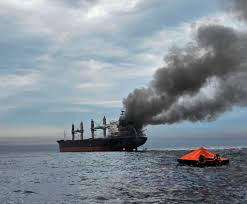
Photo- Not ‘a litre of oil’ to pass Strait of Hormuz, expect $200 price per barrel of oil Iran warns . Oil prices have already skyrocketed as tensions escalate
If the world allows Iran to weaponize the Strait of Hormuz, the next stop could be $200 oil and a global economic shock.
By Ya Libnan Editorial Board, Op.Ed
President Donald Trump announced on March 4 that the United States would provide political risk insurance and guarantees for energy tankers and that the U.S. Navy would escort ships through the Strait of Hormuz if necessary. The announcement briefly calmed markets, but so far it has remained only words.
The world is still waiting for action.
The Strait of Hormuz remains effectively closed to most international shipping, while several vessels have already been attacked by Iran’s Islamic Revolutionary Guard Corps (IRGC). Shipping companies are reluctant to send crews through a war zone, and energy markets remain on edge as tankers stay anchored outside the Gulf.
Ironically, the only major country currently able to move oil through the strait with relative ease appears to be China, while much of the rest of the world waits for leadership.
Iran has openly threatened to weaponize the global energy market. Officials from the Revolutionary Guard have warned that oil prices could reach $200 per barrel if the confrontation continues.
That would be more than three times the price when the war began, sending shockwaves through global economies and pushing inflation sharply higher.
Every dollar increase in the price of a barrel of oil raises gasoline prices at the pump by roughly 2.5 cents per gallon.
When oil rises sharply, American consumers feel the impact almost immediately.
Imagine the shock households will face if oil reaches $200 per barrel. That would represent an increase of roughly $120 per barrel above pre-war levels, potentially adding about $3 per gallon to gasoline prices across the United States.
For millions of families, that could mean paying $6 or even $7 per gallon at the pump, sending transportation costs, food prices, and inflation soaring.
History already provides the roadmap.
During the Iran-Iraq War in the late 1980s, Iran began attacking oil tankers in the Persian Gulf in what became known as the “Tanker War.” Global energy markets faced a similar threat. The United States did not hesitate.
Washington launched Operation Earnest Will, reflagging Kuwaiti oil tankers under the American flag and escorting them through the Gulf with U.S. Navy warships. When Iran continued threatening shipping, the United States responded decisively with Operation Praying Mantis, crippling Iranian naval assets responsible for attacks on maritime traffic.
The result was immediate. Tanker traffic resumed, global energy markets stabilized, and Iran’s attempt to weaponize the Strait of Hormuz failed.
Today the stakes are even higher. Nearly 20 percent of the world’s oil supply passes through this narrow waterway. A prolonged disruption threatens not only energy markets but the stability of the global economy.
Some policymakers may argue that the release of oil from strategic reserves can temporarily stabilize markets. Emergency reserves can indeed provide short-term relief and buy time during supply disruptions.
But relying on reserves is a risky strategy if the conflict drags on.
History offers a warning. Wars in Iraq and Afghanistan lasted far longer than initially expected. If the current conflict expands or continues for months, strategic reserves could be depleted while the underlying problem — the closure of the Strait of Hormuz — remains unresolved.
In other words, reserves may treat the symptom, but they do not solve the crisis.
The only durable solution is to restore freedom of navigation.
The Strait of Hormuz is not merely a regional waterway — it is the artery through which a large portion of the world’s energy supply flows. Allowing it to remain threatened emboldens those who seek to use energy as a geopolitical weapon.
President Trump has already outlined the right policy. What the world now needs is the follow-through.
The lesson from history is unmistakable: when global energy security is threatened, leadership cannot remain a promise.
It must become action.
Because if the Strait of Hormuz remains closed and oil surges toward $200 a barrel, the consequences will not be limited to the Middle East. They will be felt by every American family filling their tank, every truck delivering food, and every business struggling with rising costs.
Time for the United States to secure the Strait of Hormuz.
Time for President Trump to deliver.
