Joseph Aoun, the Lebanese president, called for direct talks with Israel to end the fighting. He also leveled blame at Hezbollah, the Iran-backed group, for igniting the war.
Israeli forces advanced in southern Lebanon on Monday, entering new territory as part of a stated effort to expand a military-controlled buffer zone, as Israel stepped up its campaign against the Iran-backed armed group Hezbollah.
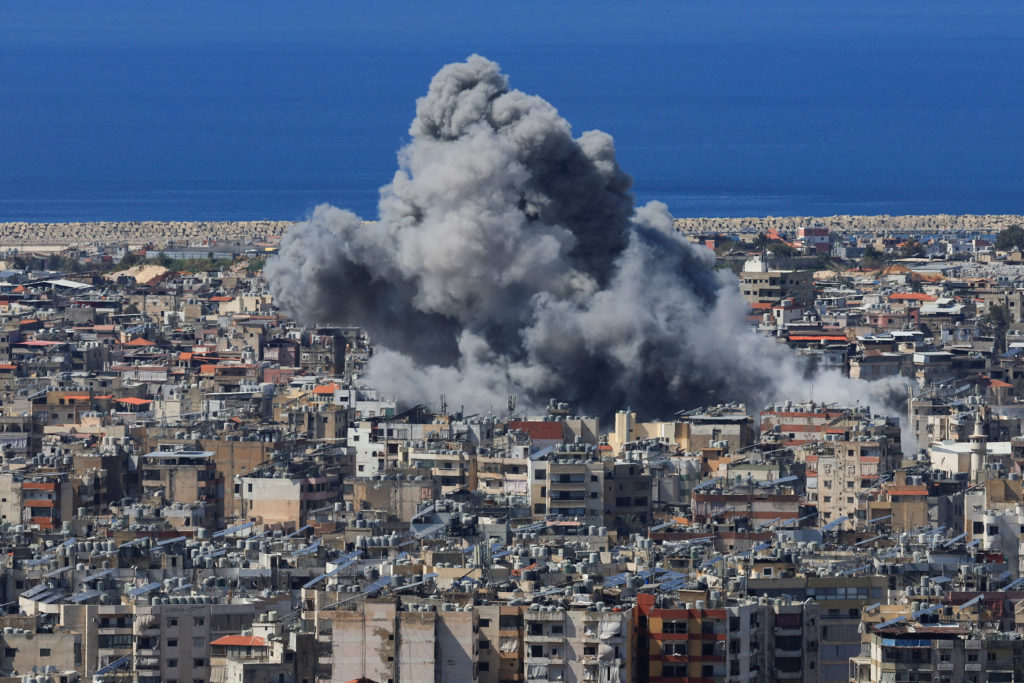
Israeli fighter jets also launched among their heaviest bombardment yet of the southern suburbs of Beirut, the Lebanese capital, sending huge explosions echoing throughout the city. Earlier on Monday, Israel had threatened to attack sites linked to Al-Qard Al-Hasan, Hezbollah’s de facto bank.
Israeli ground forces began a raid in an area close to the border with Lebanon, the military said in a statement, after seizing new sites inside Lebanon in recent days.
The fighting in Lebanon began last week, when Hezbollah launched a rocket attack against Israel, in retaliation for the killing of Ayatollah Ali Khamenei, whom Israel assassinated in the opening strikes of the U.S.-Israeli war with Iran. Since then, the Israeli military has responded with an escalating military campaign across Lebanon.
At least 600,000 people in Lebanon have fled their homes and at least 486 people had been killed, including more than 80 children, according to the Lebanese authorities. Edouard Beigbeder, the regional director for UNICEF, the United Nations’ children’s agency, called the death toll “a stark testament to the toll that conflict is taking on children.”
Joseph Aoun, the Lebanese president, presented what he called a new initiative to end the fighting during a phone call with European officials, according to his office. Under the terms he mentioned, Lebanon’s government would hold direct talks with Israel — under international supervision — for ending the escalation and disarming Hezbollah.
It was unclear whether those talks would be supported by Hezbollah, which is distinct from the Lebanese government and has long operated as a powerful state within a state. But despite political will to disarm Hezbollah over the past year, the Lebanese government has been largely unable to effectively confront the group.
But Hezbollah is facing rising public frustration, as many Lebanese say they have been dragged by the militia into a deadly confrontation with Israel without any clear benefit.
Mr. Aoun also issued unusually blistering criticism of Hezbollah on Monday, accusing the group of having “no regard for the interests of Lebanon or the lives of its people,” according a statement provided by his office. The Hezbollah rocket attack on Israel, he said, had achieved nothing.
“Did they provide a deterrent to prevent Israel from launching an aggressive response against Lebanon and its people? Absolutely not,” Mr. Aoun said. “Did they achieve, even on an emotional level, a convincing revenge for the assassination of Supreme Leader Khamenei? Certainly not.”
Israel Katz, the Israeli defense minister, vowed on Thursday that the country would “not only not retreat from Hezbollah, but rather seize the opportunity to strike them. We are hitting them and will continue to do so.”
Military analysts say the Israeli actions could signal that Israeli forces are preparing for a wider ground invasion in Lebanon. The Israeli military has called up roughly 100,000 reserve soldiers as part of the war with Iran, some of whom have been sent to the northern border.
Lt. Col. Nadav Shoshani, an Israeli military spokesman, dismissed that prospect. “This is part of our forward defense posture. This is a measure to make sure that our troops in those positions are safe,” Colonel Shoshani told reporters on Monday.
THE NEW YORK TIMES
