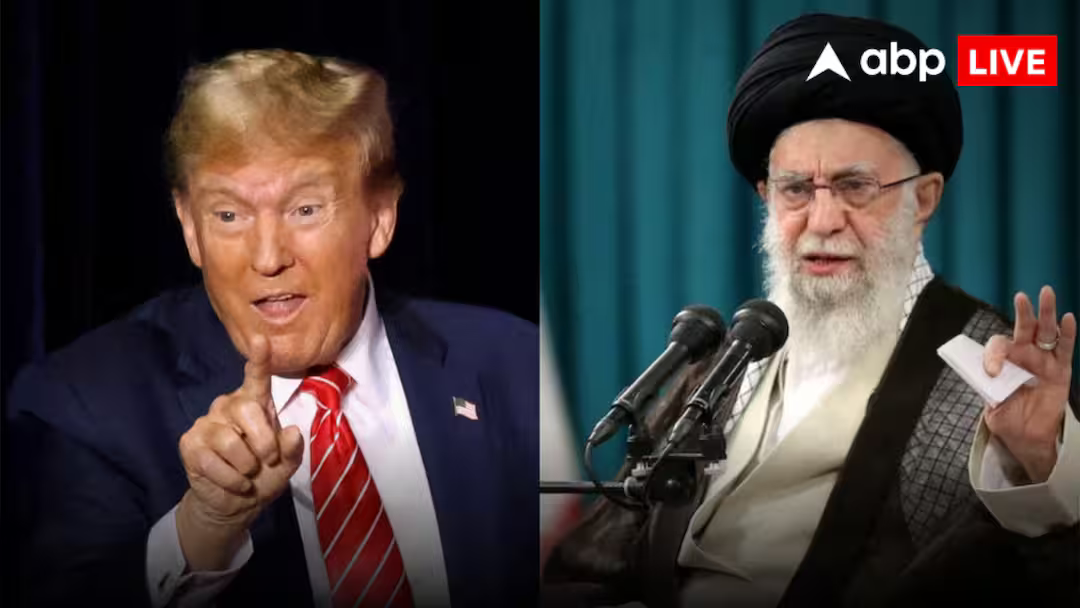
Combined photo of U.S. President Donald Trump and former slain Iranian Supreme leader Ayatollah Ali Khamanei . Trump is insisting on a role in naming Khamanei’s successor and today called on Iran to surrender unconditionally. Experts suggest that if the conflict turns into a prolonged war of attrition, the U.S. and Israel might be more likely to blink first, despite Iran’s internal problems
By: Naji Al Boustani, Op-Ed
With the continued fierce US-Israeli attacks on Iran, and Tehran’s retaliatory strikes against Israel and US bases, as well as its targeting of the global oil supply line through the Strait of Hormuz, amid expectations that these attacks will expand to encompass the widest possible range of economic interests in the oil, economic, financial, and even water purification sectors—all of which are vital to the survival of the Gulf states and, consequently, to the stability of the global economic and financial situation—the central question arises: Whose missiles will be exhausted first? The answer to this question could indicate, to a large extent, who will emerge victorious in this war!
Yes, if the American plan succeeds in striking all of Iran’s ballistic missile launch sites (both fixed and mobile) and destroying most of its drone stockpile, the Iranian regime will be reduced to a purely defensive position, unable to inflict any significant damage, especially after the destruction of most of its fighter jets, helicopters, and naval frigates, which could pose a serious threat to its adversaries. Consequently, once its ballistic missile stockpile is depleted, or its launch sites are destroyed, the countdown to the Iranian regime’s downfall will begin, as it will become vulnerable to open-ended destructive attacks, without any ability to establish a balance of deterrence. It should be noted that Iran’s pre-prepared defense plan partially includes bombing Israel and striking American bases in the region, but its primary focus is on destabilizing the economic and financial foundations of the Gulf states, and by extension, the entire world, in the hope of prompting international intervention to halt a war against Iran as quickly as possible, before global economic and financial security collapses entirely. This Iranian plan aims to present the world with two options: either to intervene swiftly to stop American and Israeli attacks, or to bear the escalating negative economic and financial repercussions, which will weigh heavily on the entire world, including exorbitant prices, economic recession, and financial collapse.
It is worth noting here that, according to a highly credible Western military monitoring index, the events of the ongoing war in the region showed a downward trend in Iran’s missile and drone launch capabilities during the first five days of the conflict. Specifically, on the first day, Iran launched 350 ballistic missiles and 294 drones; on the second day, 175 ballistic missiles and 541 drones (excluding the second day); on the third day, 120 ballistic missiles and 200 drones; on the fourth day, 50 ballistic missiles and 85 drones; and on the fifth day, only 40 ballistic missiles and 45 drones. While it is true that Iranian forces may have begun implementing a form of austerity to prolong the fighting and inflict damage, the more accurate assessment is that their stockpiles are rapidly dwindling due to the relentless bombardment they endure and the continuous missile launches they conduct, without being able to secure any supplies from outside Iran. They are currently relying on missile and drone attacks supporting their security campaign, carried out by both Lebanese Hezbollah and the Iraqi Popular Mobilization Forces, while awaiting the Yemeni Ansar Allah movement’s entry into the battle as well.
Conversely, there is no doubt that the Gulf states’ stockpiles of interceptor missiles are rapidly dwindling as a result of the open confrontation. By Thursday night, some 2,200 ballistic and cruise missiles had been intercepted! The defensive capabilities of some countries, such as Saudi Arabia and the UAE, remain better than those of Bahrain, for example. In any case, these countries can only defend themselves effectively for a few more days if the pace of Iranian attacks remains high, and for a very few weeks at best if the pace of Iranian attacks decreases. Therefore, intensive efforts are currently underway behind the scenes to quickly secure interceptor missiles for these countries, not only from the United States but from any available source, especially Europe. There are even negotiations with Ukraine, which has developed interceptor missile systems to counter Russian attacks, to sell some of these systems to the Gulf states, particularly since they are less expensive than the costly American interceptor missiles. The American-Western decision has been made that the Gulf states cannot be left vulnerable to Iranian attacks without defensive means, because this would mean the flight of all Western companies, with serious repercussions for global economic and financial stability.
Meanwhile, urgent plans are being developed to secure oil exports to the world via alternative routes to the Strait of Hormuz, or under heavy military escort through the strait. Efforts are underway to persuade several European and Western countries to send aircraft and missiles, not for offensive missions against Iran, but for defensive purposes to protect the Gulf states, oil supplies, and commercial interests in the region, which are closely linked to the interests of the Western world as a whole. Under the same broad heading, geopolitical experts, in an analysis of major global events, assert that the timing of the overthrow of Venezuelan President Nicolás Maduro was not coincidental. Rather, it was intended to secure a safe oil reserve for the United States first, Western countries second, and the rest of the world third, in preparation for the pre-planned war on Iran, which, as expected, has negatively impacted oil exports from the fields and wells of the Middle East.
In conclusion, Iran on one hand and the Gulf states on the other are currently in a race against time. Either Iran will become vulnerable to continuous and open bombardment without the ability to inflict harm until the deep state, which has been entrenched in Tehran for half a century, falls, or Gulf and Western interests will become vulnerable to continuous and open bombardment without the ability to defend against it, thus accelerating the pace of economic and financial collapse, which will then cast its shadow on the vast majority of the world’s countries and peoples!
About the author : Naji Al Boustani is a former Lebanese minister and a member of the Free Patriotic Movement which was allied with Hezbollah since 2006 until 2025 after its defeat by Israel .
Translated from Arabic
Source: El Nashra
