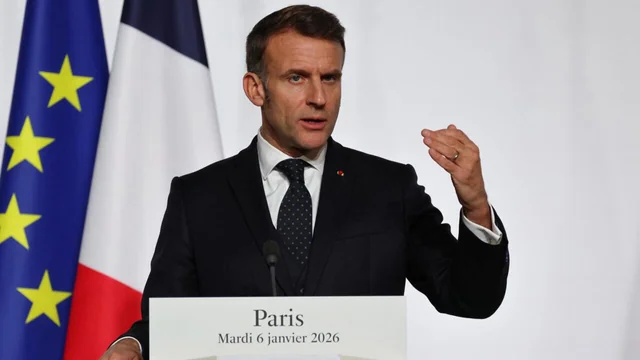
French President Emmanuel Macron said in keynote nuclear speech in which he announced that France will increase the number of Nuclear warheads for the first time in decades: “to be free, we have to be feared”
France will increase its nuclear warheads for the first time in decades, French President Emmanuel Macron announced on Monday, saying that “to be free, we have to be feared”. Macron delivered the update on the country’s nuclear strategy in a keynote speech from the military base hosting the nation’s ballistic missile submarines.
French President Emmanuel Macron announced the updates to France‘s doctrine on the potential use of nuclear weapons in a keynote speech delivered from a military base hosting the country’s ballistic missile submarines.
Macron said France was entering a new phase in its nuclear deterrence strategy, one that would complement NATO’s nuclear mission and he invited European allies to participate in nuclear deterrence exercises.
“What I’d like is for Europeans to regain control of their own destiny,” Macron said.
France is poised to increase its nuclear warheads for the first time in decades.
Macron emphasised that the country’s nuclear power would be in the service of peace. However, he warned of the country’s capacity to potentially draw on its significant nuclear arsenal in a way “that no country, no power, however strong, could recover”.
The president added that France would host a summit in Paris on March 10 to encourage the development of nuclear energy and its uses, acknowledging that France is well placed “to promote civilian nuclear energy”.
The speech primarily aimed to spell out how French nuclear weapons fit into Europe’s larger security posture in the wake of new questions raised by the Russian invasion of Ukraine and recurring tensions with US President Donald Trump over Ukraine, Greenland and NATO.
European leaders have voiced growing uncertainty about the US commitment to defend Europe under its own nuclear umbrella, a policy long intended to ensure that allies – particularly NATO members – would be protected by US nuclear forces in the event of a threat, without developing their own nuclear capabilities.
France is the only nuclear power in the European Union.
The long-planned speech went ahead despite the expanding Middle Eastconflict following joint Israeli-US strikes on Iran that decapitated much of its leadership at the weekend.
World’s fourth-ranking nuclear power
“We have to re-articulate nuclear deterrence,” Macron told the Munich Security Council last month, adding that France has already had “a strategic dialogue” with German Chancellor Friedrich Merz and other European leaders on increasing cooperation.
“Europe has to learn to become a geopolitical power,” he told Munich.
France and Britain adopted a joint declaration in July that allows both nations’ nuclear forces to be “coordinated” while remaining independent. The UK, no longer an EU member but a NATO ally, is the only other European country with a nuclear deterrent.
France’s deterrence doctrine relies on a defensive strategy intended to safeguard the country’s vital interests. While France is also a member of NATO, it maintains full independence over its nuclear forces while contributing to the alliance’s broader deterrence posture.
Under the French Constitution, the president is commander-in-chief of the armed forces and the sole to decide on the potential use of nuclear weapons.
France’s Charles de Gaulle aircraft carrier is the only surface warship in Europe capable of carrying nuclear weapons deployed by French Rafale fighter jets using catapult-assisted takeoffs.
France has four nuclear-armed submarines: Le Triomphant, Le Téméraire (The Fearless), Le Vigilant and Le Terrible, based in Île Longue on the Atlantic coast, one of the nation’s most secretive military sites. Since 1972, at least one nuclear-armed submarine has been on patrol at all times, ensuring France’s permanent capacity to carry out a strike.
France has an estimated 290 nuclear warheads, according to latest figures released by the Stockholm International Peace Research Institute (SIPRI) and the Federation of American Scientists (FAS). More than 80% of France’s warheads are submarine-launched, according to the Bulletin of the Atomic Scientists.
That makes France the world’s fourth-largest nuclear power after Russia in the top spot (with more than 4,300 warheads) followed by the United States (with 3,700) and China (600). The United Kingdom – which is no longer an EU member but still a NATO ally – is estimated to have about 225 warheads, according to SIPRI and FAS.
(FRANCE 24 with AP, AFP and Reuters)
