By Laila Bassam, Yomna Ehab and Nayera Abdallah
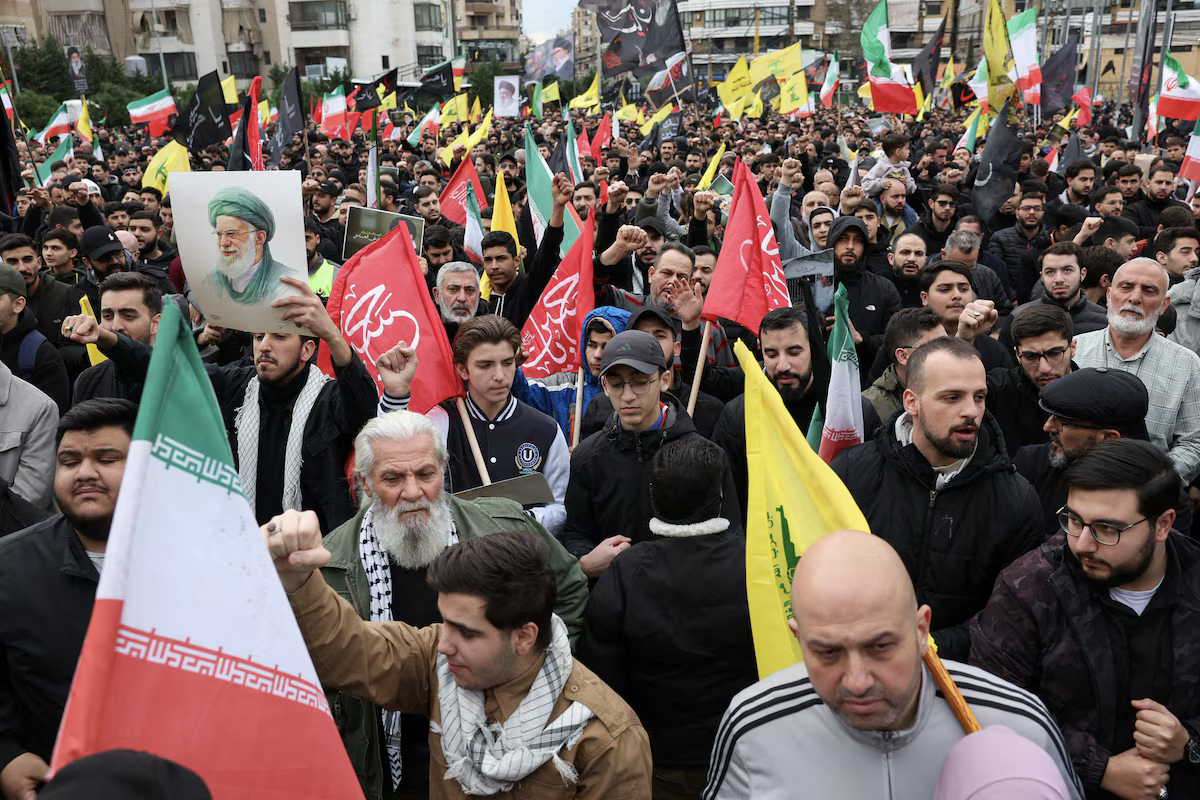
Photo –Hezbollah supporters rally in solidarity with Iran, after U.S. and Israeli strikes killed Iranian Supreme Leader Ayatollah Ali Khamenei, in Beirut, Lebanon, March 1, 2026. REUTERS/Mohamed Azakir
BEIRUT, March 2 (Reuters) – Israel carried out heavy airstrikes on the Hezbollah-controlled southern suburbs of Beirut on Monday, after the Iran-backed group launched missiles and drones towards Israel in retaliation for the killing of Iran’s Supreme Leader Ali Khamenei.
More than a dozen explosions rocked Beirut, witnesses said, in the most intensive strikes on the southern suburbs since a war between Israel and Hezbollah in 2024.
Lebanese security sources said airstrikes hit several areas of the southern suburbs, known as Dahiyeh.
The Israeli military said it had begun striking Hezbollah targets across Lebanon and held Hezbollah responsible.
“Hezbollah opened a campaign against Israel overnight, and is fully responsible for any escalation,” Israeli Chief of the General Staff, Eyal Zamir, said in a statement.
The projectiles launched by Hezbollah were the first since the start of U.S. and Israeli strikes on Iran.
Israel also carried out airstrikes in southern Lebanon and the Bekaa Valley in eastern Lebanon, the Lebanese security sources said.
The Shi’ite Muslim group, long one of Tehran’s principal allies in the Middle East, said it launched the attack against Israel in response to Israel killing Khamenei and continuous Israeli violations against Lebanon.
“The resistance leadership has always emphasized that the continuation of Israeli attacks and the assassination of our leaders, youth, and people gives us the right to defend ourselves and respond at the appropriate time and place,” Hezbollah said in a statement.
“The IDF (Israel Defense Forces) will operate against Hezbollah’s decision to join the campaign, and will not enable the organization to constitute a threat to the State of Israel,” the Israeli military said.
Israel and Lebanon agreed to a U.S.-brokered ceasefire in 2024, ending more than a year of fighting between Israel and Lebanese militant group Hezbollah that had culminated in Israeli strikes that severely weakened the Iran-backed group. Since then, the sides have traded accusations over violations.
Lebanon’s presidency said on Saturday it had been told by the U.S. ambassador that Israel would not escalate against Lebanon as long as there are no hostile acts from the Lebanese side.
Hezbollah refuses to disarm
Israel has been striking Hezbollah targets since the November 2024 ceasefire, in an attempt to stop imminent threats and to further degrade the group’s weapons stocks.
Under the terms of the 2024 ceasefire deal, which followed fighting that broke out on October 8, 2023, and escalated into all-out war a year later, Hezbollah was required to vacate southern Lebanon and be replaced by the Lebanese military.
“Lebanon’s official military and security forces, infrastructure, and weaponry will be the only armed groups, arms, and related materiel deployed in the southern Litani area,” reads the ceasefire agreement.
Israel also received a “side letter” of guarantees from the US, in which Washington affirmed and detailed Israel’s right to defend itself against renewed threats.
Lebanon’s president, Joseph Aoun, has been challenged with finding a way to disarm Hezbollah without pushing the powerful Iranian proxy too hard and sparking a civil war.
Aoun has been reiterating ever since he was elected that a state monopoly on weapons was inevitable, and has been urging committee supervising the ceasefire between Israel and Hezbollah to ensure Lebanon’s army was the only armed presence in the country’s south.
In August, his government instructed the army to come up with a plan to eradicate weapons outside state control by year’s end. In September, LAF Commander Rodolphe Haykal presented a five-stage plan to disarm Hezbollah, starting with a three-month effort south of the Litani River, the part of the country along the Israeli frontier.
The LAF has operated only south of the Litani, and it is questionable whether the campaign will get to the subsequent stages further north, where Hezbollah’s strategic weapons are stored.
Hezbollah itself says it will not disarm. Secretary-General Naim Qassem has accused the government of “serving the Israeli project” and issued not especially subtle threats about a civil war, a potent threat for a country still recovering from its last internecine conflict
Not only is Hezbollah refusing to give up its current stocks, it also seems to be energetically restocking its supplies.
Reuters
