A Roadmap for Turning the End of Dictatorship into a Democratic Future
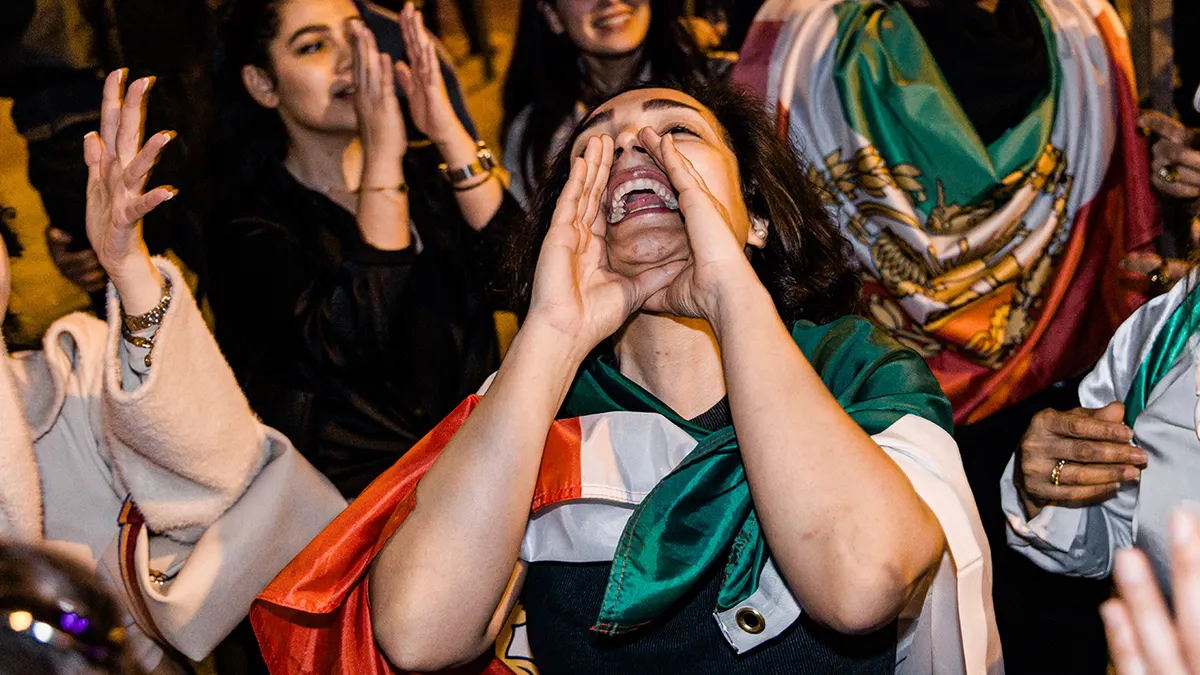
Photo- Iranians across the country could be seen and heard celebrating the death of Supreme Leader Ayatollah Ali Khamenei after coordinated Israeli US strikes
By: Ali Hussein, Lebanese Political Analyst, Op.Ed.
It is rare for citizens of a country under attack to take to the streets cheering the enemy’s bombs. Yet that is what the world witnessed in Iran after recent strikes on the ruling regime. Those scenes were not chaos or confusion; they were clarity. They reflected a people who no longer fear change — and who see the end of tyranny as an opening, not a collapse.
The question is no longer whether Iranians want regime change. They have answered that decisively and at enormous cost. The real question is what comes next — and whether the free world can help steer Iran away from repeating the cycle of repression under a new face.
History offers a sobering lesson: removing a ruler is not the same as dismantling a system. Dictatorships are designed to survive decapitation. Without a roadmap, entrenched power structures regenerate themselves through succession, coercion, and fear. What Iran needs now is not slogans or improvisation, but a deliberate, protected transition from dictatorship to democratic institutions.
Transitions Need Drivers
Every successful democratic transition shares three elements: domestic legitimacy, a civilian steering mechanism, and a credible external guarantor. When these elements align, systems change without collapsing. When they do not, chaos or authoritarian restoration follows.
Coalitions do not function without leadership. Yet Iran’s history — and today’s polarized global environment — demand that leadership be trusted, steady, and non-imperial. In this context, the most credible lead steward for Iran’s transition is Switzerland.
Switzerland brings what this moment requires: internationally respected neutrality, institutional continuity, and long experience convening adversaries and mediating complex political transitions. Its role would not be to rule Iran or design its future, but to convene, protect, and anchor the transition process over time — leadership without domination.
This stewardship should be semi-permanent but clearly bounded, fading as Iranian institutions take root.
Behind this neutral leadership must stand real leverage. The United States and the European Union should quietly provide economic stabilization, phased sanctions relief, and deterrence against spoilers, while international institutions assist with elections, rule of law, and recovery. Power is present — but not imposed.
The Roadmap
First: Popular Authorization.
Iran’s civic forces — workers, women, students, professionals, minorities, and reform-minded religious figures — must clearly withdraw consent from the current system. This establishes that clerical succession under the old rules lacks legitimacy.
Second: A National Transition Council.
A temporary, civilian, mandate-limited council should steer the transition. Its task is not to govern Iran’s future, but to block automatic succession, preserve state continuity, oversee constitutional reform, and prepare free elections within 12–18 months.
Third: External Guarantees.
Under Swiss stewardship, international recognition, economic support, and diplomatic normalization should be conditioned on transparent progress. Violent obstruction must carry clear consequences.
Fourth: Splitting the Coercive State.
Senior perpetrators of repression must face accountability. Rank-and-file security personnel must be offered off-ramps and integration into a reformed national structure. This prevents civil war and encourages institutional defection from the old order.
Fifth: Immediate Economic Stabilization.
Democracy cannot survive economic collapse. Early stabilization — food, fuel, healthcare, wages, pensions, and currency — is essential to maintaining public confidence and preventing authoritarian nostalgia.
Sixth: A New Social Contract.
A constitution-making process must lock in civilian control of the military, independent courts, equal citizenship, free media, political competition, and a clear separation between arms and politics.
Why This Can Work
This roadmap avoids the failures of past interventions. It is Iranian-led, structured rather than spontaneous, protected rather than militarized, and patient rather than transactional. Most importantly, it answers the hardest question honestly: who drives the transition — and how.
Iran is not lacking talent, education, or civic courage. What it has lacked is a protected path forward. With legitimacy from within, structure at the center, and trusted stewardship from the outside, Iran can move from dictatorship to democracy without tearing itself apart.
The Iranian people are ready.
The roadmap exists.
The only remaining question is whether the world is prepared to help see it through.
