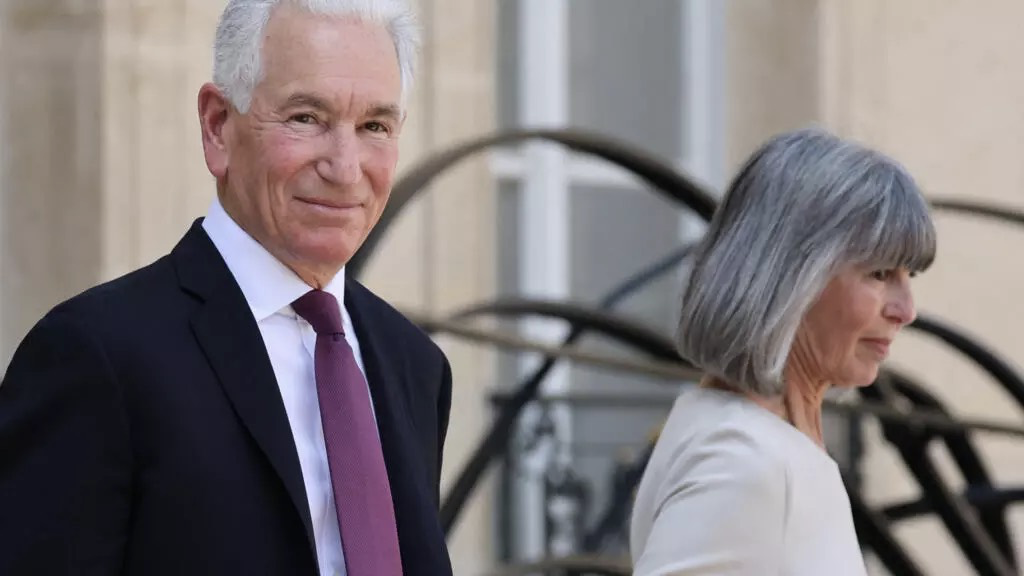
Charles Kushner and his wife Seryl Kushner leave the Élysée Presidential Palace in Paris after a meeting with French President Emmanuel Macron on July 18, 2025. © Ludovic Marin, AFP
US Ambassador Charles Kushner is at the centre of a diplomatic row raging in Paris, but he is not the only one. US President Donald Trump’s envoys are stirring controversy across Europe – from social media spats to public snubs of foreign leaders – testing alliances and leaving longtime partners to pick up the pieces.
Paris – When US Ambassador Charles Kushner skipped an official summons from France’s foreign ministry earlier this week over accusations that he was meddling in domestic politics, it sparked a diplomatic clash rarely seen between close allies. But in the second era of US President Donald Trump, such episodes are becoming increasingly common.
Kushner – the father of Trump’s son-in-law Jared Kushner – re-posted a post on X from the Trump administration regarding the death of a far-right activist in Lyon, which has become a lightning rod in far-right circles. French officials saw the repost as unacceptable interference in domestic affairs by a diplomat.
The dispute escalated when Kushner failed to appear at the Quai d’Orsay after being summoned, prompting Foreign Minister Jean-Noël Barrot to block his access to ministers. Kushner eventually spoke by phone with Barrot on Tuesday.
The clash is just the latest example of a broader pattern: a new generation of largely inexperienced, Trump-appointed diplomats whose brash communication styles and lack of decorum have sometimes unnerved their host governments.
Social media envoys
Ambassador Bill White in Belgium has drawn criticism for his sometimes Trumpian style online. He posted an all-caps message on X with questionable punctuation on February 16, demanding Belgian authorities “DROP THE RIDICULOUS AND ANTI SEMITIC ‘PROSECUTION’” against three Jewish religious figures in Antwerp.
The case concerned legal action taken against three men accused of performing circumcisions contrary to Belgian law, which stipulates that only a doctor can perform a circumcision. White framed it as anti-Semitism.
After being urged by the Belgian government to refrain from interfering in internal matters, he escalated the situation in another social media post, calling Belgian Health Minister Frank Vandenbroucke “very rude” and “quite obnoxious”.
“I was told he does not like my great President,” White added.
White also targeted Conner Rousseau, leader of the Flemish centre-left party Vooruit, after Rousseau compared Trump’s crackdown on immigration to Nazi-era tactics. White demanded a public apology and declared that Rousseau was barred from entering the United States – a threat he withdrew four days later.
Ideology over diplomacy
In Poland, Trump appointed Thomas Rose, a conservative commentator openly critical of Prime Minister Donald Tusk. Rose has frequently attacked the Polish government while insisting Poland remains Trump’s top European ally.
Tensions flared in February after Wlodzimierz Czarzasty, speaker of Poland’s lower house and leader of the New Left party, accused Trump of “destabilising” international institutions. He added that he would not support Trump’s Nobel Peace Prize nomination, saying “he doesn’t deserve it”.
In response, Rose announced he would cut off contact with the speaker, warning that such statements risked damaging relations between Warsaw and Washington.
Luxembourg’s new US ambassador, businesswoman Stacey Feinberg, also made waves during her Senate confirmation hearing. She said her goal was to “humbly” educate Luxembourg about China’s “nefarious” intentions, arguing the country lacked a sufficient understanding of the risks posed by Beijing.
“Lucifer does not show up looking like the devil,” she said.
Her remarks irritated both Luxembourg officials and China. Luxembourg’s government responded pointedly that it did not need to be lectured about either superpower and was “not a vassal” of any nation.
Germany, meanwhile, remains without a US ambassador more than a year after Trump’s return to the White House – a notable gap in one of Washington’s most important European allies.
US ambassador to Turkey Tom Barrack, a former real estate developer (who also serves as Trump’s special envoy to Syria) shocked the Lebanese journalists shouting questions during a press conference by urging them to behave in a “civilised” manner and not “animalistic”, tying their behaviour to “the problem with what’s happening in the region” – language widely viewed as inappropriate for a senior diplomat.
Elsewhere, Trump’s envoys have generated controversy as well. Former Louisiana governor Jeff Landry was pointedly appointed special envoy to Greenland and has since openly promoted Trump’s views on annexing the Danish autonomous territory.
Amateur hour
These incidents reflect a broader trend: many of Trump’s European appointees are political outsiders rather than career diplomats – a choice that some see as sheer amateurism, and one that raises questions about both competence and intentions.
Andrew Gawthorpe, a lecturer specialising in US foreign policy at Leiden University, noted that diplomatic posts in European allied nations have long been filled by campaign donors or business figures “because they’re viewed as just kind of like nice jobs … nothing particularly complicated about it”.
What sets this group apart, he said, is their “ideological edge”: media commentators, family members and allies who “don’t really care about diplomatic norms” and are focused on boosting their own profiles within conservative US media and social circles.
University of Dublin international politics professor Scott Lucas said that in Trump world, political loyalty often trumps experience. He cited Kushner’s refusal of an official summons in Paris as “a deliberate snub” and noted that similar behaviour by other envoys risks pushing European countries closer together rather than weakening them.
“The postings that are taking place now to the most important European countries … they’re not being done for diplomacy. They’re being done because of the Trump camp mission,” he said.
In many cases, the appointments appear designed to reward friends and family – or to advance Trump’s ideological agenda – rather than to manage alliances.
Gawthorpe stressed that the result looks like carelessness rather than a master plan.
“It’s just a group of people who don’t really care about damaging these relationships,” he said.
But Lucas warned that even careless, performative acts can carry real consequences, from heightened tensions with France and Poland to a broader pattern of US policy driven more by partisan messaging than professional diplomacy.
Vacant posts in key nations like Germany – Europe’s largest economy – underscore that policy often flows from Trump’s chosen inner circle rather than those with vital international experience or career diplomats.
The result is an American foreign policy increasingly shaped by political loyalty and ideology – with European allies left to navigate the fallout.
FRANCE24/ AFP
