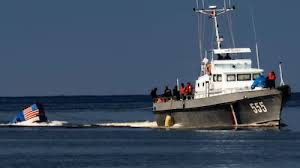
Cuban forces killed four people on an American speedboat after its crew opened fire on Cuban border agents Wednesday morning, the country’s Interior Ministry said.
As the Florida-registered vessel came within a nautical mile of Cuba’s northern coast, the border guard troops approached and asked for identification, the Interior Ministry said in a statement.
The speedboat crew opened fire on the Cuban troops, injuring the vessel’s commander, the ministry said. Cuban forces returned fire.
Four people on the speedboat were killed and six wounded, the ministry said. The wounded were evacuated to receive medical attention.
The Washington Post could not independently confirm Cuba’s version of events. Secretary of State Marco Rubio, who was traveling in the Caribbean on Wednesday, declined to say whether U.S. citizens were on the speedboat. U.S. authorities were assessing what happened, he told reporters in St. Kitts and Nevis, and would conduct their own investigation rather than rely on the account of the Cuban government.
“We will verify that independently as we gather more information,” Rubio said, “and we’ll be prepared to respond accordingly.”
It was not immediately clear why the boat would have been traveling so close to Cuba’s north-central Villa Clara province. Cuban authorities are investigating, the Interior Ministry said.
“In the face of current challenges, Cuba reaffirms its determination to protect its territorial waters, based on the principle that national defense is a fundamental pillar of the Cuban State in safeguarding its sovereignty and ensuring stability in the region,” the ministry said.
The Trump administration has been blowing up private vessels in the Caribbean and the eastern Pacific Ocean since September. U.S. authorities have reported 42 strikes on boats that they say were smuggling drugs, killing at least 143 people. U.S. forces have also boarded and seized ships that officials say were carrying Venezuelan oil.
Tensions between Washington and Havana have escalated in recent weeks as President Donald Trump’s effective oil embargo on the communist nation worsens a years-long humanitarian crisis.
After capturing Venezuelan President Nicolás Maduro in a surprise military raid on Jan. 3, the Trump administration took control of Venezuela’s oil exports and banned petroleum deliveries on which Cuba relied.
In an executive order last month, Trump declared the Cuban government’s “policies, practices, and actions” an “unusual and extraordinary threat” to U.S. national security and threatened to impose tariffs on all goods from any country that supplied it with oil.
Rubio was in St. Kitts to attend a meeting of the Caribbean Community, or CARICOM, when he learned of the attack. He said the U.S. Coast Guard was informed by its Cuban counterpart.
“Suffice it to say, it is highly unusual to see shootouts in open sea like that,” he said. “It’s not something that happens every day.
“It’s something, frankly, that hasn’t happened with Cuba in a very long time.”
U.S. Southern Command reported striking three vessels in the Caribbean and the eastern Pacific on one day last week, killing 11 people.
Rubio, the Miami-born son of Cuban immigrants, has said the administration hopes its economic chokehold will help topple what he has called the “illegitimate regime” in Havana.
Stéphane Dujarric, spokesman for U.N. Secretary General António Guterres, warned this month that the administration’s moves could precipitate a humanitarian “collapse” and urged dialogue. In a shift, the U.S. Treasury Department issued new guidance Wednesday loosening some restrictions on fuel.
Ramon Saul Sanchez, who leads an exile group in Miami that helps migrant families, said that while it is unknown why the boat shot at Wednesday was traveling so close to the island, some Cubans believe fleeing by sea is their only option as the island’s economic and political crisis deepens.
“People think that going by sea you can enter through wherever, and that before dying in Cuba, I’ll risk my life in the water,” he said.
He said his organization has been calling hospitals in Cuba trying to find out more about those who were killed and injured, but has not received any information, nor have any potential relatives in Florida emerged to seek help. If it is a smuggling operation, he noted, relatives might be reluctant to come forward, for fear of putting their family members in further danger.
In recent weeks, there have been scattered reports of boats carrying Cubans being picked up or rescued at sea. Authorities in Mexico said they had rescued seven Cubans who were picked up by fishermen in the Caribbean Sea earlier this month.
Washington has maintained an embargo on most trade with Cuba since 1960, the year after the communist revolutionary Fidel Castro overthrew the government of U.S. ally Fulgencio Batista, and cut diplomatic relations in 1961.
President Barack Obama and Raúl Castro, Fidel’s brother and successor, restored ties in 2015, but the thaw was brief. During Trump’s first term, he canceled much of the diplomatic outreach and ramped up pressure on Havana.
His tariff threat against potential oil suppliers is backed up by U.S. warships deployed in the Caribbean. Mexico quickly canceled shipments, but Russia has sent a tanker loaded with 200,000 gallons of fuel to the island, where it is expected to arrive in the coming week.
Trump and Rubio, a former senator, have both depended on Cuban American voters who oppose the government in Havana for electoral success in Florida. Trump has said that the administration is “talking … to the highest people in Cuba,” although he has not indicated what he wants from its government.
Cuban officials have said that they are open to conversations and that messages have been exchanged, but no significant talks have taken place.
“We have always been willing to maintain a serious and responsible dialogue with the different governments of the United States, including the current one,” Cuban President Miguel Díaz-Canel wrote on X last month. But such talks must be based on “sovereign equality, mutual respect, principles of International Law, and mutual benefit without interference in internal affairs and with full respect for our independence.”
Andy Gomez, former director of the University of Miami’s Institute for Cuban and Cuban-American Studies, said the best word to encapsulate the current moment in Cuba’s history is “uncertainty.”
“You have Raúl Castro who is going to be 95 years old in a couple of months,” he said, “and then we have a president of the United States that operates on whims.”
The Washington Post
