WASHINGTON- A ruling by the Supreme Court of the United States striking down sweeping tariffs imposed by Donald Trump has added fresh uncertainty to already fragile US–China trade relations.
While the decision may appear to strengthen Beijing’s hand, analysts say Chinese leaders are likely to act cautiously, aware that Trump retains other legal tools to reimpose import duties.
The two countries have been trying to preserve a delicate trade truce to avoid an all-out trade war that could disrupt the global economy.
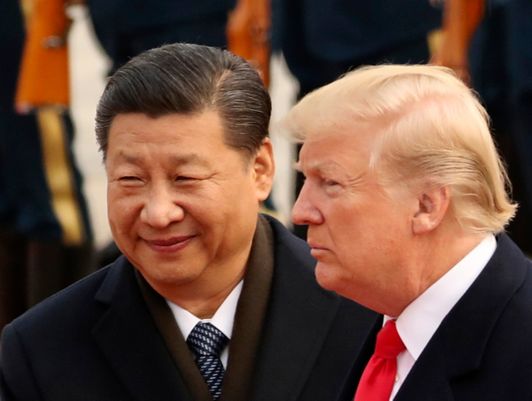
The court’s ruling comes ahead of Trump’s planned visit to Beijing for talks with Chinese President Xi Jinping.
Experts suggest Xi is unlikely to publicly capitalize on the ruling and will instead focus on stabilizing ties and reinforcing personal diplomacy.
Angered by the decision, Trump announced a temporary 10% global tariff, later raising it to 15%, and signaled he would pursue alternative legal pathways to sustain his trade agenda.
He continues to frame tariffs as necessary to counter China’s economic and military expansion.
Although the ruling complicates matters, analysts believe Beijing assumes tariffs could be reinstated with relative ease, while hoping negotiations might still produce concessions or reduced trade tensions.(
Imports from China have been falling
China’s share of the overall U.S. import market fell to 9 percent in 2025, compared to 13.4 percent in 2024, according to the Commerce Department’s trade report for December that was released on Thursday.
That is China’s lowest market share since the early 2000s. Less than a decade ago, China accounted for one-fifth of annual U.S. imports.
U.S. imports from China fell to $308 billion in 2025, their lowest level since 2009 and a drop of more than 42 percent from the record high of $539 billion in 2018 according to a report by Politico
Factoring all the tariffs Trump announced last year, as well as the rollbacks he granted, Chinese goods faced an “effective” U.S. tariff rate of 30.9 percent in November, according to Olu Sonola, head of U.S. economic research at Fitch Ratings in New York, and his colleague Sarah Repucci. This included, but was not limited to, Trump’s “reciprocal” tariffs that the Supreme Court struck down, the report added
AP/ Politico
