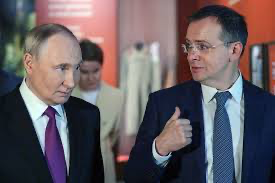
File : Vladimir Putin (L) with his aide Vladimir Medinsky (R) a historian who rewrote Russia’s history textbooks to justify Putin’s invasion of Ukraine
Russia’s delegation to the latest round of US-brokered peace talks between Kyiv and Moscow in Geneva is once again being led by ultraconservative historian and presidential aide Vladimir Medinsky – a man who rewrote Russia’s history textbooks to justify Moscow’s all-out invasion of Ukraine.
Vladimir Medinsky made his own soldiers when he was a boy. Growing up in the 1970s in the city of Smila, a railway junction in Ukraine’s Cherkasy oblast on the uplands of the Dnieper River, Medinsky would cut toy soldiers out of paper, paint on their uniforms with fastidious hands and fix them to thick cardboard backing.
“We drew a big map showing mountains, rivers, valleys, and cities and organised ‘toy battles’ on it,” Medinsky – then serving as President Vladimir Putin’s minister of culture – told Russian news agency TASS in 2016. “We fought a state against a state, an army against an army.”
Medinsky is no longer playing. After being absent from the past two rounds of negotiations in Abu Dhabi, the 55-year-old presidential aide is back at the head of Moscow’s delegation to the US-brokered talks in Geneva on ending the war in Ukraine on Tuesday and Wednesday.
It is a role he first held in the days and weeks following Russia’s full-scale invasion of Ukraine in February 2022, when delegations from Kyiv and Moscow met first in Belarus and then on the banks of the Bosporus in Istanbul to hammer out a ceasefire and eventual peace. Nearly four years of war has followed the talks’ ultimate failure.
Medinsky’s presence in Geneva has raised hackles in some quarters. Negotiators from the Ukrainian side have accused Medinsky in the past of using the talks to launch into long lectures unspooling his Russian nationalist reading of his country’s historic relationship with Ukraine.
After peace talks first resumed in Istanbul last May, Medinsky was quick to cast his mind back to another war of attrition waged in the far reaches of the world.
“We don’t want war, but we are ready to fight for a year, two, three – however long it takes,” he reportedly said during the talks. “We fought Sweden for 21 years. How long are you ready to fight?”
The end of the end of history
“My understanding is that whenever he is heading the delegation, it’s a sign that Russia wants to present the more political-ideological line and talk about global positioning of power, and how we can make sure that Russia is respected on the international arena and the civilisational choices and political and ideological values that Russia stands for are accepted and respected,” said Maria Falina, an assistant professor at Utrecht University’s department of history and art history specialising in modern and contemporary Eastern Europe.
“And when the delegation is headed by somebody from the military or secret services, then it is a more technical discussion about territory, land, peace guarantees, security, et cetera. So I think it really is about the what kind of message the Kremlin wants to send, and what they expect from each new round of the talks – and a lot has to do with what’s happening on the front line.”
Born to a retired colonel who served in both the Warsaw Pact’s invasion of Czechoslovakia and the doomed Soviet occupation of Afghanistan, Medinsky’s own application to a Moscow military academy was turned down due to his poor eyesight.
Turning instead towards journalism, which he studied at the prestigious Moscow State Institute of International Relations, Medinsky maintained a keen interest in Russian history – and military history in particular.
A model student and member of the Communist Party’s Komsomol youth organisation, he nonetheless joined the ranks of the demonstrators who flocked to defend Moscow’s White House in August 1991, where Russian Federation president Boris Yeltsin was sheltering from an abortive putsch launched by hardliners in the military. A few months later, the Soviet Unioncollapsed.
Medinsky graduated the following year. Along with a few friends from university, he launched a PR firm that soon found a strong client base in financial institutions and the tobacco lobby.
Although he launched his own political career following Putin’s rise to power in 1999, Medinsky became better-known for a three-volume series, “Myths About Russia”. These widely read books aimed to debunk what Medinsky said were negative stereotypes about Russia, its people and its history – many of which he said had been spread over the centuries by foreign powers eternally hostile to the Russian nation.
He continued his studies, earning a doctorate in medieval history based on a thesis accusing Western historians of systemic bias towards Russia. A group of academics have accused Medinsky of plagiarising his thesis.
“For Medinsky and for others promoting – we can call it Putin’s vision of politics in Russia, but it’s not just his, it’s a collective enterprise – Russia is existing in very strong opposition to the collective West,” Falina said. “And this collective West is the embodiment of post-Second World War liberal democratic values. Russia presents an alternative, and it is a civilisational and ideological alternative to this … liberal world order and liberal political values. And Medinsky is a spokesperson for this ideological package.”
Culture wars
Medinsky’s shock appointment to minister of culture in 2012 made it clear that his crusade had found high favour. Once named to Putin’s cabinet, Falina said, the new minister wasted little time in mobilising the full power of the Russian state behind his revisionist project.
“As minister for culture, Medinsky was promoting cultural productions in film, in theatre, exhibitions, anything – you name it – that supported his understanding of Russian patriotism,” she said. “Of supporting the idea of the great Russian state, be it in the Middle Ages, Early Modern period, Imperial Russia, Soviet Union – it doesn’t really matter, as long as it is a strong Russian state which is both strong and somehow culturally, nationally Russian.”
Underlying these efforts, Falina said, was a growing will in the Kremlin to rework Russia’s tangled history of revolution, reaction and war into a simpler story that would place the country at the heart of world affairs.
“They’re trying to use history to create social cohesion,” she said. “And of course, they’re not the only ones who are doing this – history has been used like this by many countries – but the key difference is that in some societies, history is being used for peace and reconciliation processes … where you foster a historical dialogue, and then you overcome a divisive past and create social coherence. But what they’re trying to do is impose a single narrative of the past, and through that, brush over any potentially divisive elements.”
Throughout his term as culture minister, Medinsky continued to serve as the head of the state-backed Russian Military Historical Society, organising summer camps for Russian teens instructing them in the glory of the country’s past military triumphs.
When the Russian State Archive released a declassified military investigation calling into question the existence of the much-mythologised “Panfilov’s Twenty-Eight Guardsmen” – a group of soldiers who in 1941 reportedly laid down their lives to bring an entire German tank division to a halt at the height of what Russia calls the “Great Patriotic War” – Medinsky campaigned for the archive head’s resignation. He soon got it. Even if the story wasn’t true, he said, the myth was “a sacred legend that no one should touch”. A feature-length blockbuster would soon follow.
Nowhere is Medinsky’s role in these increasingly bitter history wars clearer than when Moscow in 2023 rolled out a new history textbook to every high schooler in the country – as well as parts of Ukraine under Russian military occupation.
Partly written by Medinsky, the book has been criticised for a deeply revisionist account of Russia’s trials, triumphs and tribulations across the 20th century, praising Joseph Stalin’s leadership and portraying the war against Ukraine as a continuation of Moscow’s fight against Nazi Germany and its collaborators.
“There were multiple attempts to create a single history textbook that all schools in all the country would use,” Falina said. “It was highly criticised. They abandoned the attempt and restarted it several times – which happens in large bureaucracies – and with every new iteration it became more and more patriotic, more and more conservative, less and less critical of any excesses of [the] Russian or Soviet or pre-Imperial past. And Medinsky there played a critical role.”
AFP/ FRANCE 24
