Israel’s disclosure of a naval commando operation in the northern Lebanese town of Batroun has thrust back into focus a case that straddles security, political, and legal fault lines.
The announcement, accompanied by Israeli claims surrounding Imad Amhaz, comes at a delicate moment, coinciding with ceasefire arrangements, meetings of the monitoring mechanism committee, and ongoing efforts to resolve the files of detainees and missing persons
The Israeli announcement and security narrative
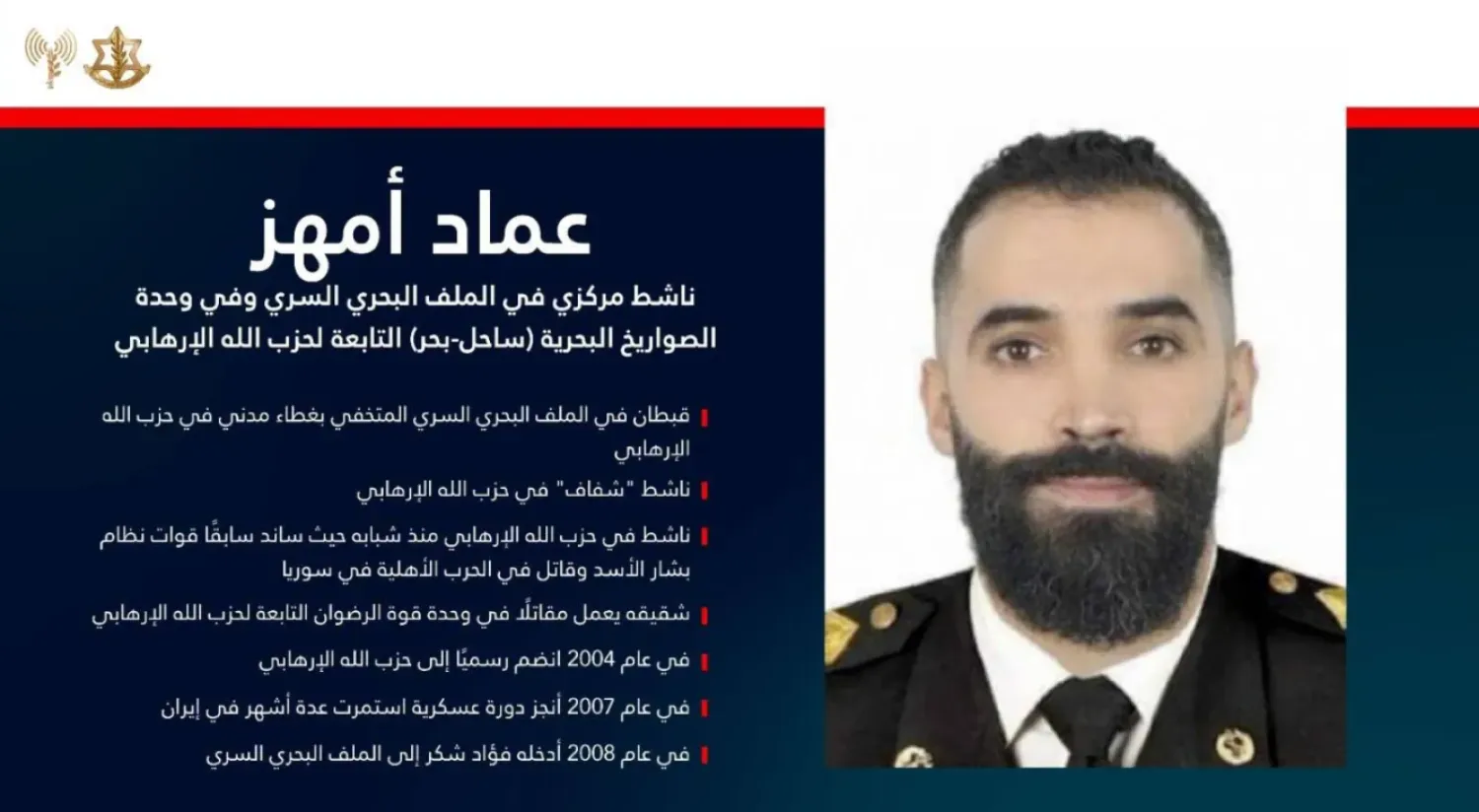
Israeli army spokesman Avichay Adraee said Israeli forces carried out an operation around a year ago in Batroun, far from the Lebanese Israeli border, during which Imad Amhaz was transferred to Israel for interrogation.
According to the Israeli account, Amhaz is linked to Hezbollah’s secret maritime file and its coastal missile unit, received military training inside and outside Lebanon, and acquired maritime expertise related to operational missions.
Adraee said the interrogation of Amhaz enabled, according to his statement, the acquisition of information related to organized maritime activities run under a secret framework and using civilian fronts.
He said this information helped obstruct the progress of this file at what he described as a sensitive stage, adding that Iran provided support for these activities.
A broader political and security context
In an analytical reading, security and defense researcher Riad Kahwaji told Asharq Al-Awsat that the case of Imad Amhaz and the timing of its disclosure could not be separated from the broader political and security context, particularly the meeting of the ceasefire monitoring mechanism committee and the ongoing negotiations.
He said Israel was trying through this timing to justify its refusal to withdraw from five points by arguing that Hezbollah remained present and continued to conduct military activity.
Kahwaji said the Israeli messages also aimed to show that Hezbollah’s role was far greater than perceived inside Lebanon, arguing that the group was no longer merely a local organization but part of a broad regional project led by Iran.
He said the issue was not related to a trench or one or two military positions, but rather to an integrated structure that included maritime capabilities, infrastructure, and strategic preparations.
He added that Iran had invested tens of millions of dollars in this project, saying Israel was seeking to highlight the scale of military investment in a country whose population was suffering severe internal pressures.
Kahwaji said the file went beyond the area south of the Litani River, noting that the issue was not limited to that region but included the maritime dimension and other areas, particularly since Amhaz was in Batroun in northern Lebanon at the time of the operation.
He said Israel was speaking about tunnels, weapons depots, and equipment in an attempt to show a contradiction between what the Lebanese state declared regarding the disarmament track and what Israel considered a continuation of Hezbollah’s military activity and armament.
He said attempts to strip Imad Amhaz of his civilian status fell within this context, explaining that Israel had from the outset sought to present him as linked to what it called Hezbollah’s naval weapons.
He added that the Lebanese state, in contrast, said the core problem lay in Israel’s continued occupation of the five points, while Israel responded that the main reason was that Hezbollah had not stopped arming itself and that the threat remained.
The Lebanese position and legal dimension
For his part, Nabih Awada, a member of the committee representing detainees and former prisoners in Israeli jails, told Asharq Al-Awsat that the case of Imad Amhaz was, from a legal perspective, that of a civilian abducted from a Lebanese area far from the border. He said his detention did not fall under military arrest.
Awada said this also applied to other documented cases, stressing that the file was being followed up with official Lebanese authorities and with the International Committee of the Red Cross.
He said the Lebanese state was dealing with Imad Amhaz on the basis that he was a civilian and considered that the location of his detention, its circumstances, and its nature did not fall within any military engagement or combat activity. He said this description was what the state relied on in addressing the file before international bodies.
Presidential stance regarding the detainees
Awada said the full details of the file were raised during a meeting with the president of the republic, who he said was fully convinced that the priority of the current stage was the release of Lebanese detainees.
He said the president stressed the need to start at least with civilians detained after the war, given that hostilities had stopped and there was no longer any legal justification for holding them.
He said the president had acted on this basis by communicating with the International Committee of the Red Cross, as well as international and US parties.
The Amhaz family’s stance
Alongside official positions, sources close to the family of Imad Amhaz told Asharq Al-Awsat they denied any knowledge of military activity attributed to him, saying Amhaz had been leading a normal civilian life and that the family had never been informed of any link between him and any military or security activity.
They said the information published did not reflect the family’s account.
Detainees and missing persons figures
On figures, Awada said the file submitted to the president included 20 Lebanese detainees whose presence in Israeli prisons had been confirmed, half of whom were arrested during the war and half afterward.
He said among those detained during the war were seven fighters and three civilians, including Imad Amhaz, who was considered a civilian.
Those detained after the ceasefire were all civilians, in addition to three people missing before the war and around 40 missing since it began.
Israeli Maariv revealed in a report The newspaper quoted a military source as saying, “Much of the information about the plans and intelligence possessed by the other side was used as the basis for part of the exercise. The exercise also addressed our ability to train for potential threats, such as targeting or raiding ships and facilities.” The Shayetet 13 commando unit was also tasked with training for various scenarios involving raids or attacks on ships.on Thursday that the information Hezbollah possesses regarding strategic installations and ship movements in Israeli territorial waters has stunned the Israeli army.
Maariv reported that the Israeli Navy recently conducted a large-scale exercise involving all three of its fleets, as well as forces from the Air Force and the Information and Communications Technology Division.
Maariv also reported that the interrogation of Hezbollah operative astonished Israeli security officials, as the information he provided revealed the extent of Hezbollah’s intelligence gathering on strategic installations and ship movements in Israeli territorial waters.
The newspaper quoted a military source as saying, “Much of the information about the plans and intelligence possessed by the other side ( Hezbollah) was used as the basis for part of the exercise. The exercise also addressed our ability to train for potential threats, such as targeting or raiding ships and facilities.” The Shayetet 13 commando unit was also tasked with training for various scenarios involving raids or attacks on ships.
The Israeli military stated that the exercise took place in the economic waters of the Mediterranean Sea and lasted several days. However, the army noted that the exercise combined multi-area combat scenarios.
The Israeli army had previously revealed a commando operation in which it captured Captain Imad Amhaz from the Batroun beach in November 2024, describing him as a “key operative in the clandestine maritime file and a member of the coastal missile unit (7900)” in Hezbollah. He was transferred to Israel for interrogation.
I
Ashram Al Awsat/ El Nashra
