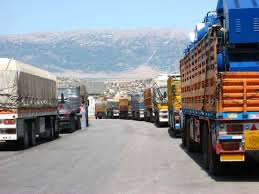
Lebanese trucks are shown at the Masnaa border crossing as they wait to enter Syria
How Syria’s transit monopoly keeps Lebanon economically hostage—and how to end it
For as long as anyone can remember, Syria has used its geographic position to exert economic pressure on Lebanon. Regardless of who ruled in Damascus, one constant remained: the manipulation of the land transit route Lebanese exporters depend on to reach Arab Gulf markets.
Syria is the only country bordering Lebanon through which agricultural exports can be trucked to the Gulf. That monopoly has repeatedly been weaponized. Every few years, a new regulation, fee, delay, or outright ban appears—always at Lebanon’s expense.
The latest decision by Damascus is just the newest chapter. Syrian authorities announced that non-Syrian trucks will no longer be allowed to enter the country, forcing goods to be unloaded at designated border points. In practical terms, this cripples regional trade.
Roughly 500 Lebanese trucks use this route daily, most carrying fresh agricultural products bound for Gulf customers. Jordan is also affected, with around 250 Jordanian trucks transiting Syria each day. But there is a crucial difference: Jordan has direct land access to Gulf markets. Lebanon does not.
For Lebanon, this decision is not an inconvenience—it is economic strangulation.
This pattern exposes a hard truth: as long as Lebanon relies on Syria as a transit corridor, its exports will remain hostage to political blackmail. No change of regime in Damascus has altered this reality. Expecting future goodwill is not a strategy; it is denial.
For years, experts have urged Lebanon to break free from this dependency. The solution is neither radical nor experimental: Roll-on/Roll-off (RoRo) shipping.
By purchasing or leasing RoRo vessels, Lebanon could ship trucks directly from Lebanese ports to Arab Gulf countries, bypassing Syria entirely. When professionally managed by an experienced shipping operator, RoRo transport is more reliable, politically insulated, and—at scale—often more economical than overland trucking through hostile territory.
Beyond cost and efficiency, the strategic value is decisive. RoRo shipping restores sovereignty over trade, protects farmers from sudden disruptions, and shields the economy from decisions made in Damascus for political leverage.
The lesson is painfully clear: Syria has always used the transit route as a pressure tool—and it always will.
It is time for Lebanon to end Syria’s blackmail once and for all.
Economic independence begins with controlling how—and through whom—your goods reach the world.
