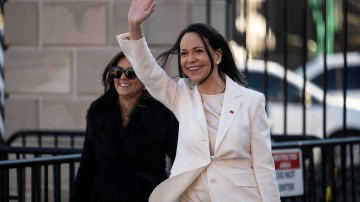
Venezuelan opposition leader María Corina Machado met with president Trump at the White House in Washington — and gave him her Nobel Peace medal which he reportedly gladly accepted
“None of this is ‘Operation María Corina Machado.’ It’s ‘Operation U.S. national security,’” said a White House adviser.2/06/2026 05:29 PM EST
- White House advisers and people close to the Trump administration are growing frustrated with Venezuelan opposition leader María Corina Machado, viewing her recent remarks about when elections could be held as potentially undermining their work in Venezuela
A White House adviser, granted anonymity to speak freely about the matter, said Machado’s recent comments to POLITICO saying that elections could occur in her country in under a year rubbed some people the wrong way, even though she’s still personally liked.
“All María Corina Machado does is try to negate all of this … she’s selfish,” the adviser said. “None of this is ‘Operation María Corina Machado.’ It’s ‘Operation U.S. national security,’ which is not tied to her in any way. She’s a spoiler and she’s working against U.S. national security goals.”
The person accused Machado, who won the Nobel Peace Prize last year for her work leading the opposition to the now-deposed Nicolás Maduro, of “undermining the president’s policy success” — such as the release of political prisoners in Venezuela, joint law enforcement operations between the two countries and other items — by trying to make herself the “sole star” of the Venezuelan opposition.
Machado’s office dismissed the criticism as “media noise” and rumors, insisting the opposition is “closely aligned” with the U.S. government “in our approach.”
“We are the first to be invested in ensuring that this process moves forward in a firm and stable manner,” the office said in a statement to POLITICO. “The interests of the United States administration and those of the Venezuelan people are the same: a Venezuela that is prosperous, secure, free, and democratic.”
Another person close to the White House, granted anonymity to speak freely, also winced at election timeline predictions.
“[Twenty-four] months is a more realistic time frame but strategically, she shouldn’t be opining on a time frame,” the person close to the White House said.
And the White House stressed that President Donald Trump’s priority is rebuilding Venezuela, and that elections “cannot happen overnight.”
“As the President stated, there will be elections at the right time, but his top priority is to bring Venezuela back from the dead and rebuild the country,” a White House official said in a statement to POLITICO. “When the country has recovered to the point where it can hold clean, transparent elections, it will be up to the Venezuelan people to choose their leader. We want a stable, prosperous, free, and friendly Venezuela, but this cannot happen overnight.”
The State Department did not respond to a request for comment.
Machado did not say in her POLITICO interview that she wanted to see elections right away. She told POLITICO “we believe that a real transparent process with manual voting, total audit throughout the process, could be done in nine to ten months.” She added “that depends on when you start” and also did not call for the technical process to reach elections to begin.
But the election comments are hardly the only things sticking in the craw of some in the White House.
The White House adviser said concerns with Machado have been percolating over the last few months. Initially, the adviser said, the administration was trying to be “respectful” and hoping she’d be patient as the U.S. pursues changes in Venezuela.
Her comments on elections, the adviser said, have been seen as efforts to stay relevant as the transition unfolds.
Trump said in a press conference shortly after Maduro’s capture that Machado “doesn’t have the respect” to lead Venezuela, prompting worries from supporters of the Venezuelan opposition that the White House was sidelining her.
After a meeting with Machado in the Oval Office, where the Venezuelan opposition leader gifted Trump the medal she received from the Nobel Committee and dedicated the award to him, the president slightly altered his tone. He said on Jan. 16 that Machado was “a person who I have a lot of respect for, and she has respect obviously for me and our country.”
Machado has also insisted that she has a good relationship with the Trump administration. But Machado remains in Washington, weeks after the operation to capture Maduro, and it is unclear what the United States may do to facilitate her return to Venezuela.
GOP hawks, especially members who represent South Florida’s large Cuban and Venezuelan diaspora communities, have called for elections to happen as soon as possible, arguing that a delay could entrench the grip on power Maduro’s allies still enjoy.
Secretary of State Marco Rubio, who was a friend of the Venezuelan opposition in Washington when he represented Florida in the Senate, outlined some of the conditions necessary for elections in Venezuela in Jan. 28 testimony before the Senate Foreign Relations Committee. There, he said “if the opposition has no access to the media, if opposition candidates are routinely dismissed and unable to be on the ballot because of the government, those aren’t free and fair elections.”
Prior to the POLITICO interview, Machado had previously declined to comment on the specific timeline for an election, saying in January that setting “dates or a calendar” for elections in Venezuela would be irresponsible.”
POLITICO
