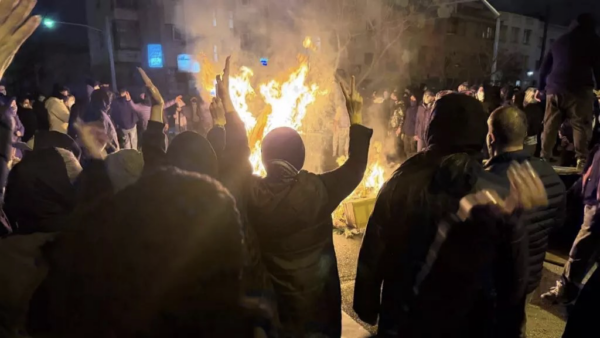
Photo obtained by The Associated Press shows Iranians protesting in Tehran, January 9, 2026. © UGC via AP
The Iranian regime’s recent crackdown on protests in Tehran and the country’s central region featured the use of military weapons, such as automatic or semi-automatic machine guns, that were previously only deployed in the remote northwestern Kurdish areas, according to Amnesty International. For Iran’s overlooked Kurdish minority, it could mean there’s worse to come.
Three years after he fled Iran, Diako Alavi is getting by with little scraps of information about his large family living in cities and towns in the country’s northwestern Kurdish-majority areas.
The internet and communication blackouts that accompanied the regime’s recent crackdown on protests have left him reliant on messages providing the barest, essential facts.
“To be honest, I couldn’t talk to all of them,” explained the 37-year-old, who now lives in France. “I am not aware of the situation of all of them, but I just heard that we are safe. We are still alive.”
The situation this time in Alavi’s hometown of Saqqez in Iran’s Kurdistan province appeared to be a lot calmer than during the previous wave of anti-regime protests. Saqqez is also the hometown of Jina Mahsa Amini, whose death in police custody in September 2022 sparked the “Women, Life, Freedom” movement.
Alavi, like many townspeople, attended the young Kurdish woman’s funeral in Saqqez and joined the first protest that sparked a nationwide opposition movement. Months later, the high-school English teacher in a local school was forced to flee after spending two weeks in prison for participating in the protests that put Saqqez in the international spotlight.
The situation this time in his hometown was different, Alavi explained.
“The protests were very limited in some of the Kurdish areas this time,” he said. “Maybe they were afraid of the huge suppression, which we see is happening in other cities.”
While the 2022-2023 protests spread from the Kurdish periphery to the centre, the latest demonstrations erupted in the country’s commercial beating heart: Tehran’s Grand Bazaar, where merchants on December 28 voiced their frustration over the currency crisis, igniting another nationwide flame of discontent.
The contrast between the birthplaces of the “Women, Life, Freedom” movement and the latest protests could not be starker. Saqqez, a highland town in the Zagros Mountains straddling the borders of Iran, Iraq and Turkey, is more than 600 kilometres and a world away from the Grand Bazaar, the symbolic seat of the bazaaris, a socially conservative class of merchants who have been loyal to the Islamic Republic for nearly half-a-century.
Iran’s Kurds, in contrast, have historically opposed the theocratic rulers in Tehran and have borne the brunt of brutal regime crackdowns since the 1979 Islamic Revolution.
If the residents of Saqqez and the surrounding areas did not take to the streets en masse this time because they feared a repeat of the repression they experienced after the 2023 protests, they were unfortunately proved right.
In its latest crackdown, Iranian security forces, for the first time, used automatic or semi-automatic machine guns on crowds in the heart of Tehran, according to Amnesty International. Such lethal, military grade arms were previously used in the Kurdish provinces during the crackdown following Amini’s death, the London-based human rights group revealed at a press conference on Thursday.
The scorched-earth levels of bloodshed and brutality once confined to the ethnic margins have reached the nation’s centre. That does not bode well for stability inside Iran, the region, and for the country’s majority and minority groups.
‘Persian cities feel the pain of the Kurdish regions’
A vast country of around 92 million people, Iran shares land borders with seven countries and is home to an ethnically diverse population with some communities sharing kinship ties across national frontiers.
Ethnic Persians, making up around 50 percent of the population, are the majority and are based predominantly in the central region. The country is also home to Azerbaijanis, the largest minority group estimated at between 16 to 24 percent, followed by Kurds (between 10 to 16 percent) and a mosaic of smaller ethnic groups such as the Lurs, Arabs, Baluch and other Turkic groups.
Spread across the borders of Iran, Iraq, Syria and Turkey, the Kurds have a long, painful history of discrimination and suppression campaigns by regimes based in power centres far from their regions.
In Iran, Kurdish groups oppressed by the former shah were initially hopeful when the Islamic Revolution ousted the Pahlavi dynasty, but their hopes were quickly dashed once the Shiite regime took power. Since a 1979 rebellion in the northwest was brutally crushed, Kurdish parties with different acronyms and ideologies, most calling for federalism, a few with armed wings, have opposed the regime in Tehran.
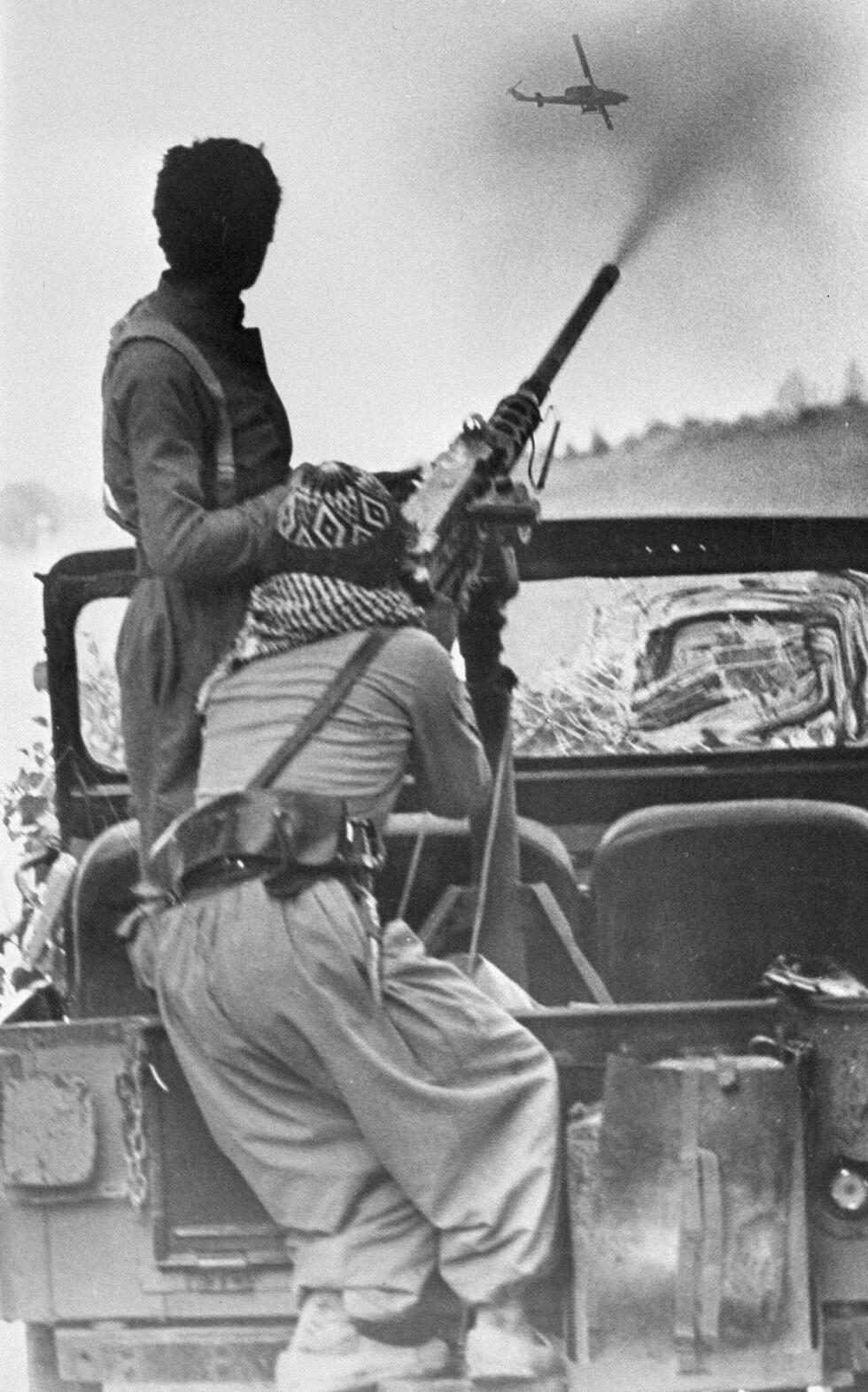
For more than four decades, the state pursued a “what happens in the northwest stays in the northwest” position, with state and semi-official Persian language media informing audiences that security forces were battling “terrorists” and “separatists” in the Kurdish badlands.
That was until this month, notes Shukriya Bradost, a Middle East security expert who has studied the history of Iran’s Kurds.
In its latest crackdown on protesters across the country, the regime “used the same military weapons in Tehran and sadly, other central, Persian-majority provinces that they use every time in the Kurdish regions”, she said. “After 47 years, the Persian cities feel the pain of the Kurdish regions.”
The toll from the latest crackdown has been staggering. On Thursday, the Iranian state finally released official figures, putting the death toll at 3,117, including 2,427 “martyrs” defined as security force members or innocent bystanders. The remaining 690 dead were described as “rioters” backed by the US.
Human rights groups have put the figure far higher. Norway-based NGO Iran Human Rights says it has verified the deaths of more than 3,400 protesters and warned the true figure could be “between 5,000 and 20,000”.
‘A powerful, mobilised force’
The public anti-regime demonstrations in many Kurdish areas this year did not draw the kind of crowds that took to the streets in the “Women, Life, Freedom” rallies. But the region did see a number of smaller protests, which were brutally suppressed.
Protests in the Kurdish-majority western province of Kermanshah in the first week of January faced harsh repression, with human rights groups such as Amnesty International verifying videos of security officials arresting protesters amid loud gunshots while the injured and dead lay on the streets. “Kermanshah feels like a war zone,” said one wounded protester. “It’s a field of bullets.”
In Malekshahi, a county in Ilam, another Kurdish-majority province, security forces fired live ammunition into a crowd of unarmed protesters and then stormed a hospital, “seeking to remove the bodies of those killed and forcibly take injured protesters out of the hospital”, reported Hengaw, a Norway-based Kurdish human rights group.
Following the protests in Kermanshah and Ilam, seven Kurdish political parties got together to issue a joint call for a general strike on January 8. Other ethnic minority provinces – such as Baluchestan in the southeast near the Pakistan border and the Azerbaijan-majority states in the north – joined the strike call.
“More than 50 cities and towns joined the strike,” Bradost said. “That was a huge success for the Kurdish parties, to show how much influence they have and how easily and effectively they can mobilise people.”
By channeling the public anger in a strike call, the Kurdish parties not only helped keep their people off streets that had turned into killing fields. They also acknowledged the economic grievances of the bazaaris and all Iranian citizens by targeting the regime where it hurt most.
Iran’s ethnic minorities tend to be cohesive and have leadership structures, such as leftist parties and civil society institutions among the Kurds, and religious and community elders among the Baluchis. The Kurds, in particular, can play an important role in bringing political change, Bradost maintains.
“If there needs to be a powerful, mobilised force against the Iranian regime, these forces are Kurdish forces and the Kurdish regions,” she said. “The Iranian opposition can use this as an opportunity to unite behind the Kurdish region, because these regions are the most mobilised in the country.”
‘All Kurds are separatists’ rhetoric
One of the major problems confronting the Iranian opposition is the absence of a legitimate, or charismatic, leader who can unite disparate groups.
Reza Pahlavi, the US-based son of the deposed shah, has emerged as a potential leader, with the overseas Persian-language channels positioning the 65-year-old as an alternative to the Islamist regime. During the recent demonstrations in Iran, several protesters chanted the former crown prince’s name, according to witness accounts. But there were also chants of “No shah, no mullahs” – particularly in Iranian universities.
Pahlavi’s close ties to Israeli Prime Minister Benjamin Netanyahu is also a divisive issue – particularly after last year’s 12-Day War, which saw Israeli strikes targeting military infrastructure, killing civilians, but failing to bring down the regime, which simply increased its repression for ordinary Iranians.
For many Kurds, whose parents and ancestors suffered brutal discrimination under the Pahlavi monarchs, the California-based, Persian elite crown prince is a hard sell as a leadership figure.
A month after the June 2025 Israel-Iran war, Pahlavi’s team in exile released an “emergency phase” plan. But while the 169-page document featured the term “territorial integrity” several times, there was no mention of “federalism”, a critical issue for Iran’s Kurds.
Whether it’s the Islamic regime or an old-new shah, the discourse of the Persian elites at home or abroad sounds dismayingly familiar for many Iranian Kurds.
“They’ve been brainwashed that all Kurds are separatists,” Bradost said. “When you use the term federalism, it’s viewed as separatism, against your territorial integrity.”
Stateless ethnic group gets played by states – again
Just days after security forces unleashed a crackdown on protesters, the Iranian military this week targeted an Iranian Kurdish opposition party headquartered in neighbouring Iraq.
The Kurdistan Freedom Party (PAK) on Wednesday said the Iranian regime targeted one of the Kurdistan National Army’s headquarters “using missiles and drones”, referring to an armed group that operates under its authority.
“We were prepared for this news, that the regime will attack Kurdish bases in Iraqi Kurdistan. There’s always this scenario,” Bradost said, noting that one of the regime’s main goals was to “distract the attention of protesters to the Kurdish party, to tell Iranians that the Kurds are separatists and that Iranian territorial integrity is in danger”.
A history of mobilisation spanning nearly a century has seen the formation of several Iranian Kurdish parties. In the past, some have fought each other. This was primarily during the 1990s, a brutal period for Kurds in Turkey and Iraq, which had ramifications for Iranian Kurdish parties as Tehran tried to leverage the factional fighting in a bid to maintain control in the Kurdish areas and extend its regional influence.
The oldest Iranian Kurdish party, the Democratic Party of Iranian Kurdistan (KDPI) traces its roots to the 1946 Republic of Mahabad, a short-lived, self-governing Kurdish state in northwestern Iran that has symbolic weight among the Kurds.
While the KDPI seeks Kurdish rights within a federal Iranian state, other parties have armed wings based in the mountainous Kurdish areas of northeastern Iraq. The PAK, which was founded in Iran in 1991, for instance, includes fighters who took part in battles in Iraq against the Islamic State (IS) group.
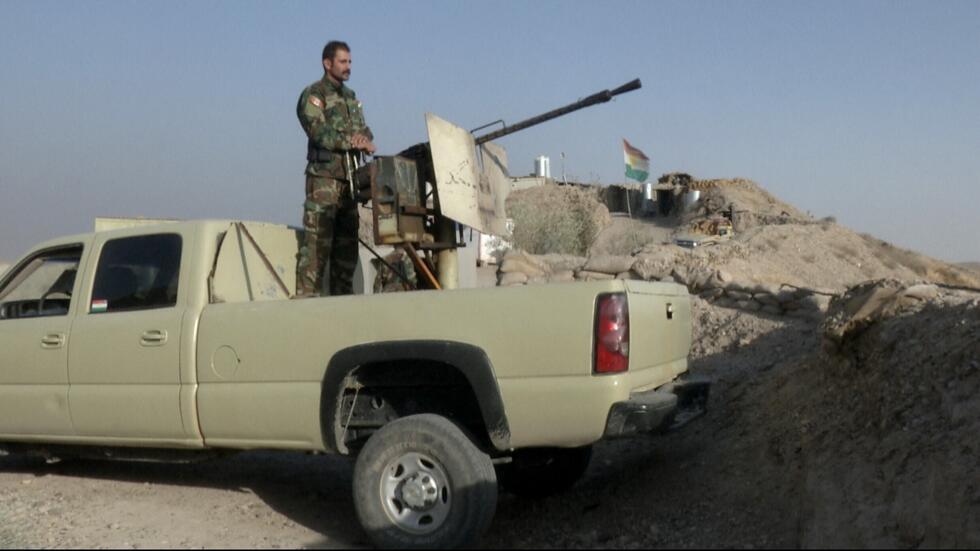
Another party, the Kurdistan Free Life Party (PJAK), is the Iranian branch of the Turkey-based Kurdistan Workers’ Party (PKK), which is considered a terrorist group by Ankara, Washington and Brussels, but whose Syrian arm nonetheless joined the US-backed Syrian Democratic Forces (SDF) forces in the fight against the IS group in Syria.
The Kurds have been called “the world’s largest ethnic group without a state” for more than a century. But the international community has been largely unsuccessful in working with, or putting pressure on, regional capitals to address the root causes of the Kurdish problem across borders.
In Syria, the recent fighting between Kurdish SDF fighters and government forces under Turkey-backed interim President Ahmed al-Sharaa is just the latest example of the international diplomatic failure to negotiate a resolution to the Kurdish issue.
From his new home in France, Alavi sees new players and administrations playing new geopolitical games in the region – and that provides no grounds for optimism.
At a recent Iranian opposition demonstration outside the European Parliament in Strasbourg, Alavi saw some participants wave Israeli flags, which dismayed him.
“There are people who don’t like that, you know,” the mild-mannered former school teacher said.
Many Middle East experts say Israel over the past two years has sought to position itself as a champion of the region’s minorities – such as Syria’s Druze community – to weaken neighbouring states for its own security interests. While many Iranians oppose the Islamic regime’s “axis of resistance” support for the Palestinian cause at the cost of the welfare of their own countrymen, not all support Israel. Pahlavi’s outreach to Netanyahu has split an already divided opposition.
US President Donald Trump’s changing discourse on Iran has added to the unease for many in the Iranian opposition. The president’s initial threats to intervene against Tehran dwindled last week with the protests inside Iran.
As a populace reeling with the killings, shutdowns and surveillance struggled to find and bury their dead, Trump claimed he had stopped executions of prisoners, toning down his intervention rhetoric. On Thursday, he was back on the verbal offensive, telling reporters the US has “an armada … heading in that direction, and maybe we won’t have to use it”.
“I can understand that people who are inside the country, who have no hope, who are seeing a huge massacre, are asking Trump to come to help us because they’re killing us,” Alavi said.
“But we can see what’s happening now is not a good situation. We’re completely stuck between two forces, none of them are very acceptable … I don’t know what to say,” he continued, sounding defeated after anxious weeks of watching the killings from afar and trying to crack the communications blackout to get news about his family.
“The biggest thing is feeling guilty. I see that with almost all my Iranian friends all over the world, we’re all feeling guilty for not being there.”
FRANCE24/ AFP
