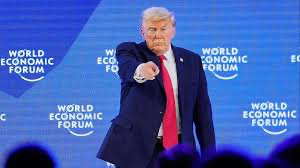
in his speech at Davos , US President Donald Trump attacked Europe’s energy policies and alleged the US “returned” Greenland to Denmark following World War Two.
Afraid of boredom, he compulsively creates drama and hopes his luck—and ours—will hold out.
By Peggy Noonan
It was insane that he might, a relief that he won’t, and people thought he would only because he’d implied as much, repeatedly.
His speech to the World Economic Forum marked yet another tear in our old, ancestral, foundational closeness with Europe. It is captured in this exchange, on separate days, to the same audience:
Canadian Prime Minister Mark Carney said on Tuesday that traditional U.S. leadership of the North Atlantic Treaty Organization was over. “We are in the midst of a rupture, not a transition.” The “middle powers must act together—because if we’re not at the table, we’re on the menu.” He got a standing ovation.
The next day, Mr. Trump ad-libbed: “Canada lives because of the United States. Remember that, Mark, the next time you make your statements.”
That, obviously, isn’t how friends speak to each other.
I continue on last week’s thoughts on aspects of Mr. Trump’s personal nature that have contributed to the current state of affairs. This week he put me in mind of a woman I once knew who was always roiled, always creating commotion and drama—quarrels, sudden attachments, fiery endings. I came to think she had a constant storm inside of her, and because of that she created storms outside, as if to maintain equal barometric pressure. To function, she needed a balance between the forces within and the forces without.
She had to create trouble to live. Does that remind you of anyone?
Mr. Trump has a real fear of boredom. When there’s peace and quiet, he becomes restless, anxious. He seems unable to tolerate normality and shows little faith in quiet progress—set a good policy in place, tend to it as it settles. So he creates drama, he attacks, arouses counter-forces, feels fear—will my luck hold?—defeats the enemy, claims triumph and relaxes. And becomes restless and creates new drama. Lather, rinse, repeat. Life is drama, always has been. It used to be gambling casinos and bankruptcy, now it’s Venezuela and Greenland. But it’s the same prowling anxiety.
It’s part of why this era feels so exhausting. In the peaceful weeks you start to get nervous, because you sense trouble is coming.
You see some of this in how he reads a teleprompter. When he is reading a prepared text he seems disengaged, as if he fears nothing exciting will happen. If he is improvising, excitement is possible. When he speaks off the cuff it’s a gamble—he doesn’t know what he’s going to say either!—and gambles are exciting and diverting.
Still, when he departs from a text he shares part of his inner world, and seems sometimes almost innocently interested in what he’s saying.
“What I’m asking for is a piece of ice. . . . It’s a very small ask.” No doubt this is at least part of how he thinks about Greenland. We aren’t talking about one nation seizing the land of another sovereign nation, he’s just a guy who needs some ice in his drink. It’s not too much to ask!
There’s his thinking on Europe. Mr. Trump often refers, justly, to his success in making NATO members increase their contribution to defense. What was revealing in the Davos speech was how he honestly seems to feel about our allies. America is always there for NATO, he said, “But I’m not sure that they’d be there for us.” If the U.S. were under attack, “I’m not sure that they’d be there.”
I wondered if Vladimir Putin whispers that kind of thing to him in their phone calls—Donald, you can’t trust your so-called friends. My second thought was what an insult it was. It’s hard to walk back “I don’t trust you” to a friend. Third, how bleak. Old allegiance, old history, shared blood, old tribes, old paper—Magna Carta, Émile Zola. You make yourself weaker in the world when you lose foundational friendships. It’s horrifying to witness their collapse. If you have two friends who’ve been friends 20 or 40 years, and they break, and the rupture isn’t healed, you feel toward them embarrassment and a kind of shame.
As is well known and has often been pointed out, everything is personal to Mr. Trump. The news is it isn’t getting less so.
“Until the last few days when I told them about Iceland, they loved me,” he said, referring to European leaders. “They called me daddy.” On Europe’s major business leaders: “I know every one of them. They’re sort of—they’re looking down. They don’t want to see me and they don’t want to stare me in the eyes.”
(Several times Mr. Trump confused Greenland with Iceland, which is understandable as Greenland is white and covered with ice and Iceland is green and covered with tourists.)
In an extended riff, he spoke of how he treated Switzerland. “They come in, they sell their watches, no tariff.” So he slaps on a tariff. The Swiss president, “a woman,” called and was “repetitive”—her country is small, you can’t do this. “She just rubbed me the wrong way.” So he increased the tariff. But then he lowered it, “because I don’t want to hurt people.”
On French President Emmanuel Macron: “I like him. I actually like him. Hard to believe, isn’t it?”
This was followed by something interesting. Mr. Trump talks about how he bullied Macron on pharmaceutical pricing. “I said, here’s the story, Emmanuel. The answer is you’re going to do it. You’re going to do it, fast.”
This startled me as I knew what sound I was hearing. It was the sound of Edward G. Robinson in a 1930s film on “Million Dollar Movie” in 1958. Which, like me, young Mr. Trump grew up watching on New York television. You can’t exaggerate how important television was in the making of this man, and I don’t mean “The Apprentice,” I mean those old movies.
Referring to Venezuela, Mr. Trump didn’t explicitly mention the U.S. removal of its president, Nicolás Maduro. Instead he said, in the rhythm of Robinson as Little Caesar, “We’ve been given great cooperation once the attack ended—the attack ended, they said, ‘Let’s make a deal.’ More people should do that.” Again, that’s movie mob talk.
In a section on rebuilding the U.S. military, Mr. Trump said, “We’re bringing back battleships.” The new ones are “100 times more powerful” than the legendary battleships of World War II, which he went on to name—the Missouri, the Iowa, the Alabama. “I thought maybe we could take them out of mothballs.” But he learned modern ones were much more powerful. “So that was the end of the mothballs.”
It’s unusual for a man to be surprised that modern battleships are more advanced than ones decommissioned decades ago, but more interesting was his engagement in what he was saying. Suddenly I was certain he grew up watching “Victory at Sea,” the great 1950s documentary series about the battleships of World War II. I researched it, and yes, the ships he mentioned were in the series, which indeed he watched as a child, experiencing history at a remove, on a screen.
WSJ
