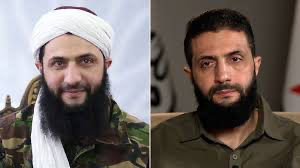
Before nd after : Former Nusra Front leader Abu Mohammed al-Golani (L) who revealed his real name as Ahmed al-Sharaa (R) and named himself Syria’s interim president after deposing former dictator Bashar al Assad . Ever since he became the president he switched to civilian attire . The Nusra Front was deeply intertwined with extremist movements, AlQaeda and ISIS
President Trump’s bet on Syria’s new leader is facing a pivotal moment, as Kurdish forces are under attack from President Ahmed al-Sharaa’s forces in the northeast and facing growing pressure to fold into the central government.
Al-Sharaa’s government and the Kurdish-led militias, collectively known as the Syrian Democratic Forces (SDF), reached a ceasefire over the weekend, but the agreement proved to be frail as violence escalated with government forces pushing into Kurdish-held territory in northern and eastern Syria.
Kurdish officials and allies worry that President Trump is turning his back on the SDF, a longtime U.S. ally in counterterrorism operations against the Islamic State in Iraq and Syria (ISIS) in the area.
Tom Barrack, the U.S. special envoy to Syria, is urging Kurdish forces to integrate into al-Sharaa’s military.
“The original purpose of the SDF as the primary anti-ISIS force on the ground has largely expired, as Damascus is now both willing and positioned to take over security responsibilities,” he wrote Tuesday on the social platform X.
But whether the ceasefire turns into a long-term peace agreement remains uncertain, as there’s intense distrust between the Kurdish forces and Damascus.
“I think there’s still a very real possibility that we could see a renewal of violence,” said Victoria J. Taylor, director of the Iraq Initiative for the Atlantic Council’s Middle East program, who noted the SDF and the Kurds in northeast Syria are not “completely united” under SDF Gen. Cmdr. Mazloum Abdi.
Mohammed A. Salih, a nonresident senior fellow at the Foreign Policy Research Institute, argued there is a “great” deal of disappointment among Kurds on how the agreement was handled by the U.S. — and concerns that Washington will “pull the rug” from under its allies.
“All of this shows a degree of rush and haste in terms of trusting the government in Syria, which might prove to be risky,” Salih, an expert on Kurdish and Middle Eastern affairs, said in an interview with The Hill.
For months, tensions have been simmering between al-Sharaa’s forces and the SDF, with Damascus pressing the Kurdish YPG, a Syrian Kurdish militia, to be a part of the Syrian Defense Ministry. Kurdish officials fired back, arguing that al-Sharaa, who led the push to oust longtime leader Bashar Assad, is not able to control the interim government factions within Syria, which for years has been marred with infighting.
Government forces began their military offensive earlier this month, capturing districts in Aleppo and heading east, reaching Deir ez-Zor and Raqqa and pieces of Hasakah province. As al-Sharaa’s fighters advanced, they were taking control of agricultural regions, gas and oil fields and camps containing ISIS-linked civilians and prisons.
The initial agreement was struck on Sunday, but fighting broke out in several areas, with each side accusing the other of committing atrocities and being in violation of the ceasefire. Barrack, who is also the U.S. ambassador to Turkey, said Tuesday that Washington has no interest in a long-term military presence in Syria and is offering citizenship rights, cultural protections and political participation to Kurds in Syria.
“This creates a unique window for the Kurds: integration into the new Syrian state offers full citizenship rights (including for those previously stateless), recognition as an integral part of Syria, constitutional protections for Kurdish language and culture (e.g., teaching in Kurdish, celebrating Nawruz as a national holiday), and participation in governance—far beyond the semi-autonomy the SDF held amid civil war chaos,” Barrack wrote in a lengthy statement.
Mona Yacoubian, the director and senior adviser of the Middle East Program at the Center for Strategic and International Studies (CSIS), said the U.S. has always emphasized that its partnership with SDF was “temporary and transactional,” but that she can “see, given the sacrifices that the Kurdish forces have made in that battle to defeat ISIS, one could understand that they have a sense of abandonment from the U.S.”
Taylor, of the Atlantic Council, said the ending of the partnership is being felt as a betrayal by Kurds in Syria — along with “many Iraqi Kurds who were very concerned about, you know, what the impact might be.”
One of the immediate crises amid the fighting is managing SDF-run prisons holding alleged ISIS fighters.
The Syrian government and SDF officials have traded blame over the handling of detainees at al-Hol camp, which housed thousands of people, mainly women and children, linked to ISIS, and dozens of prisoners who escaped al-Shaddadi prison.
The Syrian Interior Ministry said its forces recaptured 81 of the 120 purported ISIS prisoners from al-Shaddadi prison. Elham Ahmad, a senior Kurdish official in northeast Syria, told reporters Tuesday the SDF was still in control of al-Aqtan prison in Raqqa.
U.S. Central Command (Centcom) said on Wednesday it began transferring ISIS detainees from northeastern Syria to Iraq to make sure they remain in “secure” detention facilities. U.S. forces already transported 150 ISIS fighters held at a detention facility in Hasakah, and eventually upward of 7,000 could be moved from Syria to detention facilities in Iraq.
Yacoubian, of CSIS, said the key question is how the potential integration of Kurdish forces into the Syrian military, stipulated as part of the ceasefire, will play out.
“I think that points to … the fragility of the situation with respect to … are they able to, in a matter of four days, hammer out details that will work, that will satisfy the demands of the Syrian transition government, but also provide the kind of effective off-ramp for Kurdish forces,” Yacoubian told The Hill. “It’s not at all clear to me that that will be the case.”
Trump said Tuesday that he spoke with al-Sharaa on Monday about ISIS detention camps and praised the leader, whom he hosted at the White House, as a “strong guy, tough guy” with a “pretty rough resume, but you’re not going to put a choir boy in there.”
“I like the Kurds, but … the Kurds were paid tremendous amounts of money, were given oil and other things,” the president told reporters during the White House press briefing.
Ahmad said Tuesday that the U.S. “has not given any guarantees” for the safety of Syria’s Kurdish population and that the interim government has demanded that Kurds will be integrated into the army individually, not as units, which could be a deal-breaker.
“Our people here cannot trust the army that wouldn’t [guarantee] that they will protect them,” she told reporters. “So this would be our mission, and we have requested support from countries that we have defended and protected their security during the battles of ISIS.”
Adm. Brad Cooper, commander of Centcom, talked with al-Sharaa on Wednesday about Syrian forces adhering to the ceasefire and joint efforts to transfer ISIS detainees to Iraq.
“The leaders also reaffirmed continued strong commitment to the enduring defeat of ISIS in Syria. Preventing an ISIS resurgence in Syria makes America, the region, and the world safer,” Capt. Tim Hawkins, a spokesperson for Centcom, said.
Sen. Jim Risch (R-Idaho), the chair of the Senate Foreign Relations Committee, said the al-Sharaa government’s decree to respect Kurds’ rights is a good sign, but he emphasized actions on the ground must reflect the government’s words.
“Division and violence in Syria between U.S. partners only benefit bad actors like ISIS and Iran who exploit Syria to use as a breeding ground for international terrorism, including against the U.S.,” Risch said in a Wednesday statement to The Hill. “I welcome the announcement of a ceasefire and will be watching its implementation closely.”
THE HILL
