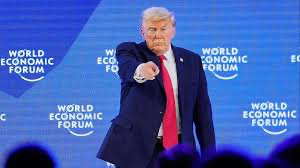
PHOTO- US President Donald Trump attacked Europe’s energy policies and alleged the US “returned” Greenland to Denmark following World War Two.
The president’s effort to acquire Greenland, even with the threat of force off the table, has changed the way allies see the U.S. “The takeaway for Europe is that standing up to him can work.
After two weeks of escalating threats toward Europe, President Donald Trump blinked on Wednesday, backing away from the unthinkable brink of a potential war against a NATO ally during a speech at the World Economic Forum in Davos.
Trump’s vow not to use military force to seize Greenland from Denmark eased European fears about a worst-case scenario and prompted a rebound on Wall Street. And his declaration hours later after meeting with NATO’s leader that he may back off of his tariff threat having secured the “framework” of an agreement over Greenland continued a day of backpedaling on one of the most daring gambits of his presidency to date.
But his continued heckling of allies as “ungrateful” for not simply giving the U.S. “ownership and title” of what he said was just “a piece of ice” did little to reverse a deepening sentiment among NATO leaders and other longtime allies that they can no longer consider the United States — for 80 years the linchpin of the transatlantic alliance — a reliable ally.
“The takeaway for Europe is that standing up to him can work. There is relief, of course, that he’s taking military force off the table, but there is also an awareness that he could reverse himself,” said a European official who attended Trump’s speech and, like others interviewed for this report, was granted anonymity to speak candidly. “Trump’s promises and statements are unreliable but his scorn for Europe is consistent. We will have to continue to show resolve and more independence because we can no longer cling to this illusion that America is still what we thought it was.”
Trump’s abrupt about-face after weeks of refusing to take military intervention off the table comes a day after Greenland shock waves sent global markets plunging, wiping out over $1.2 trillion in value on the S&P 500 alone. The president’s policy shift mirrored a similar moment in April, when he quickly reversed sweeping tariffs after a market downfall tied to his policies.
If Trump’s refusal to use the military to threaten Greenland and the U.S.’s NATO allies holds, it would represent a win for administration officials such as Treasury Secretary Scott Bessent, who on Tuesday counseled the Davos set not to overreact or escalate the fight with Trump, assuring concerned Europeans that things would work out soon.
The threat of force appeared to have the strong backing of deputy chief of staff Stephen Miller, who offered the most forceful articulation of those desires in an interview this month where he claimed that America was the rightful owner of Greenland and insisted the “real world” was one “that is governed by force, that is governed by power.”
But Miller aside, most saw the threat of force as an attempt to create leverage for an eventual negotiation. If Trump were to have pursued using military force, there could have been pushback from his closest allies like Secretary of State Marco Rubio and Vice President JD Vance, said a person close to the administration and granted anonymity to describe the private dynamics.
“Do some senior administration people talk to their best friends in conservative world and media and basically say, ‘Yeah, I don’t know why we’re doing this?’ Sure, but I think those are all in confidence,” the person said.
Increasingly, Europeans have been voicing their growing fears aloud. When Trump arrived in the snowy Swiss Alps Wednesday afternoon for this annual confab of business and political titans, the West remained on edge after the president announced last weekend that he intended to increase tariffs on several European countries that had sent troops to Greenland for military exercises. As they contemplated the fact that an American president was threatening the territorial sovereignty of one ally and turning to economic coercion tactics against others, European leaders strategized openly about retaliating in kind.
That posture marked a major shift from Trump’s first year back in office, when European leaders put up a fight but ultimately and largely accepted his terms — NATO begrudgingly agreeing to spend more on defense, taking on all of the financial burden for Ukraine aid and the European Union accepting a 15 percent tariff on all exports to the U.S. — in order to keep the president from breaking with the alliance and abandoning Ukraine.
But the president’s brazen challenge to Denmark over Greenland and shocking disregard for Europe’s territorial sovereignty amounted to a disruption that is orders of magnitude more concerning. Demanding that Denmark, a steadfast NATO ally, allow him to purchase Greenland — and, until Wednesday, holding out the prospect of using military force to seize it — threatened to cross a red line for Europe and effectively shatter 80 years of cooperation, upending an alliance structure that America largely built to avoid the very kind of imperialistic conquest Trump suddenly seems fixated on pursuing.
POLITICO
