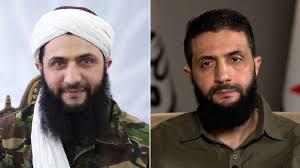
Before nd after : Former Nusra Front leader Mohammed al-Golani (L) who revealed his real name as Ahmed al-Sharaa (R) and named himself Syria’s interim president after deposing former dictator Bashar al Assad . Ever since he became the president he switched to civilian attire . The Nusra Front was deeply intertwined with extremist movements, AlQaeda and ISIS
By: Ya Libnan Editorial Board
Placing thousands of ISIS prisoners under the control of Syria’s new regime led by President Ahmed al-Sharaa is not just reckless — it is potentially catastrophic. This is not a diplomatic issue. It is a basic security question. You do not hand prison keys to people who once stood on the same side of the bars.
Al-Sharaa’s political and military roots are deeply intertwined with extremist movements. His rise did not come through state institutions or a professional army, but through networks linked to al-Qaeda and ISIS. Many of the detainees now being transferred into his custody were once his comrades-in-arms — men who shared ideology, training camps, and battlefields.
And now the world is expected to believe that this leadership will neutralize the very movement it helped build?
That defies logic.
For years, the Kurdish-led Syrian Democratic Forces (SDF), backed by the United States and its allies, carried the burden of guarding these prisoners. They paid a heavy price defeating ISIS and developed specialized detention systems to prevent escapes and uprisings.
Now that responsibility is being handed to a regime with:
- No credible counterterror detention experience
- A history of alliances with extremist factions
- Leadership whose past overlaps with the very prisoners they are supposed to guard
This is not a transition — it is a security gamble.
Warning signs are already emerging. Reports indicate chaos following regime takeovers, with some detention centers in Raqqa allegedly emptied by locals. Every jailbreak is not just an escape — it is a propaganda victory for ISIS and a step toward resurgence.
This is not about individual diplomats. They carry out policy. The responsibility lies with Washington, which endorsed this dangerous handover.
By doing so, the U.S. is:
- Empowering a regime born from jihadist ideology
- Placing hardened terrorists under the watch of their former associates
- Risking mass escapes that could destabilize the entire region
This is like asking the mafia to run a police station.
If even a fraction of these prisoners are quietly released or “lost” through corruption, the consequences will be global — from Iraq and Jordan to Lebanon and Europe and the United States.
ISIS was defeated militarily, but it was not defeated ideologically. Prisons remain its incubators. Handing control of those incubators to former insiders is a recipe for resurrection.
History will judge this decision harshly.
Because once those gates open,
there is no closing them again.
