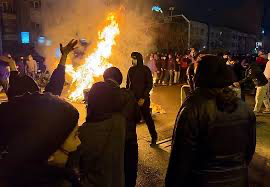
Photo – Iranians attend an anti-government protest in Tehran, 9 January, 2026 AP Photo
From Protests to Potential War: How a Crackdown in Tehran Could Spark a U.S.–Iran Confrontation
Latest Iran–US Tensions and Possible Outcomes
Iran warns of retaliation if Trump strikes, US withdraws some personnel from bases

Iran protests updates: Trump appears to soften rhetoric after Iran threats

Iran closes airspace to all flights as foreign minister denies it plans to execute protesters – live

Reports suggest US may strike Iran in coming days, as Trump says killing is ‘stopping’

Iran makes last minute ‘stop to executions’ as Trump to strike ‘in next 24hrs’
1) Where Things Stand Now
🔴 Heightened Tensions
- U.S. and UK forces have withdrawn or advised evacuation of some personnel at major Middle East bases — including Al-Udeid Air Base in Qatar — amid fears of regional escalation.
- Iran has closed its airspace and warned of decisive response if the U.S. attacks, potentially targeting U.S. and allied military assets.
- European officials and some Western analysts believe U.S. action could occur very soon — possibly within a day or two — though details remain unclear.
🟡 Trump’s Public Messaging
- President Trump publicly claimed that the killing of Iranian protesters has “stopped” based on what he described as “good authority” and indicated no executions were planned — though this claim is not independently verified.
- At the same time, he hasn’t ruled out military action, saying the situation will be watched closely and that strong responses remain possible.
🔵 Iran’s Position
- Iranian leadership has warned it would retaliate decisively against any U.S. strike.
- Iran’s Foreign Minister claims violence was due to “fighting against foreign-backed groups,” framing unrest as internal conflict and dismissing claims of mass executions — complicating external assessments.
2) Possible U.S. Courses of Action
Experts and analysts see a range of options short of full-scale war — and each would carry very different risks and consequences:
🔹 Limited Airstrikes or Missile Strikes
- Could target IRGC facilities, missile sites, or key command infrastructure to degrade Iran’s ability to retaliate or suppress protests.
- This might look similar to how past U.S. operations have used air and naval assets without committing ground forces.
🔹 Cyber Operations
- Attacks on Iranian military or communication networks to disrupt command and control, reducing Tehran’s retaliation capability.
🔹 Covert/Special Operations
- Limited sabotage or targeted missions aimed at specific capabilities — though these carry high risk of exposure and escalation.
🔹 Diplomatic/Economic Measures
- Sanctions, international pressure, and support for protesters short of military strikes remain primary options for de-escalation. Many allies favor these over direct military action.
3) What Would a Strike Mean? Risks & Consequences
⚠️ Regional Escalation
- A U.S. strike would likely trigger retaliation from Tehran, possibly targeting U.S. and allied bases around the Gulf or even shipping through the Strait of Hormuz.
- Conflict could also pull in regional partners, risking a wider Middle East confrontation.
⚠️ Impact on Iranian Protests
Some analysts argue that external military action could:
- Unify Iranian society behind the regime against an external enemy, undermining the protest movement.
- Strengthen the clerical leadership’s domestic narrative of defending national sovereignty.
⚠️ International Law & Politics
- There’s debate over whether military strikes in response to internal repression are justifiable without international mandate or clear national security threats.
- Many U.S. lawmakers and populations around the world express skepticism about unilateral action absent broad support. (Polling suggests many Americans want congressional approval before strikes.)
4) So — Is an Attack Really Imminent?
📉 Not Guaranteed, but Prepared
✔ U.S. forces are adjusting posture and planning options.
✔ Trump has publicly threatened strong responses if repression continues.
📈 But There Is No Official Order Yet
❌ No authorization has been publicly announced.
❌ Trump’s statements have tempered direct attack talk, emphasizing observation and caution.
❌ Diplomatic channels remain open in parallel with military planning.
In other words:
➡️ A military strike could happen, and preparations are visible.
➡️ But as of now, there’s no confirmed imminent attack order — only credible indications that options are being weighed seriously.
5) Scenarios Ahead — What Might Happen Next
Scenario A — No Strike
- Trump announces continued monitoring, backs sanctions, and increases pressure through diplomacy and intelligence cooperation with allies.
Scenario B — Limited Strike
- A precise air or missile strike targets strategic IRGC assets rather than all-out war — meant as a deterrent signal.
Scenario C — Expanded Conflict
- Retaliation from Iran leads to escalating strikes, widening into broader U.S.–Iran confrontation.
Scenario D — Diplomatic Breakthrough
- International mediation leads to reduced tensions and negotiated steps to protect protesters and avert violence.
Summary
✅ U.S. military action is seriously on the table and being prepared.
✅ Trump’s messaging combines deterrence and restraint — a common strategy to avoid premature escalation.
✅ A full-scale attack is not yet confirmed, but limited military options are being actively discussed.
✅ Any strike would have major regional and strategic consequences, possibly uniting Iran internally against external pressure.
