By Tom O’Connor, Senior Writer, Foreign Policy & Deputy Editor, National Security and Foreign Policy, Newsweek
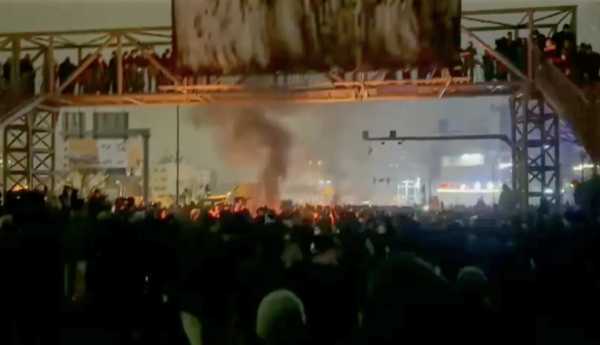
PHOTO Footage circulating on social media from Iran shows protesters taking to the streets despite an intensifying crackdown, in Tehran, Iran, on January 9. | UGC/AP
Iran’s Battered IRGC Faces Moment of Truth Amid Protests
By Tom O’Connor, Senior Writer, Foreign Policy & Deputy Editor, National Security and Foreign Policy
As Iran‘s government moves to quell some of the largest protests the nation has faced in years without triggering U.S. intervention, the spotlight is on the elite and influential Islamic Revolutionary Guard Corps (IRGC).
Having established since the Islamic Revolution as both a powerful war-fighting force as well as a tool of suppressing internal dissent, particularly through its Basij paramilitary arm, the IRGC has traditionally been deployed as one of the most potent forces in both restoring order and combating foreign infiltration.
But the IRGC finds itself still reeling from major blows suffered during a 12-day war with Israel in June, when scores of key commanders and personnel were killed. A number of other members and leading allies were slain in other theaters of the broader conflict surrounding the war in Gaza, particularly in Lebanon, Iraq and Syria, leaving the Axis of Resistance coalition built by the IRGC over the course of decades now in a moment of crisis.
Even with these setbacks, however, the IRGC’s deeply entrenched role positions it as a key player in any outcome of the unrest that has shaken the foundations of Supreme Leader Ayatollah Ali Khamenei‘s rule.
“With an estimated force of around 180,000 personnel, the IRGC retains substantial institutional depth,” Saeid Golkar, associate professor at the University of Tennessee-Chattanooga who has written extensively on the inner workings of the IRGC, particularly the Basij, said. “Losses at the senior level did not disrupt command continuity or operational capacity, and Khamenei was able to replace the deceased commanders with relative ease.”
“The Basij, as a mass organization embedded in society, also remained intact, since its effectiveness depends on local networks and coordination rather than a narrow leadership elite,” Golkar told Newsweek. “Overall, the war imposed symbolic and strategic costs on the IRGC but did not meaningfully weaken its ability to suppress domestic dissent.”
A motorist drives past billboards bearing the portraits of slain IRGC generals, left to right, Hossein Salami, Mohammad Bagheri and Gholamreza Mehrabi…
The Ayatollah’s Top Men
The IRGC’s organization underwent a substantial forced restructuring as a result of Israeli strikes last year. Among the top figures killed included IRGC commander-in-chief Major General Hossein Salami; Iranian Armed Forces Chief of Staff Major General Mohammed Bagheri; IRGC Aerospace Forces commander Brigadier General Amir Ali Hajizadeh; Khatam Al-Anbiya Central Headquarters commander Major General Gholam Ali Rashid; and IRGC Intelligence Organization chief Brigadier General Mohammad Kazemi.
Golkar noted that most of the losses were “oriented toward external deterrence rather than domestic security,” while “the forces central to suppressing dissent, including the IRGC Ground Forces, security units, intelligence organs, and the Basij, were largely unaffected.”
For example, Brigadier General Gholamreza Soleimani remains at the helm of the Basij, while Brigadier General Mohammad Hossein Nejat “retains significant influence” within the Tharallah Headquarters, the IRGC command responsible for security in Tehran, Golkar said. Rear Admiral Alireza Tangsiri also evaded targeting during the 12-day war to maintain his charge of the IRGC Navy.
As for the current most important individuals having been promoted as a result of the death of their seniors, Golkar identified the new top IRGC commanders as Major General Mohammad Pakpour in place of Salami as commander-in-chief, with Brigadier General Mohammad Karami assuming Pakpour’s former role as head of the IRGC Ground Force, as well as Brigadier General Majid Mousavi in place of Hajizadeh in the Aerospace Force and Brigadier General Majid Khademi in place of Kazemi in the Intelligence Organization.
Notably, Bagheri’s position as head of the Iranian Armed Forces was filled by a member of Iran’s conventional military, the Artesh, Major General Abdolrahim Mousavi. Two other key appointments made over the past six months include Brigadier General Hojatollah Ghoreishi being named IRGC coordinating deputy in October and Brigadier General Ahmad Vahidi being appointed as deputy commander of the IRGC last month.
Ali Alfoneh, senior fellow at the Arab Gulf States Institute in Washington who specializes in tracking the structure and trends within the IRGC, identified Vahidi—a former head of the IRGC’s expeditionary Quds Force and minister of defense who also most recently served as interior minister to late President Ebrahim Raisi—as “the most influential figure within the IRGC.” His portfolio “includes internal security, and he is deeply familiar with the inner workings of Iran’s state bureaucracy,” Alfoneh told Newsweek.
Next in terms of clout, he argued, is Aerospace Force chief Majid Mousavi, “who is responsible for rebuilding Iran’s missile arsenal in anticipation of a future confrontation with Israel.”
This hierarchy signals a potential shift in priorities for the IRGC, as he said that the current head of the Quds Force, Major General Esmail Qaani, who took charge after the U.S. killing of Major General Qassem Soleimani in January 2020, “is no longer a central figure, reflecting the broader decline of the IRGC’s regional proxy network.”
Alfoneh also saw the overall state of the IRGC as having suffered since the intervention of the Axis of Resistance into the war in Gaza, sparked in October 2023 by a surprise attack from the Palestinian Hamas movement against Israel.
“The weakening of the IRGC began with the near-destruction of Lebanese Hezbollah in September 2024, continued with its hasty withdrawal from Syria amid the collapse of the Assad regime, and culminated in the 12-day war, during which Israel effectively decapitated the organization’s senior leadership,” Alfoneh said.
“Despite these blows, the IRGC’s decentralized structure allowed it to continue launching missiles at Israel,” he added. “Even so, today’s IRGC is a shadow of its former self.”
The Deal Debate
The IRGC is traditionally viewed as one of the most loyal institutions to the supreme leader and the Twelver Shiite Islam Velayat-e Faqih, or Guardianship of the Islamic Jurisprudence, system over which he presides. Established amid the 1979 revolution led by Khamenei’s predecessor, Ayatollah Ruhollah Khomeini, that established the Islamic Republic, the IRGC consolidated a number of paramilitary groups and soon went on to play a front-line role in the eight-year war with Iraq that erupted just a year later.
In addition to building the sprawling Axis of Resistance network abroad, the IRGC has also in the decades since expanded its stakes within Iran’s political and economic sectors. And with questions already surrounding who may succeed 86-year-old Khamenei, the IRGC’s potential to adopt an even greater role, perhaps even leadership, has been a major source of speculation.
Should the situation in Iran escalate further, Alfoneh argued, the IRGC would be well-positioned to step up and potentially cut a deal to avoid the kind of U.S. intervention that struck three Iranian military sites amid the 12-day war with Israel in June, perhaps looking to instead replicate the kind of arrangement established in Venezuela following the U.S. Delta Force operation that seized President Nicolás Maduro and his wife out of their home in Caracas earlier this month.
“As for a potential break with Supreme Leader Ali Khamenei, the IRGC—as an institution with vast economic interests and an entrenched business empire—prioritizes survival above ideological loyalty,” Alfoneh said. “If necessary, this could include complicity in the leadership council’s potential sidelining of Khamenei and reaching a Venezuela-style accommodation with President Donald J. Trump, or even endorsing Reza Pahlavi, provided the organization’s core interests and privileges are preserved.”
Pahlavi, the U.S.-based son of Iran’s last shah, whose monarchy was deposed by the 1979 revolution, has sought to position himself as a potential substitute for the Islamic Republic. Some footage surfacing from within Iran’s demonstrations appear to show a number of protesters holding his image and chanting his name, though the extent to which he may be capable of mounting a successful power play remains uncertain, even in the event of a government collapse.
“In the past, Iranians appealed for support and were met with hesitation or silence,” Pahlavi recently told Newsweek. “Today, there is growing recognition that this regime is irredeemable and has reached the end of the road.”
Referring to Trump’s vow of intervention in the event of the mass killing of protesters at the hands of security forces, Pahlavi hailed the U.S. leader’s “clear warnings to the criminal leaders of the Islamic Republic,” which have likely “made a difference in how the regime has acted.”
Meanwhile, in a letter sent to United Nations leadership and obtained by Newsweek on Friday, Iranian Permanent Representative to the U.N. Amir Saeid Iravani accused the U.S., along with Israel, of having “encouraged violence, supported terrorist groups, incited societal destabilization, and sought to transform peaceful protests into violent disorder under the guise of ‘support,’ ‘rescue,’ or the ‘protection of the Iranian people.’”
Afshon Ostovar, associate professor at the U.S. Naval Postgraduate School and a leading expert on the IRGC, argued that the IRGC at this stage retained a significant capacity to handle internal security challenges. At the same time, he saw the potential for dissent among the organization’s ranks, a phenomenon that has yet to manifest but could prove deeply consequential to the fate of the Islamic Republic.
“The 12-Day war left the IRGC battered, and much weaker as an external actor. But the IRGC remains a potent force domestically,” Ostovar told Newsweek. “It retains the arms, personnel, and command and control to kill Iranian civilians on the streets. Military defections are always a possibility.”
“The more stress and pressure on the regime, but from within and from the outside, the more likely defections may start to happen,” Ostovar said. “Without defections, the regime is unlikely to lose control of the country.”
(NEWSWEEK)
