HIGHLIGHTS
- The U.S. conducted “a large scale strike” on Venezuela, President Donald Trump said in a post on social media early Saturday morning.
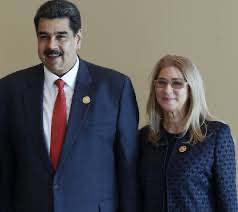
- The U.S. operation captured Venezuela’s President Nicolas Maduro and his wife and removed them from the country.
- The strategy to pressure Maduro comes as the U.S. and Venezuela’s opposition say Maduro rigged an election last year to stay in power. Trump has also accused Maduro of running a “narco-state.”
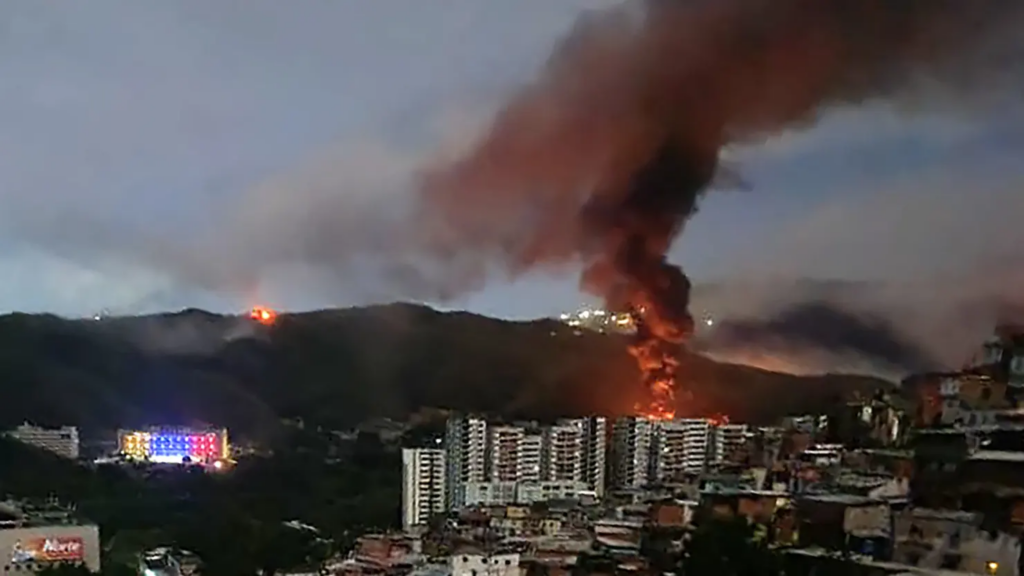
Fire at Fuerte Tiuna, Venezuela’s largest military complex, is seen from a distance after a series of explosions in Caracas on Jan. 3, 2026 Str | Afp | Getty Images
U.S. President Donald Trump said Saturday the United States conducted a large-scale strike in Venezuela that resulted in the capture and removal of Venezuelan President Nicolas Maduro.
Maduro and his wife, Cilia Flores, were captured and removed from the country following the operation, which was conducted in coordination with U.S. law enforcement authorities, Trump said in an early morning post on Truth Social.
“The United States of America has successfully carried out a large scale strike against Venezuela and its leader, President Nicolas Maduro, who has been, along with his wife, captured and flown out of the Country. This operation was done in conjunction with U.S. Law Enforcement,” Trump said.
No further details were provided.
CBS News reported that the U.S. Army’s elite Delta Force unit was involved in the capture of Maduro.
The Pentagon declined to answer CNBC’s queries and referred questions to the White House. The White House, which reposted Trump’s Truth Social statement on its X account, didn’t immediately respond to a CNBC request for comment.
U.S. Attorney General Pam Bondi said in a post on X that Maduro and his wife have been indicted in the Southern District of New York. “They will soon face the full wrath of American justice on American soil in American courts,” she said.
Republican Senator Mike Lee of Utah, who had earlier questioned whether the U.S. attack was constitutional, said in a X post on Saturday that Secretary of State Marco Rubio told him the U.S. operation “was deployed to protect and defend those executing the arrest warrant.”
“This action likely falls within the president’s inherent authority under Article II of the Constitution to protect U.S. personnel from an actual or imminent attack,” Lee added.
Rubio, meanwhile, responded to the operation on social media by reposting a statement he made in July 2025, stating: “Maduro is NOT the President of Venezuela and his regime is NOT the legitimate government. Maduro is the head of the Cartel de Los Soles, a narco-terror organization which has taken possession of a country. And he is under indictment for pushing drugs into the United States.”
U.S. Deputy Secretary of State Christopher Landau said in a post on X that Maduro would “finally face justice for his crimes.”
There was no immediate confirmation from the Venezuelan government.
Delcy Rodríguez, Venezuela’s vice president, demanded that the U.S. provide proof that Maduro and his wife are alive, in an interview on state television station Venezolana de Televisión.
Maduro’s official Facebook page posted a video stating that attacks occurred in the states of Miranda, Aragua and La Guaira, according to a Google translation of the Spanish-language statement.
The statement in the video added that the U.S. would fail in its goal of possessing Venezuela’s oil and minerals, and that Maduro had declared a national emergency and mobilized defense forces.
The official spokesperson for Nobel Peace Prize winner Maria Corina Machado, who leads the Venezuelan opposition, said in a post on X that it had no comment on the operation.
Trump told The New York Times that the operation was a result of “a lot of good planning.”
“It was a brilliant operation, actually,” Trump told the Times.
Explosions were reported in the Venezuelan capital, Caracas, at about 2 a.m. local time (0600 GMT), according to images circulating on social media that could not be independently verified.
Venezuelan state-run energy company PDVSA’s oil production and refining were normal, and its key facilities had suffered no damage, according to an initial assessment, two sources with knowledge of the company’s operations told Reuters.
The port of La Guaira near Caracas, one of the country’s largest but is not used for oil operations, was reported to have suffered severe damage, Reuters reported.
Trump has repeatedly threatened action against Maduro. On Dec. 23, 2025, he said it would be “smart” for Maduro to leave power.
Trump last month announced a blockade of sanctioned oil tankers moving in and out of Venezuelan waters, saying the country was “completely surrounded by the largest Armada ever assembled in the History of South America.”
The strategy to pressure Maduro comes as the U.S. and Venezuela’s opposition say Maduro rigged an election last year to stay in power. Trump has also accused Maduro of running a “narco-state.”
Colombian President Gustavo Petro said in a post on X that Caracas was under attack and urged an emergency meeting of the Organization of American States and the United Nations.
Maduro, who succeeded Hugo Chavez in 2013, has said Washington is seeking control of its oil reserves, the largest in the world.
CNBC
