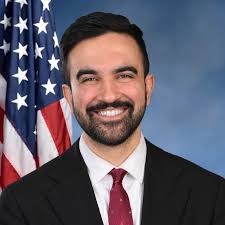
New York City Mayor Zohran Mamdani reversed all the executive orders signed by former Mayor Eric Adams after his indictment on corruption charges, including two pertaining to Israel.
As one of his opening acts in office, New York City Mayor Zohran Mamdani swiftly reversed every executive order his predecessor, Eric Adams, signed after his indictment on federal corruption charges, including two that pertained to Israel.
On his first day in office Jan. 1, Mamdani revoked an order signed by former Mayor Adams that barred city agencies from boycotting or divesting from Israel. Mamdani also revoked an Adams order that adopted the International Holocaust Remembrance Alliance’s definition of antisemitism.
The sweeping executive action rescinded all orders Adams signed after he was indicted on federal corruption charges in September 2024.
Mamdani, however, kept the newly-created office to combat antisemitism, which Adams launched in May.
One of the executive orders issued by Adams had adopted a definition of antisemitism that included opposition to the existence of the state of Israel.
Another had prohibited agency heads from boycotting or divesting from Israeli bonds and other assets and discriminating against the nation, its citizens or affiliated individuals and companies. That order countered the Palestinian-led Boycott, Divestment and Sanctions movement, and was signed during Adams’ final weeks in office.
The Boycott, Divestment and Sanctions movement, or BDS, aims to put economic pressure on Israel over what it claims are violations of international law and human rights abuses against Palestinians. Since 2005, the BDS movement has urged banks, municipalities, pension funds, religious groups and universities to remove their investments from Israel, according to the BDS website.
Mamdani, a democratic socialist who won the Democratic nomination for mayor and this week became the first Muslim mayor of the nation’s most populous city, is a staunch advocate for Palestinian rights. He had previously voiced support for the BDS movement and pledged to review all of Adams’ executive orders.
Mamdani’s action drew fire from some conservatives and Israeli officials who have been concerned about the mayor’s criticism of Israel.
New York City Councilmember Inna Vernikov said in social media posts that the antisemitism definition revoked by Mamdani is recognized by 40 nations, including the European Union, Canada, Australia, United Kingdom and Germany. “Good enough for Germany, but not good enough for Mamdani,” said Vernikov, a Republican.
Vernikov also assailed Mamdani’s revocation of an Adams order that regulated protests at houses of worship. “Pro-Hamas antisemites emboldened by (Mamdani) are coming,” Vernikov said in a post.
Israel’s foreign ministry rebuked Mamdani and the National Jewish Advocacy Center also criticized his actions.
In a social media post, the foreign ministry said revoking the IHRA’s definition of antisemitism and lifting the restrictions on boycotting Israel are “antisemitic gasoline on an open fire.”
The Anti-Defamation League has also taken aim at Mamdani in recent weeks over his appointees’ social media posts. One former aide who was accused of making antisemitic statements resigned.
At a news conference last month, in response to one of the ADL reports, Mamdani said “we must distinguish between antisemitism and criticism of the Israeli government” and ignoring that distinction “draws attention away from the very real crisis of antisemitism we see not only just in our city but in the country at large.”
The mayor’s office has not commented publicly on the criticism over the executive order reversals. A senior adviser to Mamdani who was not authorized to speak publicly on the matter dismissed the criticism by the Israeli government as nonconsequential and told USA TODAY that the mayor has affirmed that combating antisemitism is critical.
Civil liberties advocates backed Mamdani’s decision to revoke Adams’ Israel-related orders.
New York Civil Liberties Union Executive Director Donna Lieberman said Adams’ orders “adopted a flawed and far too broad definition of antisemitism” and blocked city agencies from boycotting Israel.
“Both orders seem to have been designed to suppress speech Mayor Adams disagrees with but that is protected by the First Amendment,” Lieberman said.
In a statement, Jewish Democratic Council of America Executive Director Halie Soifer told USA TODAY that Mamdani’s decision to retain NYPD Commissioner Jessica Tisch and continue the office to combat antisemitism were welcome steps.
“Mayor Mamdani has made repeated promises, including to us directly, to defend Jewish New Yorkers against the rising tide of antisemitism, and he must meet that commitment,” she said. “His broad revocation of all previous executive orders, which include at least two related to Israel and antisemitism, must be followed by meaningful actions to protect Jewish New Yorkers against the dangerous scourge of antisemitism in the days, months, and years ahead.”
During his campaign, Mamdani held positions critical of Israel and its treatment of Palestinians amid the war in Gaza. He has accused Israel of committing genocide in Gaza and said he would honor the International Criminal Court’s arrest warrant issued for Israeli Prime Minister Netanyahu over alleged war crimes in Gaza.
Trump suggested during a July meeting with Netanyahu at the White House that he could restrict funds for New York if Mamdani followed through. “He’ll behave. He better behave, otherwise he’s going to have big problems,” Trump said.
US TODAY
