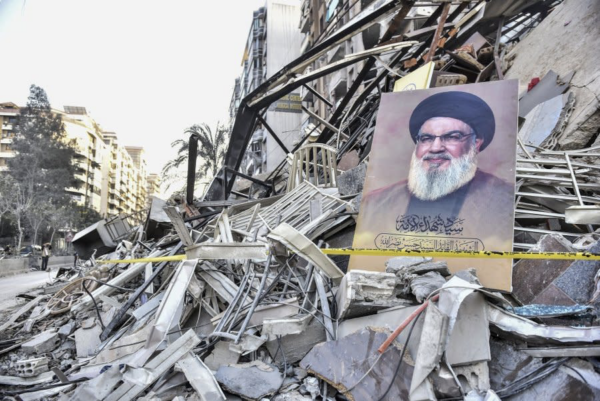
A portrait of slain Hezbollah chief Hassan Nasrallah appears in front of the rubble of a building at the site of an Israeli airstrike in Beirut’s southern suburbs. November 14, 2024. Nasrallah often used the metaphor of a “spider’s web” to describe Israel as weak, fragile, and facing internal collapse, believing its societal issues and internal crises (like protests or political divisions) make it vulnerable. In both the 2006 and 2024/25 wars Hezbollah declared victory despite the disproportionate losse it incurred
By: Naji Al Boustani
Despite the deadly and devastating blows that Hezbollah has suffered, and despite Israel’s continued unilateral, intermittent war against the group, without any retaliation from the latter, the group’s leadership insists on talking about winning the recent battle against the Israelis and claiming a “victory,” in a way that does not align with many of the facts on the ground. So, what “victory” are they talking about?
First , It must be noted that military doctrine regarding defenses during wartime indicates a main front defensive line, and a secondary rear defensive line in some cases, and even a third defensive line in very rare cases. However, Hezbollah does not rely on this approach, because its defensive strategy is based on a completely different concept, primarily relying on hundreds of independent and self-sufficient defensive cells. It is true that it divided the border fronts into areas managed by different combat units, such as the “Nasr,” “Badr,” “Aziz,” and “Haydar” units (each responsible for a specific geographical area), and it is true that these regiments were supported by specialized elite combat units, such as the “Radwan Force” and the “Abbas Regiments,” as well as the “Missile Unit,” the “Artillery Unit,” and the “Drone Unit.” However, the more accurate description is that the focus is on each village and town in Lebanon having its own independent leadership and integrated combat equipment, which gives them the ability to fight even when communication and supply lines are cut off.
Thus, Hezbollah built its defensive strategy on the presence of a regional commander and fully equipped military units under his command in each of the border regions, extending into the Lebanese interior. Notably, these fighters were recruited from within the relevant villages and towns, rather than from outside, to avoid conspicuous movements between areas during wartime. Each unit possessed appropriate weaponry, particularly anti-tank missiles, mines, mortars, and short-range and, in some cases, medium-range rocket launchers, in addition to machine guns. Each village or town was self-sufficient in terms of ammunition stockpiles, eliminating the need to transport weapons and ammunition during battles. This self-sufficiency, without external logistical support, was not limited to a few days or weeks, but extended for many months. What applies to weapons and ammunition also applies to food, water, medicine, and other essential supplies for wartime.
This defensive strategy made the Israeli army’s advance during the 2024 war extremely difficult and exceptionally costly, especially since the word “retreat” is not in the lexicon of Hezbollah fighters. Consequently, every village and town the Israeli army attempted to advance into fought to the last man, until the last fighter within its boundaries fell! As a result, the Israelis realized that capturing any village or town would require days of intense fighting and could not be achieved without incurring significant losses in personnel and equipment. In other words, while the Israeli army was capable of expanding its occupation in southern Lebanon due to its superior military capabilities, this could not be accomplished without suffering heavy casualties, which the Israeli public opinion might find difficult to tolerate, particularly when attacking any village or town. This reality prompted the Israeli side to seek alternative methods to achieve its objectives, especially regarding disarming Hezbollah and pushing its fighters away from the border, methods that would avoid direct and extensive ground advances.
This is precisely what led Hezbollah to speak of a “victory” achieved during the recent war, given its strong resistance to Israeli attempts at territorial expansion and its ability to repel attacks for extended periods, despite Israel’s overwhelming air superiority. Even the capture of any territory came at a high cost for the Israelis, as the Israeli army struggled to maintain control of the positions it advanced into in any village or town without coming under direct fire from Hezbollah fighters in neighboring villages and towns, due to the outlined defensive structure . This overshadowed Hezbollah’s success in targeting Israeli territory with a total of 15,400 rockets during the 2024 war.
However, this reality has changed due to the field measures implemented in the south in accordance with the ceasefire agreement signed on November 27, 2024, which ultimately benefited Israel. Therefore, the question now is: Has Hezbollah permanently lost its deterrent power? This is what we will address in the fourth article of this comprehensive series.
Translated from Arabic
Source: El Nashra
