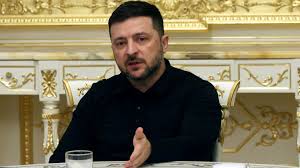
Ukraine’s President Volodymyr Zelensky has indicated he is willing to pull Ukrainian troops back from parts of the eastern Donetsk region still under Kyiv’s control and establish a demilitarized zone under potential peace terms.
Seemingly irreconcilable positions on territory have repeatedly stalled peace talks pushed by the U.S. since President Donald Trump was reelected for his second term in office. Zelensky’s comments offer some hint that weeks of labored discussions have yielded steps toward a deal to end Europe’s largest land war in decades, although obstacles do still remain to the inking of a final agreement.
What To Know
Zelensky told reporters on Tuesday that one option could see a “free economic zone” in demilitarized areas of eastern Ukraine, according to local media. Russia would also have to pull out its forces from parts of the east, but Moscow has not indicated it is willing to do so.
Kyiv’s leadership would put this to a public vote, according to the domestic reports. A second option outlined by the Ukrainian president could effectively freeze the conflict along the four mainland regions Russia has claimed to have annexed, which would be monitored by international forces.
Russia has claimed to have annexed the two eastern Ukrainian regions of Donetsk and Luhansk—collectively known as the Donbas—as well as the southern Kherson and Zaporizhzhia regions of the country. Moscow seized the Crimean Peninsula to the south of the mainland in 2014.
Russia has been unwilling to give up its claims to these five regions, whereas Kyiv has consistently vowed to reclaim the territories and says giving up land would be against its constitution.
Russia currently controls the majority of Donetsk, but Ukraine still holds chunks of the bitterly contested region. The Kremlin said it would seize the rest by force if necessary, though analysts say this could still take years to achieve.
Several other issues, including the size of Ukraine’s military and who controls nuclear facilities, have also consistently hampered negotiations. Zelensky said Ukrainian negotiators had “not reached consensus” with the U.S. on Donetsk or on who would be responsible for the Zaporizhzhia Nuclear Power Plant, Europe’s largest nuclear site that has been in Russia’s grip since the early days of the full-scale war in 2022.
“But we have significantly aligned most positions,” Zelensky said.
He presented the media with a revised 20-point peace plan on Tuesday. Ukrainian negotiators are expecting a response from Russian officials later on Wednesday, he said.
A Ukrainian delegation has been in Florida in recent days. Trump’s envoy, Steve Witkoff, described the talks on Sunday as “productive and constructive.”
“We sense that America wants to reach a final agreement, and from our side, there is full cooperation,” Zelensky said in his daily evening address on Tuesday.
Territorial disputes are “the most difficult point” of the agreement, Zelensky told reporters, according to The Associated Press. The Ukrainian president said earlier this month that the U.S. had proposed instating “free economic zones” in a bid to break the deadlock over territory.
Among the 20 points of the current draft document, as published by Ukrainian media, are a commitment to sovereignty, the country’s accession to the European Union and pledges of “Article 5-like” security guarantees from the U.S., NATO and European signatories.
Ukraine had argued that its admission to NATO would be on the only way to effectively ensure Russia did not restart its invasion effort. Moscow deemed Kyiv’s membership to the alliance as off the table. Under NATO’s Article 5, an attack on one member state is deemed an assault on all.
The document also looks at plans for rebuilding a post-war Ukraine and for holding elections.
The 28-point proposal originally formulated by the U.S. last month sparked instant alarm in Kyiv and among Ukraine’s allies, as it was viewed as rewarding Russia and damaging Ukraine. The U.S. was forced to deny Moscow had come up with the proposed terms.
“We are working actively and doing everything necessary to ensure that the documents come to fruition and that they are realistic,” Ukrainian President Volodymyr Zelensky said in his evening address on Tuesday.
Newsweek
