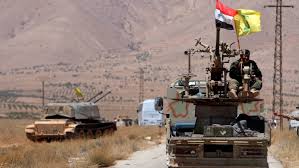
Hezbollah and Syrian flags flutter on a military vehicle in Western Qalamoun, Syria August 28, 2017.
By SARIT ZEHAVI
This month, we mark one year since the fall of the Assad regime and the rise of the new government in Syria. This anniversary comes shortly after the one-year anniversary of the ceasefire between Israel and Hezbollah in Lebanon. Has Israel – and the region – become safer since then?
At first glance, the answer appears to be affirmative. Israel’s military achievements have been phenomenal, and its subsequent policies have prevented terrorist organizations from flourishing beyond the border.
In Lebanon, the victory over Hezbollah was clear and decisive: the elimination of its entire leadership, including the new chief of staff about a month ago; an 80% reduction in rockets and aerial arsenal; the elimination or neutralization of command levels and field commanders thanks to the “pagers attack”; and the destruction of Hezbollah’s ability to carry out an invasion into Israel. All of this has been reinforced by ongoing daily Israeli strikes targeting Hezbollah’s rehabilitation efforts.
Despite Syria’s new leadership, Hezbollah, Sharaa has not abandoned radical Islamist ideology
In Syria, the new leadership is also fighting Hezbollah’s attempts to smuggle weapons into Lebanon, as well as battling ISIS. It appears that Syrian President Ahmed al-Sharaa is working to establish his position in the West as a leader seeking to bring prosperity and a new era to Syria.
But the reality in the Middle East is more complex.
Unfortunately, neither Hezbollah, despite its defeat, nor Sharaa, despite his victory, has abandoned its radical Islamist ideology.
Hezbollah adheres to the radical Shi’ite ideology driven by Iran’s Islamic Revolution, while Sharaa does not deny his loyalty to al-Qaeda’s ideology. He commanded its Syrian branch, Hayat Tahrir al-Sham (HTS), before taking control of the entire state.
In an interview during the Doha Forum on December 6, Sharaa clarified that he is not, and never was, a terrorist.
He implicitly accused the United States and Israel of terrorism when he said, “We saw the wars in Iraq and Afghanistan, where the ones killed were innocent, and those who killed them labeled others as terrorists. So now, after 25 years, there is a better understanding of who is a terrorist.”
The events surrounding Syria’s leadership transition this year exposed the depth of the problem. Syria is becoming an Islamist, anti-Israel state whose military reference scenario is war against Israel.
The chant “Khaybar Khaybar, O Jews” appears both in popular demonstrations and among military personnel – proof that extremist discourse has become embedded in the official narrative. Khaybar was a Jewish tribe defeated by the Prophet Muhammad during the early Islamic conquests of the Arabian Peninsula.
In celebrations in Damascus, flags of Syria and HTS (al-Qaeda’s Syrian branch) were waved alongside Hamas flags – evidence that Syria’s new regime, with unmistakable jihadist roots, is using hostility toward Israel as a central engine for building national identity and consolidating political power.
October 7 taught us not to underestimate threats of this nature. This is a declaration of intent by a young regime enjoying broad Western support and already receiving Turkish weaponry and American backing.
In Lebanon, it has becom clear to all stakeholders in recent weeks that the Lebanese Armed Forces are not delivering – they do not enter private areas where Hezbollah stores its weapons and do not act seriously to disarm it. Despite its declarations of a disarmament plan, the Lebanese government is not truly willing to confront a group that insists it will not abandon its “resistance” path or its weapons.
In conclusion, despite Israel’s remarkable military victory a year ago, which indirectly contributed to the collapse of the Assad regime in Syria, there is deep concern about how events may unfold.
Will Hezbollah rebuild its military capabilities despite the IDF’s efforts to prevent it? And how can we prevent Syria from transforming into a jihadist state when, both in the streets and within the Syrian military, the jihadist narrative and hatred of Israel have already taken deep root, encouraged by the new regime?
This is a wake-up call for the international community. Terrorism must not be allowed to flourish; there is no reason to lift sanctions on HTS nor to extend leniency to the Lebanese government or to Sharaa in Syria.
The author a major in the IDF reserve , served for 15 years in the Israeli military specializing in intelligence and holds an MA in Middle East Studies from Ben-Gurion University. She is the founder and CEO of ALMA, an organization specializing in research and analysis of Israel’s security challenges on the northern border.
Jersalem Post
