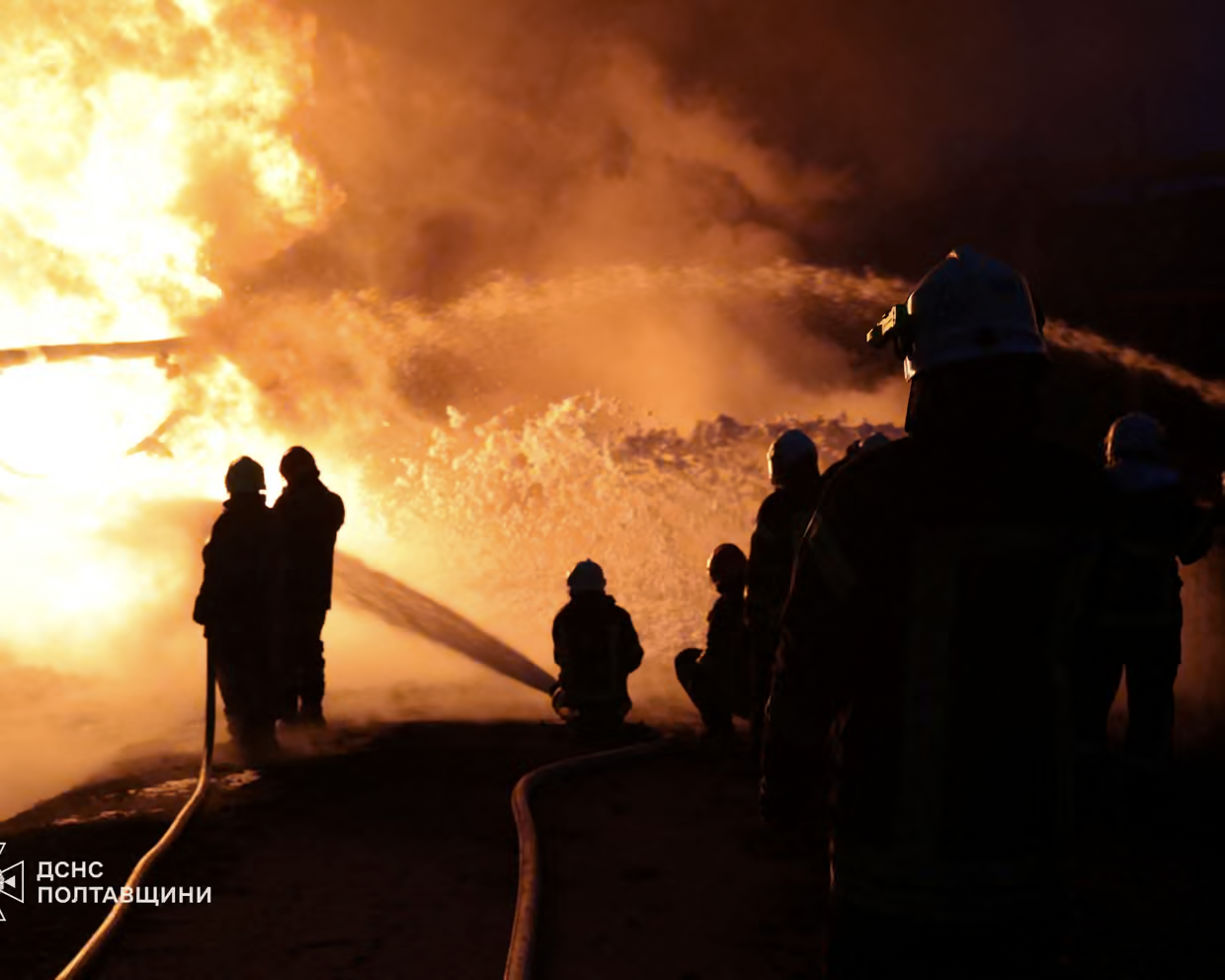
Firefighters work at the site of a Russian drone and missile strike in the Poltava region of Ukraine. Photograph: State Emergency Service Of Ukraine/Reuters.
President says European leaders are weak and Russia holds the cards in any peace talks
By Laurence Norman , Anastasiia Malenko and Alexander Ward
President Trump dialed up pressure on Ukraine to swiftly accept a U.S.-designed peace plan, hardening his position toward the embattled country and its European backers, who insist U.S. security guarantees are vital to a peace deal.
Exacerbating tensions between Europe and Washington, Trump lambasted European leaders as weak and said Russia holds the cards in any peace negotiation with Ukraine.
Ukrainian President Volodymyr Zelensky “is going to have to get on the ball and start accepting things,” Trump said late Monday in an interview with Politico, adding that Ukraine “is losing.”
In a sign of Zelensky’s willingness to accommodate Trump’s demands, up to a point, the Ukrainian president said Tuesday that he was willing to hold long-delayed elections. Ukraine would need help to do so under continuous Russian attacks and to ensure military participation in the vote, he added.
Zelensky said Ukraine’s parliament would have to approve legislation which could enable elections during martial law. His five-year term was set to end in 2024, but martial law, declared after Russia launched its full-scale invasion in 2022, prohibits elections from taking place.
Trump reiterated previous calls for elections in his Politico interview. “It is an important time to hold an election,” Trump said, acknowledging, “maybe Zelensky would win.”
Zelensky said the talks with European governments and the U.S. are focused on a 20-point framework agreement outlining the draft peace plan, as well as a separate document on security guarantees for Kyiv. A third document describes plans for Ukraine’s reconstruction.
Changes to the 20-point plan worked out in recent days by European and Ukrainian officials will likely be shared with the U.S. tomorrow, he said. Zelensky said he expected meetings with members of Trump’s national security team to take place this week.
The 20-point document includes a provision that Zelensky described as similar to the North Atlantic Treaty Organization’s Article 5, but he said the details would be discussed in the coming days. Article 5 refers to a provision of NATO’s founding treaty that requires alliance countries to come to the aid of other threatened NATO members. Ukraine isn’t a NATO member.
“Security guarantees are an important document between us and the United States of America, between us and the Europeans,” Zelensky said.
The Trump administration’s initial peace proposal, leaked in mid-November, alarmed Ukraine and its closest European allies for offering up concessions that were seen to heavily favor Russia.
A U.S. official said three major sticking points include which territory Ukraine should surrender to Russia as part of the peace plan; whether Ukraine can ever join NATO; and how Russian assets currently frozen by Western Europe can be used to pay for Ukraine’s reconstruction.
The official said an early provision barring Kyiv from acceding to NATO has been removed from the current plan, though the new version doesn’t address the issue at all.
The security guarantees under discussion are meant to answer the key concern of Ukraine and Europe: how to ensure that Russia doesn’t resume the war in future and seek to conquer new parts of Ukraine.
Zelensky on Monday said he wasn’t willing to concede Ukrainian land to Russia despite U.S. pressure to do so. He echoed what European officials have said for days: Without clear security guarantees including a U.S. commitment to backstop European forces, it is risky for Ukraine to make significant concessions and for Europe to follow through on the security guarantees they have worked on.
Many European officials have said privately that differences among Russia, the U.S. and Ukraine on the core issues could require weeks or months to resolve unless there is a major change on the battlefield.
The current talks have already passed a Thanksgiving deadline set by Trump. While the U.S. is pressing Ukraine to move, Trump has said it faces no specific deadline.
“We know the Americans want quick results,” said a senior European official. “On the other hand it is difficult to imagine, with [the] complexity of the issues on the table, how we can have quick results.”
Senior Trump administration officials insist they aren’t pushing Ukraine into a deal it dislikes. The goal, they say, is an agreement acceptable to both parties that ensures Ukraine’s sovereignty and defends it for the long term.
Officials point to days of direct negotiations between Zelensky’s national security adviser, Rustem Umerov, and top Trump aides Steve Witkoff and Jared Kushner as evidence that Washington’s intent isn’t to sell out Kyiv.
The White House didn’t immediately respond to a request for comment on the discussions.
The talks come against the backdrop of plummeting trust between Europe’s top leaders and Washington. A new U.S. national-security strategy said European leaders “hold unrealistic expectations” of how the Ukraine war could end. It accused the EU and European national governments of suppressing free speech and permitting large-scale immigration.
European leaders have said this month that Ukraine must be wary of the U.S. approach to ending the war, saying they should play a role in shaping the outcome of the conflict.
(WSJ)
