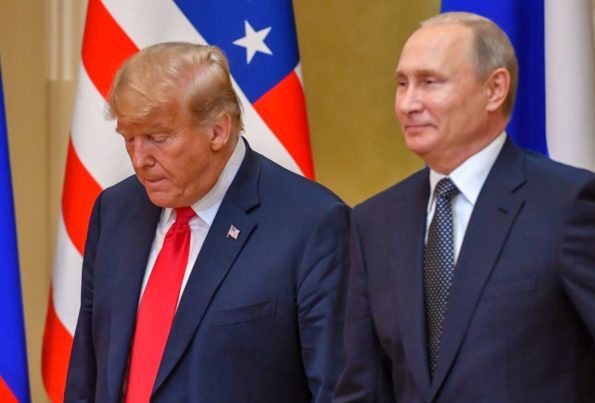
File photo of President Donald Trump and his Russian counterpart Vladimir Putin (2018) . “ Former president Joe Biden said on August 22, 2020 during his presidential campaign “Never before has an American president played such a subservient role to a Russian leader.
BY VLAD GREEN , OP-ED
It is becoming painfully clear that President Donald Trump has not learned any lessons from his long track record of misjudging Russia’s Vladimir Putin. The more Putin ignores him, the more Trump appears determined to appease him — a troubling pattern now reflected in America’s new national security doctrine.
This shift is sending shockwaves across Europe.
French Junior Army Minister Alice Rufo delivered one of the bluntest warnings yet during a session of the National Assembly. Responding to the newly released U.S. National Security Strategy, she warned lawmakers:
“The new American security strategy is an extremely brutal clarification of the United States’ ideological posture. We live in a world of carnivores, Europe is no island, and Europe will be respected only if it knows how to make itself respected.”
Rufo, who previously served as President Emmanuel Macron’s deputy national security adviser, made it clear that Washington’s dramatic shift is forcing Europe to rethink its own defense posture. Her comments represent the strongest public criticism so far from French officials since the U.S. unveiled its new doctrine.
Europe is now openly questioning whether it can continue relying on the United States. Rufo’s message was unmistakable: the continent must accelerate its rearmament because America’s new approach signals a retreat that could leave Europe dangerously exposed.
Meanwhile, reactions in Moscow were the exact opposite.
The Kremlin praised Trump’s strategy, saying it aligns closely with Russia’s worldview — a worldview built around weakening NATO, dividing Europe, and replacing cooperative security with raw power politics.
This contrast raises an urgent question:
Why are America’s closest allies alarmed while the Kremlin is celebrating?
Trump seems unwilling or unable to grasp a basic geopolitical reality: Putin respects only strength. He interprets every signal of hesitation, every word of admiration, and every attempt at appeasement as an opportunity to advance Russia’s interests at the West’s expense.
Europe understands this. As Rufo warned, the world is full of “carnivores,” and survival requires strength — not illusions.
If the United States steps back, Europe will be forced to step forward. But the cost of a weakened transatlantic alliance will be enormous and long-lasting for the Western world.
A Needed Reassessment
Several European officials and security analysts now warn that unless Washington recalibrates aspects of its new strategy, the rift within the Western alliance may deepen further. They argue that a course correction — sooner rather than later — could prevent future crises and preserve the unity that has underpinned global stability for decades. The United States may need to rethink and amend this strategy before it is too late, not to appease allies, but to avoid creating conditions that could embolden America’s adversaries.
Trump’s national security doctrine may win applause in Moscow, but it is deeply unsettling America’s partners. That alone should serve as a stark warning.
