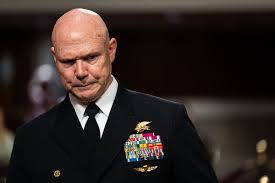
Navy Adm. Frank Bradley appeared on Capitol Hill on Thursday to brief bipartisan lawmakers in both chambers on the details of a September attack on a suspected drug boat in the Caribbean.
The meetings, held behind closed doors with the leaders of the Intelligence and Armed Services committees, shed new light on an episode that’s become a flash point in the fierce debate over President Trump’s aggressive approach to fighting alleged drug traffickers from Latin America.
Bradley was in charge of the opening volley of Trump’s drug war, on Sept. 2, which targeted alleged drug runners near the coast of Venezuela. The operation gained outsized attention last week after The Washington Post reported that the initial strike on the boat was followed by several others targeting a pair of survivors who were clinging to the vessel. Both suspects were killed.
The revelations sparked a firestorm of controversy in the Capitol, where Democrats — and even some Republicans — voiced concerns that the follow-up strikes constituted war crimes. Indeed, the Pentagon’s own manual detailing the laws of war specifies that “orders to fire upon the shipwrecked would be clearly illegal.”
The story raised numerous questions about where the orders originated, and the precise roles played by Bradley, Defense Secretary Pete Hegseth and the Pentagon’s legal team in the lead-up to the attack — questions lawmakers were hoping to get answered during Thursday’s briefings.
Bradley denies Hegseth gave ‘kill everybody’ order
Bradley, the commander of Joint Special Operations Command, denied that Hegseth issued an order to “kill everybody” aboard the alleged drug-smuggling vessel, multiple lawmakers said.
“Adm. Bradley was very clear that he was given no such order, not to give no quarter or to kill them all. He was given an order that, of course, was written down in great detail, as our military always does,” Sen. Tom Cotton (R-Ark.), the chair of the Senate Intelligence Committee, told reporters after the Thursday closed-door, classified briefing.
The Washington Post reported last week that Hegseth gave a spoken directive ahead of the Sept. 2 attack to “kill everybody.” The White House has said the strike killed 11 “narco-terrorists.”
Both the White House and Hegseth denied that he issued such an order.
Rep. Jim Himes (Conn.), the top Democrat on the House Permanent Select Committee on Intelligence, said Bradley shared a similar account during the Thursday morning briefing.
“The admiral confirmed that there had not been a ‘kill them all’ order, and that there was not an order to grant ‘no quarter,’” Himes said.
Cotton comes out in defense of operation
Cotton, a defense hawk, came out in defense of the U.S. military’s Sept. 2 operation in the Caribbean, praising the military leaders; declaring the mission was “lawful”; and proclaiming the lethal strikes since then, which have killed at least 83 people, are “justified and righteous.”
“The first strike, the second strike and the third and the fourth strike on Sept. 2 were entirely lawful and needful and they were exactly what we would expect our military commanders to do,” Cotton told reporters after the classified session.
The Arkansas senator also pushed back on Himes’s characterization of the operation as one of the “most troubling” things he has seen, telling journalists he did not see “anything disturbing about it.”
“What’s disturbing to me is that millions of Americans have died from drugs being run to America by these cartels. What’s gratifying to me is that the president has made the decision finally, after decades of letting it happen, that we’re going to take the battle to them,” the GOP lawmaker said.
When asked if the military judge advocate general (JAG) said the second and remaining strikes on Sept. 2 were lawful, Cotton confirmed they had and added that the operation was witnessed by “hundreds” of uniformed and civilian personnel, including “dozens” of lawyers, at the Pentagon, Fort Bragg and other outposts.
“Everybody was watching. Everybody had seen the intelligence and the legal basis leading up to these strikes,” Cotton said. “Everyone was present during it, and that continues to be the case.”
Sen. Chris Coons (D-Del.), who sits on the Senate Foreign Relations Committee, said he felt reassured about the process, the intelligence and the role of the JAGs during the briefing, but he emphasized that what the administration is asking U.S. troops to carry out in the Caribbean still “lacks clear justification.”
“That’s not specific to this operation or this strike,” the Delaware senator told reporters. “That’s the entire undertaking, exactly how narcotics being trafficked in the Eastern Caribbean on the open ocean connect to harming the United States at a level that justifies lethal strikes repeatedly, I have not yet been persuaded of.”
Democrats disturbed by video of second strike
While Cotton defended the operation in light of the new information, Democrats had a decidedly different response after viewing the video of the subsequent strikes.
Himes emerged from the briefing to say the evidence showed clearly that U.S. forces had targeted survivors who posed no threat to American security. He characterized the footage as “one of the most troubling things I’ve seen in my time in public service.”
“I reviewed the video, and it’s deeply, deeply troubling,” Himes said. “The fact is that we killed two people who were in deep distress and had neither the means nor obviously the intent to continue their mission.”
Himes declined to provide further details, citing the confidential nature of the meeting. But his misgivings highlight one of the chief concerns voiced by lawmakers in response to the Post story: Namely, that if U.S. forces are targeting noncombatants, how can America expect better treatment from adversaries if U.S. troops find themselves in similar circumstances?
“We always have to remember, what goes around comes around,” warned Rep. Raja Krishnamoorthi (D-Ill.), another member of the Intelligence Committee.
Survivors tried to flip boat, Cotton says
Following the first strike that killed nine alleged drug traffickers, the two survivors tried to flip the boat and continue with their mission, according to Cotton.
“I saw two survivors trying to flip a boat — loaded with drugs — bound for the United States back over so they could stay in the fight and potentially, give them all the context we’ve heard of other narco-terrorist boats in the area coming to their aid to recover their cargo and recover those narco-terrorists,” the Arkansas Republican told reporters.
Coons said that Cotton’s characterization of the boat being flipped over and the survivors attempting to flip it right side up was “fair.”
Rep. Adam Smith (D-Wash.), the ranking member on the House Armed Services Committee, said the video he was shown during the classified briefing showed the two survivors shirtless and sitting on a part of the capsized vessel that was still above water.
“It looks like two classically shipwrecked people,” Smith said in an interviewwith The New Republic. During the closed-door session, lawmakers were told that it was “judged that these two people were capable of returning to the fight.”
Smith said it is “a highly questionable decision that these two people on that obviously incapacitated vessel were still in any kind of fight.”
Coons said the second strike killed the two survivors, while the third and fourth strikes ultimately sank the vessel.
Cotton also said that the strikes were launched “several minutes” apart.
“You had obscurants, both the smoke from the first strike and then cloud cover as well. I couldn’t tell you exactly how long,” Cotton said, adding, “I think minutes.”
Questions over Hegseth’s whereabouts
Plenty of questions remained after Thursday’s briefings, especially in the eyes of the vast majority of lawmakers who did not participate in the meetings. Many of them are clamoring for Bradley and Hegseth to testify before Congress in a public setting.
Near the top of that list is the question of where Hegseth was throughout the course of the operation. The Defense secretary said this week that he had monitored the first strike, but “didn’t stick around” to see either the survivors or the subsequent strikes targeting them.
“I watched that first strike live. As you can imagine, at the Department of War, we got a lot of things to do, so I didn’t stick around for the hour and two hours, whatever, where all the sensitive site exploitation digitally occurs,” Hegseth told reporters Tuesday during a Cabinet meeting at the White House. “I moved on to my next meeting.”
That narrative suggests that Bradley launched the subsequent strikes without first informing Hegseth. The White House has said the admiral had full authority to do so, under Hegseth’s initial orders, but a number of lawmakers in the Capitol are questioning the veracity of the account.
“Absolutely not,” said Rep. Eugene Vindman (D-Va.), a former senior adviser to the National Security Council. “A Navy admiral, very well regarded, with all those years of experience — shooting at shipwrecked sailors on its face sounds absurd. So, he must have gotten an order.”
Some Republicans also want more answers about Hegseth’s whereabouts that day.
Appearing on CNN, Sen. Thom Tillis (R-N.C.) wondered what could be more pressing than the launch of President Trump’s drug war.
“I’ll take at face value, right now, what Secretary Hegseth said. He said he wasn’t there. He said he was busy doing other things,” Tillis said. “I would assume a part of the record was, what was the other thing that he was doing that was more important than a battle damage assessment over the first strike in the Caribbean?”
Sen. Angus King (I-Maine) is another skeptic.
“I want to see his calendar for that day. I want to know what meeting he went to. I want to know how long he was, where he was,” King told CNN.
THE HILL
