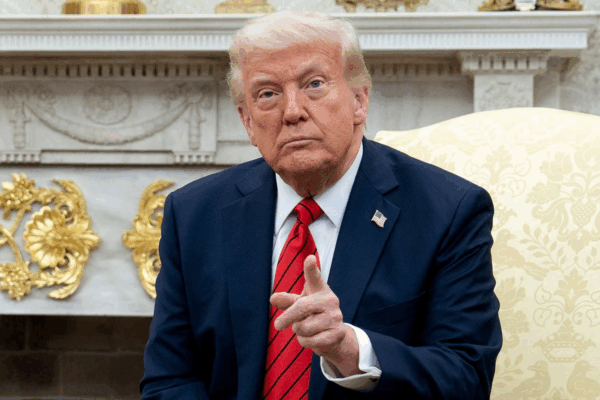
WASHINGTON – U.S. President Donald Trump confirmed on Sunday that he had spoken with Venezuelan President Nicolas Maduro, but did not provide details on what the two leaders discussed.
“I don’t want to comment on it. The answer is yes,” Trump said when asked if he had spoken with Maduro. He was speaking to reporters aboard Air Force One.
The New York Times first reported Trump had spoken with Maduro earlier this month and discussed a possible meeting between them in the United States.
“I wouldn’t say it went well or badly, it was a phone call,” Trump said regarding the conversation.
The revelation of the phone call comes as Trump continues to use bellicose rhetoric regarding Venezuela, while also entertaining the possibility of diplomacy.
On Saturday, Trump said the airspace above and surrounding Venezuela should be considered “closed in its entirety,” but gave no further details, stirring anxiety and confusion in Caracas as his administration ramps up pressure on Maduro’s government.
When asked whether his airspace comments meant strikes against Venezuela were imminent, Trump said: “Don’t read anything into it.”
Surrender and safe passage
In a related development New York Post reported that the call saw Trump’s and Maduro’s teams go over the details of what a surrender from the Venezuelan strongman would be like, given that the state department has a bounty on his head for $50 million.
Trump informed Maduro during their chat that he, his wife and son would be allowed to leave Venezuela safely, but they must do it immediately, sources said.
“First, Maduro asked for global amnesty for any crimes he and his group had committed, and that was rejected,” a source familiar with the call told the Herald.
“Second, they asked to retain control of the armed forces — similar to what happened in Nicaragua in ’91 with Violeta Chamorro. In return, they would allow free elections,” the source said.
The Trump administration has been weighing Venezuela-related options to combat what it has portrayed as Maduro’s role in supplying illegal drugs that have killed Americans. The socialist Venezuelan president has denied having any links to the illegal drug trade.
Reuters has reported the options under U.S. consideration include an attempt to overthrow Maduro, and that the U.S. military is poised for a new phase of operations after a massive military buildup in the Caribbean and nearly three months of strikes on suspected drug boats off Venezuela’s coast.
Human rights groups have condemned the strikes as illegal extrajudicial killings of civilians, and some U.S. allies have expressed growing concerns that Washington may be violating international law.
Trump said he would look into whether the U.S. military had carried out a second strike in the Caribbean that killed survivors during a September operation, adding he would not have wanted such a strike.
U.S. Defense Secretary Pete Hegseth has said the strikes are lawful but are intended to be “lethal.”
Trump told military service members last week the U.S. would “very soon” begin land operations to stop suspected Venezuelan drug traffickers.
Maduro and senior members of his administration have not commented on the call. Asked about it on Sunday, Jorge Rodriguez, the head of Venezuela’s National Assembly, said the call was not the topic of his press conference, where he announced a lawmaker investigation into U.S. boat strikes in the Caribbean.
Maduro made his first public appearance in days on Sunday, putting to an end speculation within the country that he had fled amid escalating tensions with the US.
Maduro, who usually appears on Venezuelan television multiple times a week, had not been seen in public since Wednesday – when he posted a video of himself driving around Caracas on his Telegram channel – leading to intense speculation as to his whereabouts.
On Sunday, he appeared at an annual specialty-coffee awards event in eastern Caracas.
In images that were broadcast online, the president sat before a crowd and handed out medals to coffee producers showcasing their top products. He sipped various coffees while delivering brief remarks – none of which openly addressed the current crisis in the country.
At the end of the event, he chanted that Venezuela is “indestructible, untouchable, unbeatable” while speaking about the nation’s economy.
The remarks appeared to be a nod to the tensions with the US, which has sent more than a dozen warships and deployed roughly 15,000 troops to the region as part of what it says is an effort to combat drug trafficking – but Caracas believes is an attempt to force Maduro from office.
Maduro’s appearance at the coffee awards event came just moments after US President Donald Trump confirmed he had spoken with the Venezuelan leader on the phone.
US wants our oil, Maduro tells OPEC
Meanwhile, in what appeared to be a further ratcheting up of tensions, Maduro wrote to OPEC accusing the US of seeking to seize Venezuela’s oil reserves through force, while the president of Venezuela’s National Assembly accused the US of “murder” regarding recent military strikes on alleged drug boats.
In a letter to the secretary general of OPEC, Haitham Al Ghais, dated November 30, Maduro accused the US of making “constant and repeating express threats” toward his country, in a move that he said “seriously endangers the stability of Venezuelan oil production and the international market.”
Venezuela’s oil reserves are thought to be among the largest in the world.
Venezuelan Foreign Affairs Minister Yvan Gil Pinto posted the letter to OPEC on Telegram, alongside a vow that Venezuela would “remain firm in defending its natural energy resources.”
Reuters/ News agencies
