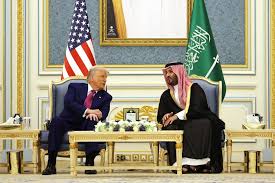
Just three years ago, the US was openly reconsidering its relationship with Saudi Arabia. President Joe Biden had vowed to make Mohammed bin Salman a pariah. Even arms sales to one of America’s closest military partners were put under review.
This week, the crown prince and de facto Saudi leader walked into the Oval Office to find a different world – one where President Donald Trump defended him so forcefully that he scolded a reporter for “embarrassing our guest” when she pressed him on the murder of Washington Post columnist Jamal Khashoggi.
Beyond the Oval Office theatrics, the substance of the administration’s announcements tells the real story of bin Salman’s remarkable rehabilitation in Washington. It also highlights Trump’s willingness to move past the Khashoggi episode and deepen relations with a kingdom that has pledged nearly a trillion dollars in US investments and maintains business ties with his own family.
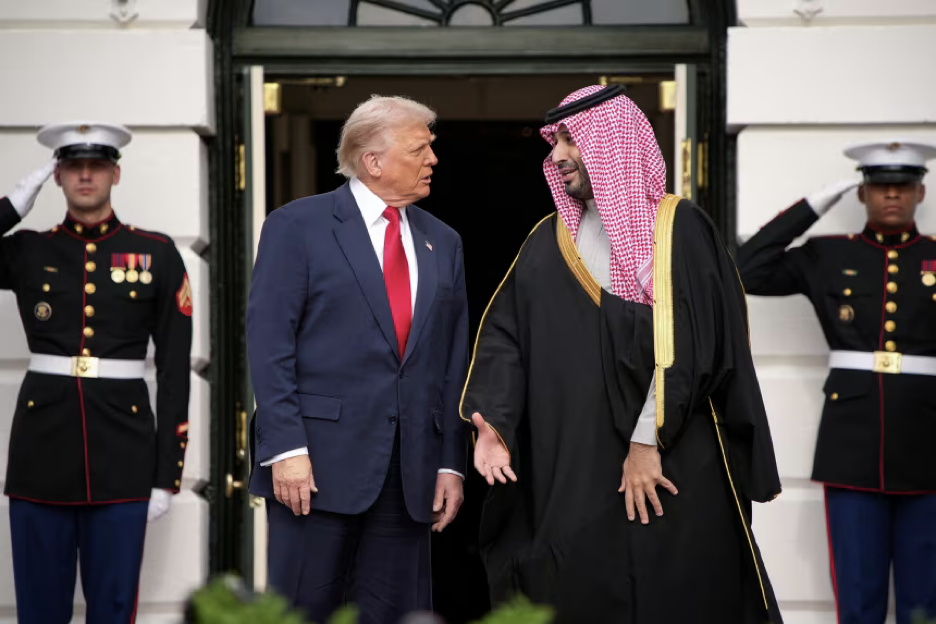
US President Donald Trump welcomes Crown Prince Mohammed bin Salman of Saudi Arabia during an arrival ceremony at the White House on Tuesday in Washington, DC. Andrew Harnik/Getty Images
The visit also underscores the crown prince’s growing clout and his ability to skillfully navigate great power rivalries to his advantage.
Perhaps his biggest win was persuading Trump to drop the one condition Washington had long insisted on before sealing major defense and trade deals with Riyadh: Full normalization with Israel.
The shift marks another reversal from just a year ago, when the Biden administration insisted that any comprehensive US-Saudi deal could only move forward if all three of its components – bilateral defense and trade agreements, Saudi normalization with Israel, and an Israeli commitment to a pathway to a Palestinian state – advanced together. But with Israel rejecting the prospect of a Palestinian state and Saudi Arabia refusing to soften its position, the framework stalled.
Now, the Trump administration appears to have decoupled those components, handing Riyadh most of what it has long sought on defense, economics and regional security.
This week it designated Saudi Arabia a Major Non-NATO Ally, moved forward with plans to sell it F-35 jets “pretty similar” to those flown by Israel, and signed a new Strategic Defense Agreement.
In a nod to Riyadh’s singular focus to rewire its economy away from oil dependence, the two countries launched an AI cooperation framework which includes clearing of the sale of advanced chips to the kingdom, signed a critical minerals agreement, and opened the door to expand cooperation on nuclear energy.
Trump also delivered on bin Salman’s regional requests as the crown prince tries to reshape the Middle East’s
security landscape, agreeing to help end the civil war in Sudan
In the Oval Office, bin Salman framed the new agreements as delivering benefits for both the US and Saudi Arabia.
“Today is a very important time in our history,” bin Salman said in the Oval Office on Tuesday, seated beside Trump.
What Saudi Arabia didn’t get
While bin Salman received almost everything Saudi Arabia has been seeking from the US, there were two notable exceptions: a green light to domestically enrich uranium for future nuclear plants and a formal defense commitment.
The US has long been reluctant to back a Saudi nuclear program that includes domestic uranium enrichment – a process that can produce bomb-grade material if purified to high levels – but CNN understands that Riyadh is reluctant to give up its right to do so, citing its substantial uranium deposits. US Energy Secretary Chris Wright told Fox News on Wednesday that the agreement doesn’t include domestic enrichment.
Among Washington’s Arab allies, Qatar has the strongest defense relationship with the US. It hosts the biggest US airbase in the region, was declared a Major Non-NATO ally in 2022, and this year received the strongest US security commitment for any Arab state, through an executive order declaring that any armed attack on the nation would be regarded as “a threat to the peace and security of the United States.”
CNN understands that Saudi Arabia is seeking at least as deep a security commitment from Washington. A senior Saudi source told CNN the kingdom wants a permanent agreement that would last beyond Trump’s presidency, a move that would ultimately require Congressional approval. But a White House statement made no mention of any obligation to defend the kingdom.
Analysis: Trump’s anti-press outburst hits differently with a Saudi prince by his side
“What (bin Salman) reportedly wants is a Senate-ratified defense commitment along the lines of a NATO Article 5 pledge,” wrote Aaron David Miller, a senior fellow at the Carnegie Endowment think tank, referring to NATO’s mutual defense clause. “The last time Washington delivered that was 65 years ago, with the 1960 US-Japan treaty.”
CNN
