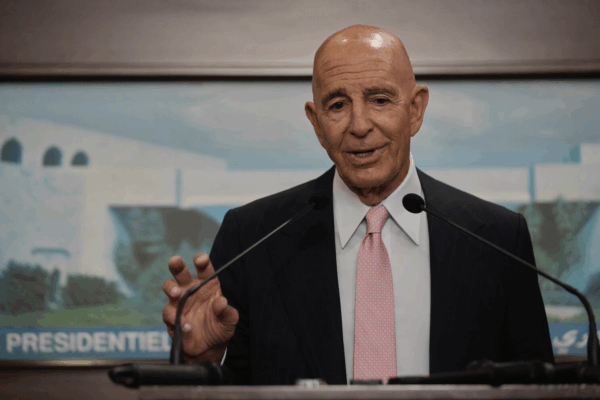
He has little grasp of the delicate balance needed in Lebanon and the wider Middle East
By : Ya Libnan Op-ED
Tom Barrack, the billionaire real estate investor turned Trump donor, diplomat, and now self-styled Middle East strategist, recently revealed more about Washington’s hypocrisy than perhaps he intended. In a 23-minute interview with journalist Hadley Gamble, Barrack lashed out at Lebanon, blaming Hezbollah for instability while admitting openly that the United States is arming the Lebanese Army not to defend the country against Israel, but to disarm Hezbollah.
A Recipe for Civil War, Not Sovereignty
Barrack himself acknowledged the obvious imbalance: Hezbollah fighters are better funded, better trained, and better equipped than Lebanese soldiers, many of whom struggle to make ends meet by moonlighting as drivers, baristas, or garbage collectors. Yet his conclusion was not to support a stronger Lebanese state, but to push Lebanon into confrontation with its own citizens. In plain terms, Washington’s strategy risks igniting a Lebanese civil war, rather than bolstering sovereignty and stability.
Hypocrisy on Full Display
Barrack noted that Hezbollah “runs the best municipalities” because Iran channels resources to them—providing water, electricity, and waste management where the Lebanese state fails. Yet instead of urging reforms or supporting the Lebanese government to fill this vacuum, he suggested choking Iran’s funding as the way forward. That is less a vision for peace and more a recipe for chaos. It exposes the contradiction: the U.S. is willing to arm Lebanon only to fight its own people, not to defend its land from daily Israeli attacks or ongoing occupation.
The Pretend Lebanese-American
Barrack has long tried to present himself as a Lebanese-American patriot. But his recent rhetoric shows him acting more like Israel’s spokesman than Lebanon’s advocate. He admitted bluntly that arming the Lebanese Army is not about resisting Israel but about confronting Hezbollah—even as Israel bombs Lebanese soil and violates its sovereignty with impunity. This is not neutrality, nor is it diplomacy. It is partisanship masquerading as statesmanship.
Peace as an “Illusion”?
Barrack also dismissed Palestinian statehood and even the concept of peace itself. Recognition of Palestine by the UK or France, he said, was “useless.” He reduced Middle Eastern conflicts to struggles for dominance, where someone must “submit.” Such crude cultural stereotyping ignores decades of legitimate demands for independence, dignity, and justice. By trivializing Palestinian aspirations and Lebanese suffering, Barrack revealed a worldview steeped in cynicism rather than diplomacy.
Conclusion:
Tom Barrack may know real estate, but his blunt, careless comments prove he has little grasp of the delicate balance needed in Lebanon and the wider Middle East. Instead of strengthening sovereignty, his words point to a strategy that fuels division, invites civil war, and denies the possibility of peace. Lebanon deserves better than to be treated as a pawn in someone else’s geopolitical game.
