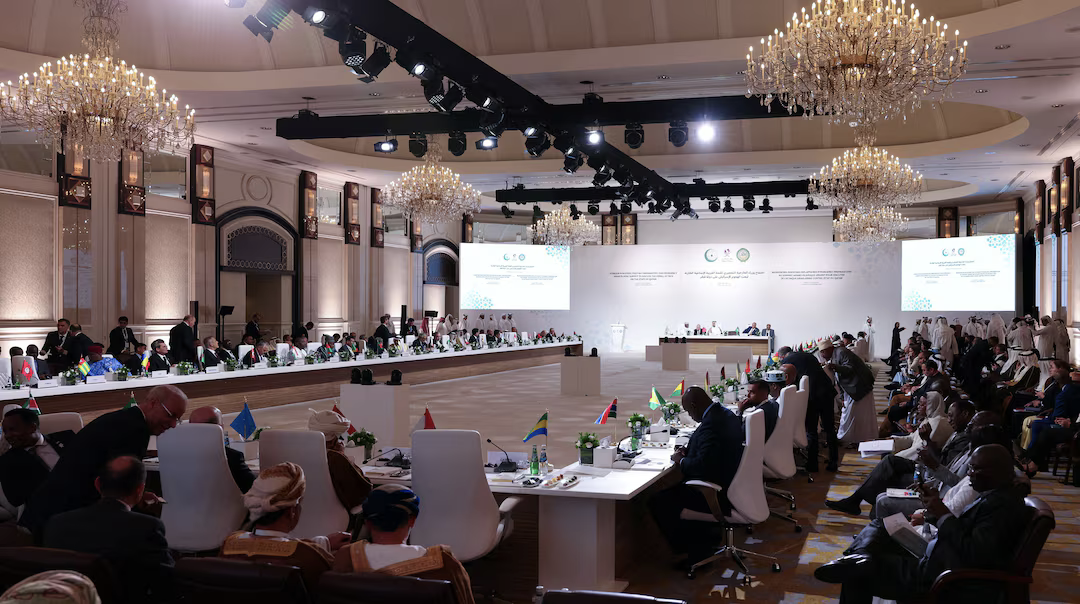
Qatar’s Prime Minister and Minister for Foreign Affairs Sheikh Mohammed bin Abdulrahman bin Jassim Al-Thani, attends the preparatory ministerial meeting for emergency Arab-Islamic summit in Doha, Qatar September 14, 2025. The Arab-Islamic summit is to warn that Israeli attacks threaten normalisation of ties. Qatar Ministry of Foreign Affairs/Handout via REUTERS
Killing Qatar’s mediation role, denying Palestinian statehood, and fueling regional anger risk burying the Abraham Accords, pushing Arab states toward China and Russia, and isolating both Israel and the U.S.
By: Ya Libnan Editorial Board , Op-Ed
Israel is once again replacing Iran as the top enemy in the Middle East. The genocide in Gaza, continued attacks on Lebanon despite the ceasefire, repeated strikes on Syria, and the most recent assault on Qatar targeting Hamas leaders represent a dangerous step backward for Israel’s standing in the region. Rather than isolating Iran, Israel’s actions are ironically making Tehran look good, while simultaneously doing a remarkable job at killing the Abraham Accords.
From Normalization to Isolation
The Abraham Accords were meant to usher in a new era of cooperation between Israel and the Arab world. Instead, Israel’s relentless military campaigns are reigniting hostility across the region. Arab and Islamic states that once cautiously engaged with Israel now see Tel Aviv as a destabilizing aggressor, undermining trust and dismantling any remaining prospects for normalization.
Killing the Messenger
Qatar has been the top mediator between Israel and Hamas, often serving as the critical channel to negotiate humanitarian pauses and prisoner exchanges. By attacking Doha, Israel effectively killed the messenger. This reckless act has triggered outrage across the Arab and Islamic world, and the upcoming Arab-Islamic summit on Monday is expected to become a powerful show of solidarity with Qatar. In his remarks, Qatari Prime Minister Sheikh Mohammed bin Abdulrahman bin Jassim Al Thani expressed gratitude for the support of Arab and Islamic nations, as well as international partners, calling Israel’s strike a “barbaric attack” and vowing to pursue “legitimate legal measures” to defend Qatar’s sovereignty.
Washington’s Miscalculation
President Trump’s unflinching support for Prime Minister Netanyahu will ultimately backfire on the United States. By aligning itself so closely with Israel’s destructive policies, Washington risks driving the Middle East eastward—toward China and Russia. Such a development would isolate not only Israel but the U.S. as well from one of the world’s most strategically important and economically dynamic regions. This shift would not only bury the Abraham Accords but also crush the dreams of Gulf leaders for a new and prosperous Middle East.
Palestine: The Missed Opportunity
A central demand of Saudi Crown Prince Mohammed bin Salman is the recognition of a Palestinian state. Yet, the U.S. continues to refuse this recognition, further driving a wedge between itself and its Arab allies. A Palestinian state would be disarmed and hence pose no security threat to Israel. Instead of embracing this opportunity, Israel and the U.S. are pushing away key regional partners and deepening the cycle of hostility.
Time for a U-Turn
The current trajectory is unsustainable. By continuing down this path, Israel risks uniting the Arab and Islamic world against it, while dragging the U.S. into deeper isolation. It is time for both Israel and the U.S. to change course—to recognize the state of Palestine, to respect Arab sovereignty, and to revive the hope of peace. Without a U-turn, the vision of a stable and prosperous Middle East will remain nothing more than a dream buried under the rubble of endless wars.
