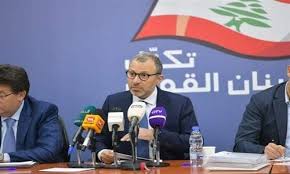
Free Patriotic Movement head MP Gebran Bassil stressed in his speech during a dinner for the Free Patriotic Movement’s Tripoli Judicial Council that “we realize how much the people of Tripoli have suffered under Syrian guardianship or occupation.” He noted that we cannot talk about Tripoli without mentioning the sound of the minaret and the bell, both from Mansour Street to St. George’s Church. He emphasized that Tripoli represents national unity because it is the capital of the diverse, mixed north and because it is Lebanon’s second capital.
Bassil emphasized: “We cannot see Lebanon lacking any component,” adding: “We cannot see it except with this diversity, and this is the great challenge we face today regarding the Lebanon we want.”
He explained, “This is a major challenge facing us as Lebanese, especially when we see what is happening in the region and how the specter of partition has become a reality, from Iraq to Syria. We must keep it at bay.”
Bassil asked, “Can we, as Lebanese, preserve our unity in light of what is happening in the region?” He emphasized that “this question is posed to the people of the north and the people of Tripoli. Would the people of Tripoli accept anyone annexing them to another country and separating them from Lebanon?!” He added, “They tried to separate the FPM from Tripoli and invented stories. Between Batroun and Tripoli, and between Tripoli and all the regions, there is unity. When the people of Batroun, Koura, and Bsharri needed refuge in Tripoli, Tripoli welcomed them. When the people of Tripoli experienced difficult times during the war, they found families and homes in Batroun.”
Bassil pointed out that the FPM presented seven projects to Tripoli at the Ministry of Energy, totaling more than a billion dollars.
He explained, “These projects are from Qadisha, a private company owned by the state, but operating according to a private system and providing its own electrical services. They also include the Deir Ammar plant, the gas station at Tripoli Port, the gasification station, the storage station in Beddawi, which was contracted and then halted. The sewage treatment plant, which is the most important station in Lebanon, was halted, costing us approximately $5 billion a year in maintenance. We have resumed work on it, and this has upset them. They also include the Bared Dam, which we have begun studying, and the Beddawi refinery.”
He emphasized, “We treated Tripoli better than others because its size dictates it and because of its specifications.” Its location and privileges qualify it for this task. Everything they have tried to do to separate us from Tripoli, and they see that distorting the image of the movement has not continued.
He said, “We are concerned with coexistence, and that is why when the people and merchants of Mino came to us and asked us to provide assistance, two years ago we began work, and today we visited the third phase, which has been completed on the street.”
Bassil emphasized that “the people of Tripoli are renovating Mino Street, not me, and many Tripolitanians are contributing to the project, led by Professor Alfred Doura.”
He pointed out that Tripoli lacks nothing, and that the largest sand market is in Tripoli. He added that it is unfortunate that these markets have not been restored. He emphasized that “we have a desire to care for Tripoli in all aspects, and we want to work for the city from wherever we are,” and that “when Tripoli prospers, the entire north will grow with it, from the port of Tripoli to the economic zone and others.”
Bassil stressed that “the movement for development and national unity does not have any racist, sectarian, or divisive thinking, but rather a unifying, inclusive mindset because we know what Tripoli means and we are committed to our national unity and Greater Lebanon and are against its division. This is what unites us with our people in Tripoli.”
While direct reports of the Syrian regime separating Tripoli from Lebanon are unsubstantiated, rumors of such a scheme emerged in July 2025 following the collapse of the Assad government. These reports, which were not officially confirmed by the new Syrian authorities, illustrate Lebanon’s deep-seated anxieties about potential renewed Syrian influence.
Tripoli , which is the second largest city in Lebanon was incorporated into the newly formed State of Greater Lebanon in 1920 after the partition of the Ottoman Empire, which separated it from the rest of Syria. Prior to 1920, Tripoli was part of the same overarching Ottoman Syria province, but the creation of Grand Liban by the French Mandate for Syria and the Lebanon was the political act that detached the city from the territory that would become modern Syria.
The Islamist regime in Syria, led by the former Al Qaeda and ISIS linked Al Nusra Front leader , Abu Mohammad al Golani who revealed his real name as Ahmed Al -Sharaa after overthrowing the Assad regime last December has been mistreating all the Syrian minorities , including the Alawites, the Christians and the Druze and many reports now point to a divided Syria along sectarian lines after thousands were killed by Syrian Security Forces ad the rebels associated with ISIS and al Qaeda
