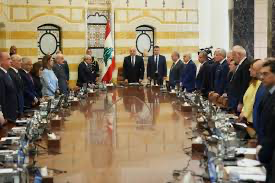
In this photo released by the Lebanese Presidency press office, Lebanese president Joseph Aoun, centre, and Lebanese Prime Minister Nawaf Salam, left background, lead a Cabinet meeting to discuss the disarmament of Hezbollah, at the presidential palace in Baabda, east of Beirut, Lebanon, August 5, 2025. (Lebanese Presidency press office via AP)
By : Ya Libnan Editorial Board
The Lebanese Cabinet convened a highly anticipated session Tuesday at Baabda Palace, with one urgent item at the top of its agenda: the disarmament of Hezbollah. But even before the discussion began, the issue was quietly pushed to the end of the session—and now seems likely to be postponed yet again.
Notably absent from the meeting were Finance Minister Yassine Jaber of the Amal Movement and Labor Minister Mohammad Haidar of Hezbollah, both reportedly abroad. Their absence—and the Cabinet’s inability to confront the issue—speaks volumes about the paralysis that has gripped Lebanon’s political system for years.
Television networks have already reported that the government is leaning toward delaying any decision on Hezbollah’s arms to a future session. But the Lebanese people can no longer afford delay. Postponement is not a strategy—it is surrender.
If Lebanon does not take bold and immediate steps to disarm Hezbollah and assert the authority of the state, it will inch closer to a fate similar to Gaza: isolated, devastated, and governed by a militia rather than a legitimate government.
A Nation Held Hostage
For years, Hezbollah has acted as a state within a state—wielding arms, waging wars, and negotiating with foreign powers, all without the consent of the Lebanese people. Its weapons have turned Lebanon into a battlefield for regional conflicts, particularly between Iran and Israel. Every time Hezbollah acts independently, the entire country bears the consequences.
Lebanon has already suffered enough. The economic collapse, political dysfunction, and the erosion of state authority are all symptoms of a deeper disease: the normalization of armed militias operating outside the control of the government. Hezbollah is not just a political party—it is an armed force loyal to a foreign power, operating with impunity within a sovereign state.
Gaza Is a Warning, Not a Model
Gaza was once a vibrant coastal strip. Today, it is a shattered enclave, isolated from the world and caught in endless cycles of violence. The world watched in horror as Gaza was pummeled into rubble, but behind the tragedy lies a painful truth: when militias replace the state, the people suffer.
This is Lebanon’s warning. Hezbollah may claim to defend the country, but in reality, it is dragging Lebanon toward the abyss. Israel has made it clear that it will not tolerate a second front in the north forever. The next war, if it comes, will not spare Beirut, the South, or the Bekaa Valley. It will destroy what remains of Lebanon’s infrastructure, economy, and fragile hope.
The International Community Must Step Up
For too long, the international community has treated Hezbollah’s weapons as an “internal matter.” This convenient fiction has allowed the group to expand its power while Lebanon disintegrates. It is time for the Arab League, the United Nations, the European Union, and Lebanon’s Western partners to stop hiding behind diplomatic niceties.
Arab states—especially Egypt, Saudi Arabia, Jordan, and the Gulf countries—must support Lebanon’s sovereignty by backing its institutions and pressuring for disarmament. Conditional financial aid, targeted sanctions on militia leaders, and a coordinated diplomatic push can help tip the balance. Disarmament won’t happen overnight, but without external pressure and support, it won’t happen at all.
The People Deserve Better
Millions of Lebanese are paying the price for Hezbollah’s militarism. From sanctions to isolation, Lebanon’s people are suffering not because of natural disasters or foreign invasions, but because of a man-made crisis fueled by weapons in the hands of unaccountable actors.
Civil society, religious leaders, and the youth must break the silence. Every delay in addressing Hezbollah’s weapons is a betrayal of Lebanon’s sovereignty and future. The Lebanese army must be empowered—politically, militarily, and morally—to be the sole defender of the nation. No country can survive with two armies and two decision-making centers.
Lebanon Must Choose
Lebanon now stands at a crossroads. One path leads to sovereignty, reform, and peace. The other leads to war, devastation, and irrelevance. There is no middle road.
This is not about vengeance or politics—it is about national survival. Hezbollah can either become a political party like any other, or it must be disarmed. Anything less ensures Lebanon’s collapse.
The question now is simple: does Lebanon want to be a sovereign nation—or another Gaza?
