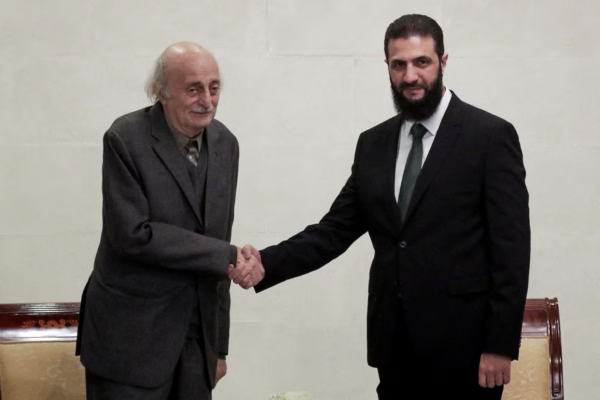
File: Lebanese Druze leader Walid Jumblatt shakes hands with Syria’s de facto leader Ahmed al-Sharaa, also known as Abu Mohammed al-Golani, after the ousting of Syria’s Bashar al-Assad, in Damascus, Syria, December 22, 2024. Despite his hollow promises, Al-Sharaa has failed miserably in protecting Syria’s vulnerable minorities and managed to drive a wedge between the Druze in Syria and in Lebanon. The last thing the Syrians want to see is another dictator like Bashar al-Assad REUTERS/Khalil Ashawi
The recent massacre targeting the Syrian Druze community in Sweida , a small religious minority group resulted in the killing of over 600 members including 140 women and children according to Syrian Observatory for Human Rights (SOHR)
Syrian interim President Ahmed al-Sharaa’s forces and allied militias have carried out the massacres in Sweida province This eruption of violence was an eerie reminder of a series of violence that has been launched against the Syrian religious communities and ethnic minorities, since the current regime has come to power.
The Syrian National Army (SNA) which is also part of a coalition led by President Ahmad Al-Shaara’s group Hayat Taheer Al-Sham (HTS) attacked Kurdish led Syrian Democratic Forces (SDF) in North-East Syria in December 2024. In particular, fierce fighting along the Tishreen Dam became the focal point. In March, indiscriminate killings of Alawites were carried out in the Syrian coastal areas especially in the city of Banias. While exact figures remain difficult to verify, more than 1,300 individuals, most of them Alawites, lost their lives. In some cases, entire families were summarily executed. These atrocities were solely directed against the Alawite minority and instigated by militias affiliated with the new regime, ostensibly as part of a response to attacks in Latakia and Tartous from armed groups affiliated with the deposed Assad regime. In the name of fighting former President Bashar Al-Assad loyalist collective punishment was given to the Alawite community.
In June this year a church in the Syrian capital of Damascus was rocked by a suicide explosion, in this deadly attack 25 people were killed. The Syrian authorities blamed the attack on the Islamic State (ISIS) group. However, a lesser- known Sunni extremist group, Saraya Ansar al-Sunnah, claimed responsibility for this attack. Many analysts believe this little-known group has deep links with HTS as their relations with HTS stretch back to before the Bashar Al-Assad
If we look at the pattern of all these past attacks, it clearly indicates that they were carried out on the instructions or at least with tacit approval of the current Syrian regime. The objective of these attacks was to subdue the minorities through terror, so they don’t demand their full political rights. The current Syrian regime got emboldened by the recent lifting of western sanctions and informal recognition it got from Arab states and the United States.
In May 2025 the US president met Ahmad Al-Shaara in the Saudi capital Riyadh and expressed admiration for him. He went further and described Al-Shaara as a strongman and declared him a “Tough guy with a very strong past.”
The US president should have ordered a thorough research to dug more into the past of Al-Shaara as his past is one marked by links to al-Qaeda, and ISIS
Al Sharaa even managed to fool Lebanon Druze leader Walid Jumblatt , who was the first Lebanese official to visit Damascus and meet with Al- Sharaa despite the objection of the Druze leadership in Syria.
Jumblatt and his team were completely fooled by Al Sharaa as recent events in Syria indicate . Yesterday he went as far as attacking Syrian Druze leader Sheikh Hikmet Al Hijri, who is the most popular Druze spiritual leader in Syria and accused the Druze of Sweida of massacring the Bedouin tribes, an unfounded claim that no one else ever made.
Only Federalism Can Save Syria
Despite his hollow promises, Ahmed al-Sharaa has failed miserably in protecting Syria’s vulnerable minorities. His brief rule has not ushered in a new era of inclusion or reconciliation, but one of betrayal and brutality. Many minorities across Syria—from Christians to Alawites, Druze to Kurds—no longer see Sharaa as a protector but as a former ISIS affiliate in a business suit.
Since unilaterally appointing himself as Syria’s interim president, thousands from these communities have been killed. Nowhere is his failure more glaring than in Sweida, where government forces dispatched to quell violence between Sunni Bedouins and the Druze ended up siding with the Bedouins. Instead of restoring order, they executed Druze civilians at gunpoint, looted homes, and set them ablaze. These actions confirm what many Syrians have long feared: Sharaa has no intention to govern for all Syrians—only to consolidate power under the guise of security.
In this climate of deep mistrust and sectarian tension, the idea of a strong, centralized government led by one faction is no longer tenable. Syria needs a new path forward—one that gives every group a stake in the country’s future while ensuring local governance, autonomy, and protection. That path is federalism.
What Is Federalism?
Federalism is a system of government in which power is divided between a central authority and smaller political units—such as states, provinces, or cantons. Each unit maintains a degree of autonomy to govern its own affairs, particularly in areas like education, policing, and culture, while still being part of a unified national framework.
It is a model that has proven successful in multi-ethnic and multi-religious countries. Perhaps the best example is Switzerland. Despite its linguistic, cultural, and religious diversity, Switzerland has remained peaceful, democratic, and united—not in spite of its differences, but because it embraced them. The Swiss Confederation consists of 26 cantons, each with its own constitution, government, and even police force. Yet all are bound together under a federal government that handles foreign policy, national defense, and major economic policies. It is a country where French, German, Italian, and Romansh speakers coexist harmoniously—not because they were forced to live under a single ruler, but because they were empowered to manage their own affairs within a shared federal system.
