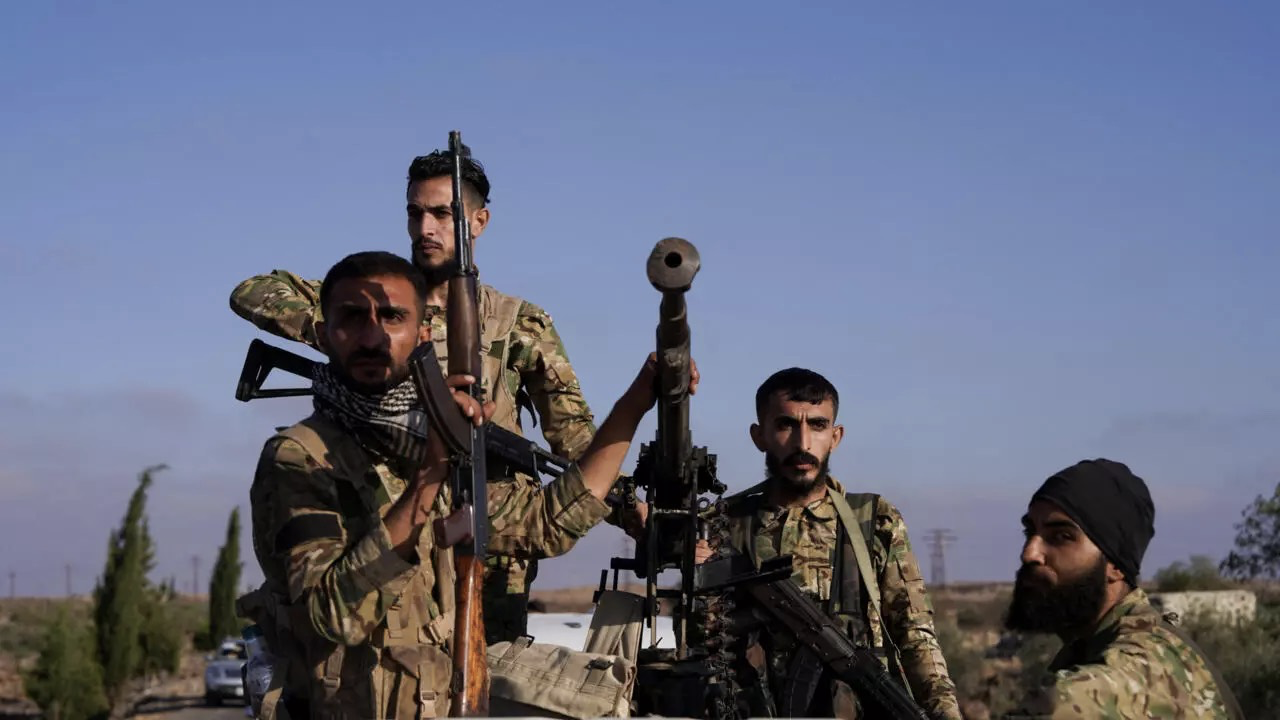
Members of Syria’s security forces ride on the back of a truck after Syrian troops entered the predominantly Druze city of Sweida on Tuesday following two days of clashes, in Sweida, Syria on July 15, 2025. The Syria’s security forces sided with the Bedouins in their attack against the Druze . Over 500 were killed 2 Druze women and 2 Druze children © Karam Al-Masri, Reuters
Sharaa said that “responsibility” for security in Sweida would be handed to religious elders and some local factions “based on the supreme national interest”.
The Syrian government announced on Thursday that local leaders would assume control over security in the city of Sweida in an attempt to end violence that has claimed hundreds of lives and prompted Israel’s military intervention.
Syrian soldiers began withdrawing from Druze-majority Sweida on Wednesday, the defense ministry said, hours after the announcement of a new ceasefire agreement in the violence-hit city.
Early on Thursday, Syria’s interim President Ahmed al-Sharaa said that protecting Druze citizens and their rights is “our priority” while Israel, in pursuit of its own goals in southern Syria, vowed to destroy Syrian government forces attacking the Druze.
In his first televised statement after Israeli air strikes on Damascus on Wednesday, Sharaa addressed Druze citizens saying “we reject any attempt to drag you into hands of an external party”.
“We are not among those who fear the war. We have spent our lives facing challenges and defending our people, but we have put the interests of the Syrians before chaos and destruction,” he said.
He added that the Syrian people are not afraid of war and are ready to fight if their dignity is threatened.
Sharaa said that “responsibility” for security in Sweida would be handed to religious elders and some local factions “based on the supreme national interest”.
Before the government intervention, Druze areas were mainly controlled by fighters from the minority.
Security forces had been deployed in the area a day earlier with the stated aim of overseeing a previous truce, following days of deadly clashes between Druze fighters and local Bedouin tribes.
But witnesses said the government forces had joined the Bedouin in attacking Druze fighters and civilians.
The US said the fighting would stop soon.
“We have engaged all the parties involved in the clashes in Syria. We have agreed on specific steps that will bring this troubling and horrifying situation to an end tonight,” Secretary of State Marco Rubio said on social media.
The United Nations Security Council will meet on Thursday to address the conflict, diplomats said.
According to the Syrian Observatory for Human Rights monitor, more than 300 people have been killed since Sunday in clashes between Druze fighters, Bedouin tribes and government forces, and in Israeli strikes.
The dead include 165 government forces but also 27 Druze civilians killed in “summary executions … by members of the defense and interior ministries”, said the Observatory.
Addressing doubts about his administration’s credibility in dealing with minorities, including the Druze, the Syrian interim president said, “We are keen on holding accountable those who transgressed and abused our Druze people, as they are under the protection and responsibility of the state,” Sharaa.
But Sharaa faces daunting challenges in trying to stitch Syria back together in the face of deep misgivings from many Syrian factions that see Sharaa’s own troops and allied militias, considering their jihadist background, to be ideologically intolerant of minorities.
Syria’s radical Islamist authorities, which toppled long-time ruler Bashar al-Assad in December, have had strained relations with Syria’s religious and ethnic minorities, and have been accused of not doing enough to protect them.
March saw massacres of more than 1,700 mostly Alawite civilians in their coastal heartland, with government affiliated groups blamed for most of the killings.
Government forces also battled Druze fighters in Sweida province and near Damascus in April and May, leaving more than 100 people dead.
Sharaa said “outlaw groups”, whose leaders “rejected dialogue for many months” had committed “crimes against civilians” in recent days.
He said the deployment of government troops has eased tensions despite Israeli intervention.
- Israeli goals
Its air strikes marked a significant Israeli escalation against Sharaa’s Islamist-led administration. These attacks came despite the interim president’s warming ties with the US and his administration’s evolving security contacts with Israel.
Perceiving Syria’s new rulers as barely-disguised jihadists, Israel has said it will not let them move forces into southern Syria while claiming that its main aim is to shield the area’s Druze community from attack, encouraged by calls from Israel’s own Druze minority.
Many Syrians, however, see the Binyamin Netanyahu government as bent on promoting and exploiting instability in Syria in order to achieve security gains at the expense of its weak neighbour.
Israel’s ambassador to the UN, Danny Danon, “Israel will continue to act resolutely against any terrorist threat on its borders, anywhere and at any time.”
Technically at war with Syria for decades, Israel has said it would not accept the presence of forces of the Islamist-led government in the country’s south, which borders the Israeli-occupied Golan Heights.
“We will not allow southern Syria to become a terror stronghold,” said Eyal Zamir, Israel’s military chief of staff.
Israel, which has its own Druze community, has presented itself as a defender of the Syrian minority, although some analysts say that is a pretext for pursuing its own military goal of keeping Syrian government forces as far from their shared frontier as possible.
“The Israeli entity resorted to a wide-scale targeting of civilian and government facilities,” that would have pushed “matters to a large-scale escalation, except for the effective intervention of American, Arab and Turkish mediation, which saved the region from an unknown fate”, Sharaa said.
Since December, when Sharaa’s group spearheaded an offensive that toppled Assad, Israel has carried out hundreds of strikes against military sites in Syria, claiming its goal was to prevent weapons from falling into the hands of the new government.
Israel also sent troops into the demilitarised buffer zone on the Golan Heights, part of which it has occupied from Syria since 1967, and carried out incursions deeper into southern Syria.
Some 153,000 Druze live in Israel, where they are citizens, and unlike other Israeli-Arabs are subject to compulsory military conscription.
Al Araby
