By: Vlad Green, Op-Ed
Summary
The suspicious death of a recently dismissed Russian transport minister is not an anomaly — it’s part of a decades-long pattern under Vladimir Putin, where political opponents, journalists, and even allies meet untimely and unexplained ends. This Op-Ed explores how Putin has built a dictatorship sustained by fear, repression, and death — with a long list of high-profile “suicides” and assassinations that expose the Kremlin’s brutal methods. As the world continues to mourn the murder of Alexei Navalny and continues to deal with Putin’s aggression abroad, it’s time to confront the true cost of his reign — and stop treating Russia as anything close to a functioning state.
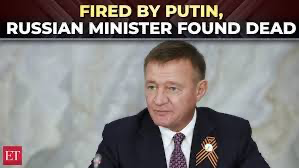
Moscow- Russia ranks among the top nations in suicide rates — but when it comes to officials, oligarchs, journalists, and dissidents, the word “suicide” has lost all credibility. When Russia’s former Transport Minister reportedly “took his own life” shortly after being dismissed by President Vladimir Putin, it was just the latest in a long line of high-profile deaths that feel less like tragedies and more like warnings.
For over two decades, critics of Putin — whether they held government office or dared to tell the truth — have ended up dead. The Kremlin’s default explanation? Suicide, accident, illness, or misfortune. The reality? A regime that rules through fear, silences dissent with violence, and masks murder with official lies.
Even within Russia, very few people still believe these narratives. The pattern is too familiar, the timing too convenient, and the messaging too calculated.
Putin’s Path to Dictatorship
Vladimir Putin didn’t just come to power — he seized it and never let go. After being handed the presidency by Boris Yeltsin in 1999, Putin quickly moved to dismantle Russia’s fragile post-Soviet democracy. Independent media were crushed. Opposition voices jailed or exiled. Regional leaders and the judiciary brought under Kremlin control. By 2020, Putin rewrote the constitution to allow himself to stay in power until 2036, cementing his role as Russia’s longest-serving leader since Stalin.
But power built on fear requires constant maintenance — and in Putin’s Russia, that means eliminating anyone who dares to challenge him.
Navalny: The Martyr Putin Couldn’t Silence
Among the countless victims, none stands out more than Alexei Navalny, the anti-corruption crusader and opposition leader who directly threatened Putin’s regime. Navalny exposed the vast wealth and hypocrisy of the Russian elite, rallied millions of disillusioned Russians, and fearlessly returned to Russia in 2021 after surviving a Novichok nerve agent poisoning — almost certainly orchestrated by the state.
For his courage, he was sentenced to years in brutal prison colonies, denied medical care, isolated from the outside world — and ultimately, in February 2024, he died at a remote Arctic prison. The official cause of death? “Sudden illness.”
But no one — not his supporters, not the international community, not even the Russian people — believed it. Navalny was executed by slow torture, and his death was the final act in a years-long campaign to erase him.
Yet in death, Navalny has become a martyr — proof that Putin fears truth more than any weapon.
A Pattern of Suspicious Deaths
Navalny’s fate was horrific, but tragically, not unique. Under Putin, Russia has become a graveyard for journalists, whistleblowers, businessmen, and officials who either knew too much or dared say too much. Here are just a few:
- Anna Politkovskaya (2006) – A brave investigative journalist and Kremlin critic, gunned down in her apartment building on Putin’s birthday.
- Alexander Litvinenko (2006) – Former FSB agent who fled to London and accused Putin of ordering assassinations. He was poisoned with radioactive polonium.
- Boris Nemtsov (2015) – Former Deputy Prime Minister and outspoken opposition leader, shot four times within view of the Kremlin after condemning the Ukraine war.
- Sergei Magnitsky (2009) – A tax lawyer who exposed massive government corruption. He died in prison after beatings and being denied medical care.
- Yuri Shchekochikhin (2003) – Investigative journalist who died suddenly from an illness that resembled poisoning while probing corruption and FSB abuses.
- Ravil Maganov (2022) – Chairman of energy giant Lukoil who criticized the Ukraine war. He “fell” from a hospital window.
- Pavel Antov (2022) – Russian MP who condemned the war in Ukraine. Days after a colleague died, Antov “fell” from a hotel window in India.
- Stanislav Markelov & Anastasia Baburova (2009) – Human rights lawyer and journalist, shot in broad daylight in Moscow.
- Valentin Yumashev (2023) – Yeltsin’s son-in-law, who distanced himself from Putin’s circle, reportedly died under murky circumstances.
Each death sends a signal: opposition will be crushed, truth will be buried, and those who cross Putin may not live to regret it.
Fear as a Weapon, Lies as a Shield
This is not governance — it is organized terror. Each “suicide,” “accident,” or “illness” is not just a death; it is part of the Kremlin’s performance of fear. The state doesn’t just kill the person — it kills the truth, the justice, and the hope that Russia can be free from tyranny.
Inside Russia, many now speak only in whispers. Others have fled, knowing full well what awaits them if they stay. Putin has built a nation where silence is survival — and where too many voices have been silenced forever.
The World Must Stop Pretending
Putin didn’t just hijack the Russian presidency — he destroyed Russian democracy, corrupted its institutions, and murdered accountability. The longer the world treats him like a legitimate statesman, the more innocent people will die.
This isn’t a strong leader preserving order. This is a dictator protecting his throne through blood.
It’s time to stop calling these deaths “suicides.”
Time to stop buying the Kremlin’s lies.
Time to expose Putin — not just as a threat to his people, but as a threat to humanity itself.
