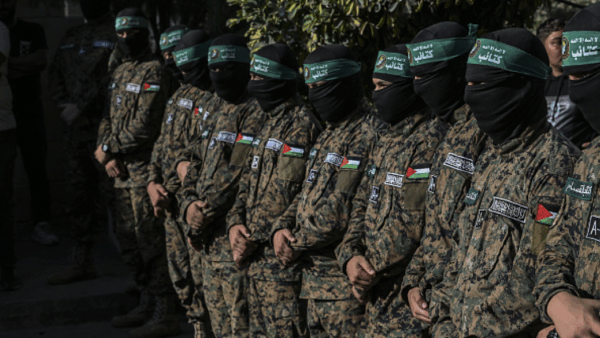
The Lebanese and Palestinian sides agreed on starting a plan “to remove weapons from the camps, beginning mid-June in the Beirut camps, and other camps will follow,” the source told AFP [Getty]
The disarmament of Palestinian camps in Lebanon will begin next month based on an accord with visiting Palestinian president Mahmoud Abbas.
A group tasked with making a plan to remove weapons held by Palestinian factions in Lebanon’s refugees camps met for the first time Friday to begin hashing out a timetable and mechanism for disarming the groups.
The Lebanese-Palestinian Dialogue Committee, a government body that serves as an interlocutor between Palestinian refugees and officials, said the meeting was attended by Prime Minister Nawaf Salam and that “participants agreed to launch a process for the disarmament of weapons according to a specific timetable.”
The group added that it also aimed to take steps to “enhance the economic and social rights of Palestinian refugees.”
A Lebanese official familiar with the discussions, who spoke on condition of anonymity because they were not authorized to comment, said work to remove the weapons would begin within a month.
The meeting followed a visit by Palestinian President Mahmoud Abbas to Lebanon, during which he and Lebanese President Joseph Aoun announced an agreement that Palestinian factions would not use Lebanon as a launchpad for any attacks against Israel, and that weapons would be consolidated under the authority of the Lebanese government.
There are multiple Palestinian factions active in Lebanon’s refugee camps, which include Abbas’ Fatah movement, the rival Hamas group and a range of other Islamist and leftist groups.
The 12 Palestinian refugee camps aren’t under the control of Lebanese authorities, and rival groups have clashed inside the camps in recent years, inflicting casualties and affecting nearby areas.
Hamas and allied Palestinian groups also fought alongside the Lebanese group Hezbollah against Israel in Lebanon in a war that ended with a ceasefire in November. Hezbollah has been under increasing pressure to give up its own weapons since then.
Hamas has not commented on the decision to remove weapons from the camps.
The Lebanese official said that Hamas’ office in Lebanon would be allowed to remain open if it worked only on political and not military matters.
There are nearly 500,000 Palestinians registered with UNRWA, the United Nations agency for Palestinian refugees, in Lebanon. However, the actual number in the country is believed to be around 200,000, as many have emigrated but remain on UNRWA’s roster.
They are prohibited from working in many professions, have few legal protections and can’t own property.
Palestinians in Syria are already disarmed
In a related development 2 Palestinian sources confirmed to Agence France-Presse (AFP) that “most of the leaders of the Palestinian factions that received support from Tehran have left Damascus for several countries, including Lebanon,” following “repression” by the new Syrian authorities, led by Syrian President Ahmad al-Sharaa, and the confiscation of their assets.
A leader in a Palestinian faction who left Damascus and refused to reveal his identity confirmed that the factions had “completely” surrendered their weapons to the authorities shortly after the fall of the Assad regime. This was confirmed by a second Palestinian source from a small faction in Damascus.
The new Syrian authorities have previously arrested members of Palestinian factions, and US President Donald Trump asked Sharaa during their meeting in Riyadh to expel Palestinian militants from the country.
NEW ARAB/ ELNASHRA
