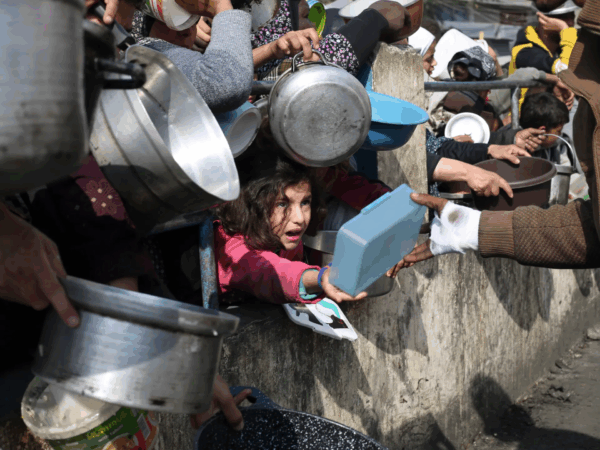
A group of independent UN experts warn famine has spread throughout Gaza after 20 months of war.
International pressure has been building on Israel over its new military offensive in Gaza that has left hundreds dead in just the last few days.
The leaders of the United Kingdom, France, and Canada threatened to take “concrete actions” on Monday, including targeted sanctions, if Israel does not stop its renewed military offensive and continues to block aid from entering Gaza.
Israel launched a new devastating ground offensive in Gaza over the weekend just as US President Donald Trump departed the region without sealing a ceasefire and hostage deal.
The Israeli military said its forces moved into northern and southern Gaza over the past day as part of the “Gideon’s Chariots” operation, which Israel warned would take place if Hamas doesn’t agree to a new hostage deal on its terms.
The ground operation came after days of heavy airstrikes on the Gaza Strip, which according to health authorities there have wiped out entire families.
Israel has said it will allow a “basic amount of food” into the besieged enclave, a move which Prime Minister Benjamin Netanyahu hinted was due to intense pressure from allies, and on Monday the Israeli agency that approves aid shipments into Gaza said five trucks had entered the enclave. However, UN aid chief Tom Fletcher described the delivery as “limited” and a “drop in the ocean of what is urgently needed.”
The latest developments come after Hamas and Israel began indirect talks in the Qatari capital Doha on Saturday.
Here’s what we know about Israel’s new offensive and what it means for Gazans.
What is Israel’s new operation in Gaza?
Israel’s Security Cabinet approved the new military offensive in Gaza on May 5. The Israel Defense Forces (IDF) later said the aim of the operation was to achieve “all the goals of the war in Gaza,” including defeating Hamas and securing the release of remaining hostages in the territory.
On Monday, Netanyahu said that Israel plans to “take control of the entire Gaza Strip.”
The warring parties failed to reach a deal during Trump’s visit last week, and Israel pressed on with its operation over the weekend. This began with a series of intense airstrikes last week and was followed by an expanded ground offensive on Sunday.
The Israeli military said Sunday that over the past week, it struck more than 670 “Hamas targets” in a wave of preliminary airstrikes across the enclave.
Early Monday morning, Israeli forces struck the medical supplies warehouse of the Nasser Medical Complex in southern Gaza’s Khan Younis neighborhood, damaging some of the medical supplies that had been provided to the center by Medical Aid for Palestinians (MAP), according to the UK-based organization.
On Tuesday, health officials in Gaza said that Israeli strikes killed at least 49 people across the enclave overnight.
On Monday, health officials said that Israel’s operation had killed at least 136 people in 24 hours, and shuttered the last functioning hospital in the enclave’s north. Entire families were killed while sleeping, according to the Palestinian Ministry of Health.
More than 400 people have been killed and over 1,000 others injured since Thursday, according to a CNN count of health ministry data.
More than 53,000 people have been killed in Gaza since Israel began its war on October 7, 2023, according to the ministry, which added that the majority of the dead are women and children.
Large swaths of Gaza are no-go zones
Around 71% of the Gaza Strip has been designated as an Israeli-militarized zone or placed under evacuation orders since the end of the ceasefire on March 18. Since fighting restarted, an estimated 436,000 people have been displaced inside the territory.
What’s happening with Gaza aid?
On Sunday, the Israeli Prime Minister’s Office said that due to the “operational need,” Israel will allow a “basic amount of food” to enter Gaza to prevent famine in the enclave, which Israel says would jeopardize its military operation.
The United Nations acknowledged on Monday that several of its trucks were allowed in through the Kerem Shalom crossing but that much more aid was needed.
Earlier on Monday, Gaza’s Government Media Office said at least 500 aid trucks were needed daily to address the humanitarian crisis in Gaza.
Netanyahu has also hinted that his country could lose the support of its closest allies, including the United States, if it doesn’t lift its 11-week blockade on the territory, which has further exacerbated a humanitarian crisis on the ground that aid agencies have said could lead to widespread famine.
The UN had warned that Gaza’s entire population of over 2.1 million people is facing a risk of famine following 19 months of conflict and mass displacement.
The leaders of the United Kingdom, France, and Canada have called on the Israeli government to stop its military operations in Gaza and allow the entry of humanitarian aid.
“If Israel does not cease the renewed military offensive and lift its restrictions on humanitarian aid, we will take further concrete actions in response,” a joint statement from the leaders read.
Those actions could include targeted sanctions, they warned.
Netanyahu responded by accusing the leaders of “offering a huge prize” to the Hamas fighters who attacked Israel on October 7 and “inviting more such atrocities” to follow.
In a separate joint statement, foreign ministers from 23 countries, including France, Germany, Italy and the UK, and EU representatives urged Israel to allow “a full resumption” of aid into Gaza immediately and to enable the UN and humanitarian organizations “to work independently and impartially to save lives.”
“Whilst we acknowledge indications of a limited restart of aid, Israel blocked humanitarian aid entering Gaza for over two months. Food, medicines and essential supplies are exhausted. The population faces starvation. Gaza’s people must receive the aid they desperately need,” the joint statement Monday said.
On Tuesday, French Foreign Minister Jean-Noel Barrot said Israel’s easing of humanitarian aid access to Gaza is insufficient. “It is totally insufficient… Immediate and massive aid is needed,” Barrot told France Inter radio.
Earlier Monday, Netanyahu had conceded that if “a situation of famine” arose in Gaza, Israel “simply won’t receive international support.”
“Even our closest allies in the world – US senators I know personally and who have been staunch, unconditional supporters of Israel for decades – are coming to me and saying: ‘We are giving you all the support to achieve victory – weapons, support for your efforts to eliminate Hamas, protection at the UN Security Council – but there’s one thing we cannot accept: images of mass starvation… If that happens, we won’t be able to support you anymore,’” Netanyahu said in an address posted to Telegram.
Netanyahu’s explanations were largely aimed at mollifying his right-wing supporters who adamantly oppose the entry of any humanitarian aid to Gaza, including to civilians.
Asked when aid will start entering into the enclave, Netanyahu’s office said “it will happen in the near future.”
(CNN)
