By: Ya Libnan
Before the creation of Israel, Arabs and Muslims lived as brothers alongside Jews. History shows that prior to the rise of Zionism and Arab nationalism, Jews and Palestinians coexisted peacefully throughout the region. In fact, Jews experienced a golden age under Muslim rule in Al-Andalus (present-day Andalusia, Spain) between the 10th and 12th centuries—a time marked by relative tolerance, prosperity, and rich intellectual life.
Muslims and Jews both worship the same monotheistic God. And while Jews, Christians, and Muslims each believe they are God’s chosen people, the Jews of the Middle East were never under existential threat from their Muslim, Arab, or Christian neighbors. The fracture in this relationship emerged only with the imposition of political agendas, particularly surrounding the establishment of the state of Israel.
Oil and Geopolitical Interests
The Middle East’s fate changed dramatically after 1945, when the region became the focal point of global power struggles—not because of religion or ethnicity, but because of oil.
Holding nearly 70% of the world’s known oil reserves, the Middle East became indispensable to the global economy. Oil fuels industry, powers transportation, drives agriculture, and supports the military machines of advanced economies. It is no exaggeration to say that without oil, modern capitalism would grind to a halt.
After World War II, as the U.S. rapidly expanded its economy, its domestic oil production couldn’t keep pace. In the 1950s, America imported only 10% of its oil; by the late 1980s, that number had surged to over 50%. Control of oil became a strategic imperative—and so did control of the Middle East.
Israel’s Role in Securing the Oil Order
Israel’s creation in 1948 was not simply about providing Jews with a homeland after the horrors of the Holocaust. It also served as a strategic foothold in the region. The U.S. State Department called Middle East oil “a stupendous source of strategic power and one of the greatest material prizes in world history.” To secure it, Washington needed reliable allies on the ground—militarily strong and politically aligned.
Israel proved its value to the U.S. in the 1967 war when it simultaneously defeated Egypt, Syria, and Jordan, curbing the rise of Arab nationalism. Since then, Israel has received massive U.S. military aid to ensure it maintains superiority over its neighbors. As Haaretz wrote in 1951, “Israel is to become the watchdog” of Western interests in the region.
The West’s Track Record: Exploitation and Intervention
From the secret Sykes-Picot Agreement to divide the Middle East between Britain and France, to the U.S.-backed coup in Iran (1953), the invasion of Iraq (1991 and 2003), and arming of regional powers to manipulate conflicts, the West’s record in the Middle East is marked by exploitation. Oil was largely controlled by Western firms—the “Seven Sisters”—until the rise of OPEC in 1973, when countries like Saudi Arabia, Iran, and Iraq nationalized their resources.
Despite this shift, U.S. involvement didn’t wane. Military interventions, sanctions, regime changes, and the constant fueling of conflicts have left behind a region scarred by war and instability.
A New Vision: Time for Change
Donald Trump, during a speech in Riyadh, made a notable statement: “I DON’T LIKE PERMANENT ENEMIES.” He envisioned a Middle East of peace and prosperity, driven not by foreign lectures or interventions, but by a new generation of regional leaders shaping their own future. He called for a Middle East defined by commerce, not chaos—one that exports technology, not terrorism.
Trump’s words may surprise many of his critics, but on this point, he was right. Peace will come not from outsiders imposing solutions, but from within—from leaders who understand their culture, history, and people.
Crown Prince Mohammed bin Salman (MBS) of Saudi Arabia has taken bold steps to modernize his country and lead the region toward a new era. His vision of the Middle East as the “new Europe” reflects an aspiration shared by others, like UAE’s Mohammed bin Zayed (MBZ) and Dubai’s Mohammed bin Rashid Al Maktoum (MBR). These leaders represent a generation willing to break from the cycles of division and war.
A Future for All
The Middle East paid in blood for the crimes committed against Jews in Europe. Let’s be honest: the creation of Israel wasn’t just about offering Jews a sanctuary—it was also a geopolitical strategy, and the Jews were used to serve the West’s interests. But Israel has matured. It’s time to treat it not as a pawn, but as a sovereign nation that must also take responsibility for peace.
It’s also time to acknowledge the rights of the Palestinian people. They too deserve a home—a land they can call their own, with dignity, safety, and freedom.
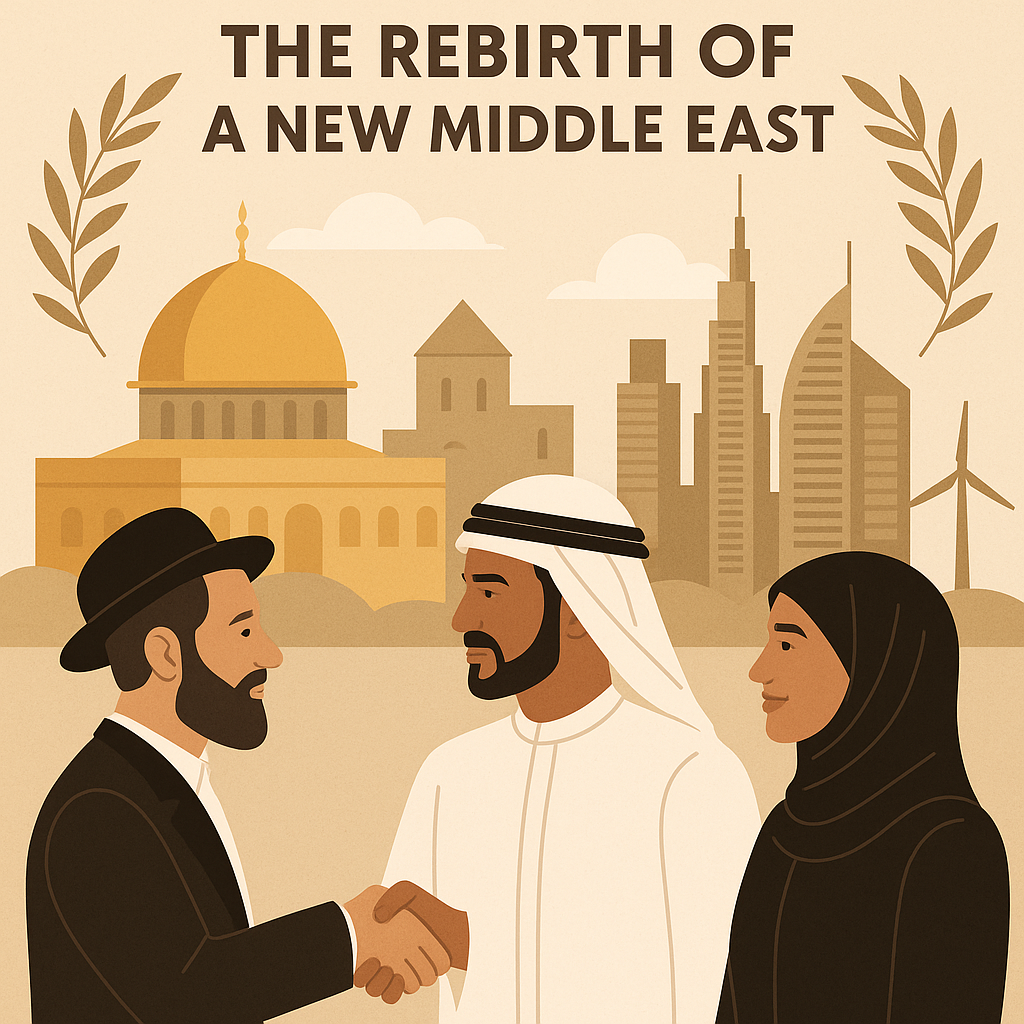
The arbitrary borders created by colonial powers must no longer divide and rule the region. The people of the Middle East—Arab, Jew, Christian, Muslim—deserve to live in peace.
A peaceful and prosperous Middle East should be the goal of the entire world. The intersection of visions—Trump’s anti-interventionist rhetoric and MBS’s ambitious reform—offers a path forward. But it will require courage. It will require new leadership. And it will require saying goodbye to those whose politics are rooted in fear and division.
The time has come to turn the page. Let the Middle East be reborn—not as a battlefield, but as a beacon of cooperation, innovation, and hope.
