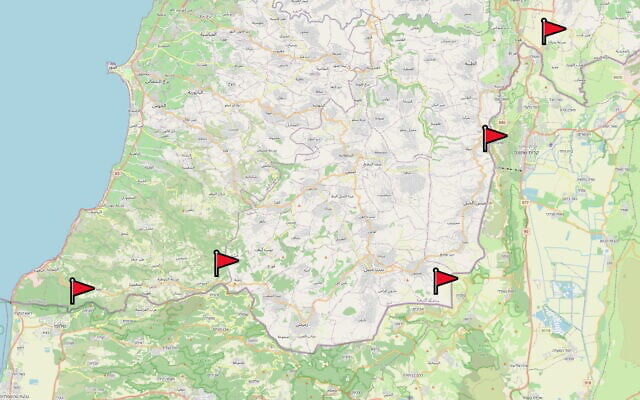
File : A map showing the locations of five IDF posts in southern Lebanon that troops will remain deployed to after a February 18, 2025, deadline. It dominates the area of Bint Jbeil, Maroun al-Ras, and Wadi Saluki (Times of Israel)
UN envoy Jeanine Hennis-Plasschaert and the UNIFIL peacekeeping force said any further “delay in withdrawal of Israeli troops is a violation of a 2006 Security Council resolution 1701 that ended a past Israel-Hezbollah war.
Israeli forces are “staying indefinitely” in a buffer zone on the border with Lebanon, Defense Minister Israel Katz said on Thursday, adding that their presence was “situation-dependent”. The news comes after Lebanon called for the full withdrawal of Israeli troops under a ceasefire that came into effect late last year.
Beirut , Defense Minister Israel Katz said on Thursday that Israeli forces would indefinitely remain in what he called a “buffer zone”, in southern Lebanon.
Katz earlier this month had said troops would stay at five locations in Lebanon’s south even after the expiry of an extended deadline for Israel to withdraw under a ceasefire with Lebanon’s Iran-backed Hezbollah group.
“There is a buffer zone. It wasn’t easy but I stood my ground, and we received a green light from the United States. We gave them a map, and we are staying indefinitely – this is situation-dependent, not time-dependent,” Katz said at a conference, according to a statement issued by his office.
Israeli forces were to withdraw from southern Lebanon on February 18 under a November 27 truce agreement which ended more than a year of hostilities, including two months of all-out war during which Israel sent in ground troops.
On the deadline day, Katz said Israel’s military “will remain in a buffer zone in Lebanon with five control positions.”
Foreign Minister Gideon Saar called them “strategic high points” that were “necessary for our security”. He said at the time that Israel would “temporarily” remain in the five points until “Lebanon fully implements its side of the deal”.
Lebanese President Joseph Aoun and the country’s other leaders declared any Israeli presence on Lebanese soil an “occupation”.
Under the ceasefire brokered by Washington and Paris, Lebanon’s military was to deploy alongside United Nations peacekeepers as the Israeli army withdrew over a 60-day period that was prolonged to February 18.
Hezbollah was to pull back north of the Litani River, about 30 kilometres (20 miles) from the border, and dismantle remaining military infrastructure there.
In a joint statement, UN envoy Jeanine Hennis-Plasschaert and the UNIFIL peacekeeping force said that at “the end of the period set” for Israel’s withdrawal and the Lebanese army’s deployment, any further “delay in this process is not what we hoped would happen” and a violation of a 2006 Security Council resolution that ended a past Israel-Hezbollah war.
Hostilities between Hezbollah and Israel – initiated by the militant group’s support of its ally Hamas – ended with the ceasefire that has largely held despite mutual accusations of violations.
The conflict significantly weakened Hezbollah and decimated its leadership
Not first time for Lebanon
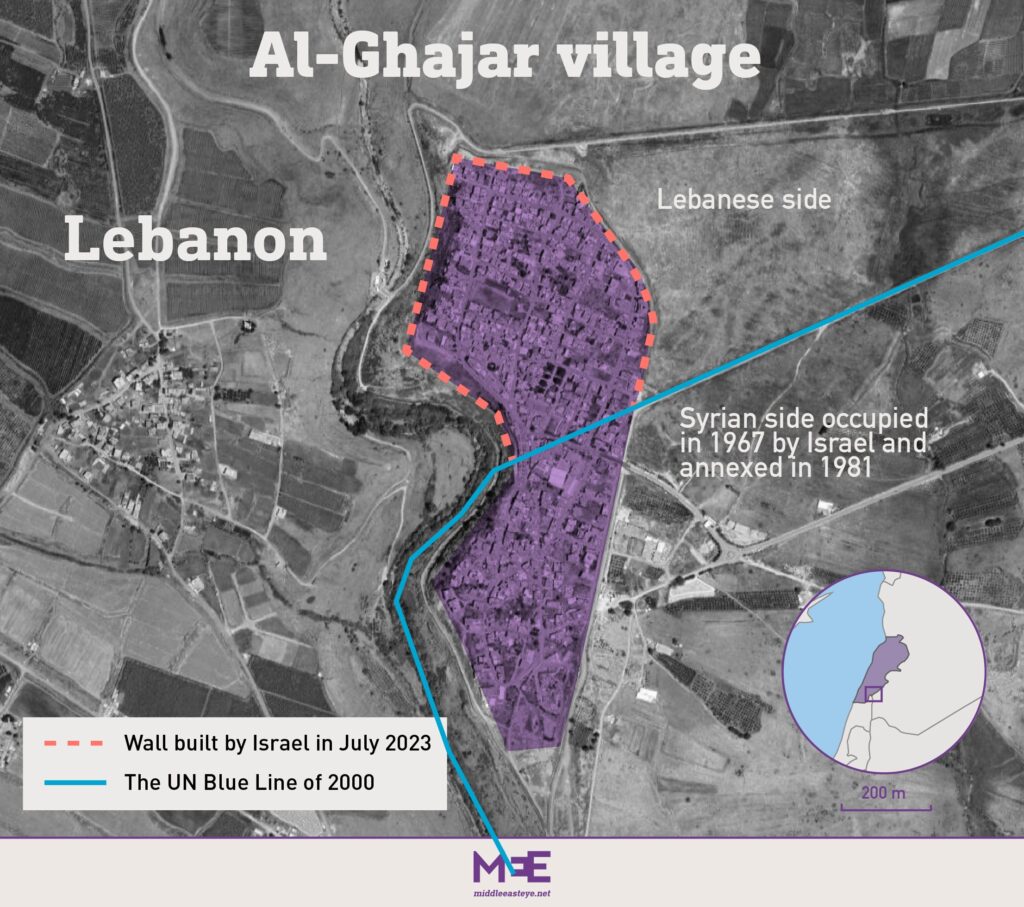
“Every war that Hezbollah launched against Israel resulted in lost territories for Lebanon” , Ali Hussein a Lebanese analyst was quoted as saying . “In 2006 Lebanon lost the northern part of the village of Ghajar and in its latest war Lebanon lost a huge territory , all in the name of the Axis of Resistance , for increasing Iran’s influence in the region “. The best thing for Lebanon is for Hezbollah to hand over its arms to the Lebanese army, since Lebanon cannot afford such a loser .” he added
FRANCE24/ AFP
