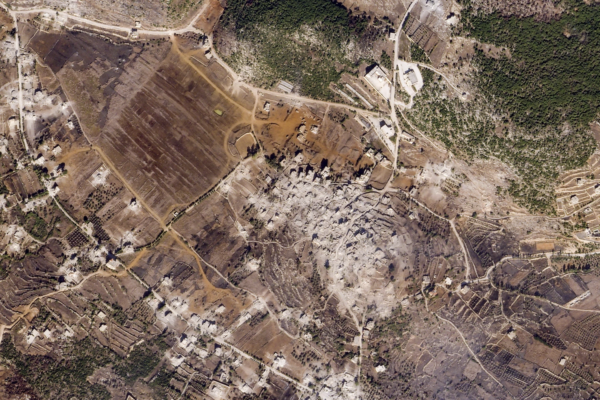
Satelite images taken on October 24 show the tiny southern Lebanese village of Ramyah has almost been wiped off the map. In a neighboring village, satellite photos show a similar scene: a hill once covered with houses, is now reduced to a gray smear of rubble. Hezbollah is being urged to implement the ceasefire deal in order not to delay the reconstruction of south Lebanon and allow the return of about one million displaced Shiites
The Israeli government said on Thursday a ceasefire deal with the Iran-backed group Hezbollah was not being implemented fast enough, days before Israel is meant to complete a withdrawal of its forces from southern Lebanon under the terms of the deal.
Israel and the Lebanese militant group agreed in November to an American- and French-mediated ceasefire, bringing an end to more than a year of fighting. Under the deal, Israeli forces were to withdraw from Lebanon and Hezbollah forces were to withdraw from southern Lebanon over a 60-day period ending next Monday morning.
“There have been positive movements where the Lebanese army and UNIFIL have taken the place of Hezbollah forces, as stipulated in the agreement,” Israeli government spokesman David Mencer told reporters, referring to UN peacekeepers in Lebanon.
“We’ve also made clear that these movements have not been fast enough, and there is much more work to do,” he said, affirming that Israel wanted the agreement to continue.
Mencer did not directly respond to questions about whether Israel had requested an extension of the deal or say whether Israeli forces would remain in Lebanon after the 60-day deadline.
Three diplomats said it looked like Israeli forces would still be in some parts of southern Lebanon after the 60-day mark.
A senior Lebanese political source said President Joseph Aoun had been in contact with U.S. and French officials to urge Israel to complete the withdrawal within the stipulated timeframe.
The Lebanese government has told U.S. mediators that Israel’s failure to withdraw on time could complicate the Lebanese army’s deployment, and this would be a blow to diplomatic efforts and the optimistic atmosphere in Lebanon since Aoun was elected president on Jan. 9.
Ali Fayyad, a Hezbollah lawmaker, said on Jan. 20 that if Israel failed to withdraw this would put all Lebanese people in a new phase of “confronting the Israeli occupation through all possible means and tools to force it from our land”.
“This confrontation is the responsibility of all Lebanese: the government, the army, the people, parties and resistance”, said Fayyad, in comments reported by Lebanon’s National News Agency.
The ceasefire agreement calls for Israel to withdraw its forces from southern Lebanon, enabling civilians on both sides of the border to return to their homes.
Here are some highlights of the agreement
The agreement, which comprises 13 points, involves Israel withdrawing from southern Lebanon, which will enable civilians on both sides of the border to return to their homes.
Over the next 60 days, Hezbollah will remove its fighters and weapons from the area between the Blue Line – the unofficial border between Lebanon and Israel – to areas north of the Litani River.
In the south, Hezbollah fighters will be replaced with the Lebanese army who will ensure that infrastructure and weaponry are removed and cannot be rebuilt.
File: A satellite image shows the destruction of the village of Yaroun in south Lebanon during the hostilities between Hezbollah and Israel. October 23, 2024. Planet Labs Inc/Handout via REUTERS. Hezbollah is being urged to implement the ceasefire deal in order not to delay the reconstruction of south Lebanon and allow the return of about one million displaced Shiites
Here is the full text of the agreement :
After discussions with the governments of the Republic of Lebanon (hereinafter “Lebanon”) and the state of Israel (hereinafter “Israel”), the United States of America and France understand that Lebanon and Israel seek a sustainable end to the current escalation of hostilities across the Blue Line and are each prepared to take steps to promote conditions for a permanent and comprehensive solution. These understandings reflect steps to which Israel and Lebanon are committed in order to implement fully UN Security Council Resolution (UNSCR) 1701, recognizing that UNSCR 1701 also calls for full implementation of its predecessor UNSC resolutions, including “disarmament of all armed groups in Lebanon”, so that the only forces authorised to carry arms in Lebanon will be the Lebanese Armed Forces (LAF), Internal Security Forces, Directorate of General Security, General Directorate of State Security, Lebanese Customs and Municipal Police (hereinafter “Lebanon’s official military and security forces”). To that end, the US and France understand the following
1. Israel and Lebanon will implement a cessation of hostilities beginning at 4am, November 27, 2024, in accordance with the commitments detailed below.
2. From 4 am, November 27, 2024, forward, the Government of Lebanon will prevent Hezbollah and all other armed groups in the territory of Lebanon from carrying out any operations against Israel, and Israel will not carry out any offensive military operations against Lebanese targets, including civilian, military or other state targets, in the territory of Lebanon by land, air or sea.
3. Israel and Lebanon recognize the importance of UNSCR 1701 to achieving lasting peace and security and commit to taking steps towards its full implementation, without violation.
4. These commitments do not preclude either Israel or Lebanon from exercising their inherent right of self-defense, consistent with international law.
5. Without prejudice to the UN Interim Force in Lebanon (UNIFIL) and its responsibilities, or to commitments in UNSCR 1701 and its predecessor resolutions, Lebanon’s official military and security forces, infrastructure and weaponry will be the only armed groups, arms, and related materiel deployed in the southern Litani area shown in the attached LAF Deployment Plan (hereinafter “the Southern Litani Area”).
6. Consistent with UNSCR 1701 and its predecessor resolutions, (UNSC 1559) in order to prevent the re-establishment and rearmament of non-state armed groups in Lebanon, any sales or supply of arms and related materiel into Lebanon will be regulated and controlled by the Government of Lebanon. Additionally, all production of arms and related materials within Lebanon will be regulated and controlled by the Government of Lebanon.
7. In order to implement UNSCR 1701, and upon the commencement of the cessation of hostilities according to paragraph one, the Government of Lebanon will provide all necessary authorities, including freedom of movement, to Lebanon’s official military and security forces, and instruct them, consistent with UNSCR 1701 and its predecessor resolutions to:
a. Monitor and enforce against any unauthorized entry of arms and related materials into and throughout Lebanon, including through all border crossings, and against the unauthorized production of arms and materials within Lebanon.
b. Starting with the Southern Litani Area, dismantle all existing unauthorized facilities involved in the production of arms and related materiel, and prevent the establishment of such facilities in the future.
c. Starting with the Southern Litani Area, dismantle all infrastructure and military positions, and confiscate all unauthorized arms inconsistent with these commitments.
8. The US and France intend to work within the Military Technical Committee for Lebanon (MTC4L) to enable and achieve a total LAF deployment of 10,000 soldiers to southern Lebanon as soon as possible. Further, the US and France intend to work with the international community to support the LAF as appropriate to achieve such an increase in its deployment levels in Lebanon, and to improve its capabilities.
9. Upon the commencement of the cessation of hostilities according to paragraph one, and without prejudice to Unifil and its mandate and responsibilities in UNSCR 1701 and its predecessor resolutions, Israel and Lebanon resolve, in coordination with UNIFIL, to reformulate and enhance the tripartite mechanism (hereinafter: “the Mechanism”). The reformulated and enhanced Mechanism, hosted by UNIFIL chaired by the US, and including France, will monitor, verify, and assist in ensuring the enforcement of these commitments.
a. Israel and Lebanon will cooperate with and facilitate the work of the Mechanism and will ensure their safety.
b. The Mechanism will work with the MTC4L to strengthen the capacity and training of the LAF to inspect and dismantle unauthorized sites and infrastructure, above and below ground, confiscate unauthorized weapons, and prevent the presence of unauthorized armed groups.
c. Alongside the Mechanism’s work, UNIFIL’s work pursuant to its mandate will continue, including the efforts UNIFIL supports through its convening role that enhances the Mechanism’s effectiveness.
10. Israel and Lebanon will report any alleged violations to the Mechanism and Unifil without prejudice to their respective rights to communicate directly with the UN Security Council. The Mechanism will develop appropriate procedures to consult, inspect, gather information, and assist in ensuring the enforcement of these commitments.
11. Upon the commencement of the cessation of hostilities according to paragraph one, Lebanon will deploy its official military and security forces to all borders, and to all regulated and non-regulated land, air and sea border crossings. In addition, the LAF will deploy forces, and set roadblocks and checkpoints on all the roads and bridges along the line delineating the Southern Litani Area.
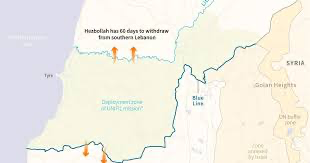
LAF Deployment Plan
12. Upon the commencement of the cessation of hostilities according to paragraph one, Israel will withdraw its forces in a phased manner south of the Blue Line, and in parallel the LAF will deploy to positions in the Southern Litani Area shown in the LAF Deployment Plan, and will commence the implementation of its obligations under the commitments, including the dismantling of unauthorized sites and infrastructure and confiscating unauthorized arms and related materiel. The Mechanism will coordinate the execution by the Israel Defence Forces and LAF of the specific and detailed plan for the phased withdrawal and deployment in these areas, which should not exceed 60 days.
13. Israel and Lebanon request that the US – with the partnership of the UN – facilitate indirect negotiations between Israel and Lebanon with the objective of resolving remaining disputed points along the Blue Line, consistent with resolution 1701.
The US and France understand that the above commitments will be accepted by Israel and Lebanon concurrently with this announcement.
These commitments strive to enable civilians on both sides of the Blue Line to return safely to their lands and homes. The US and France further intend to lead international efforts to support capacity-building and economic development throughout Lebanon to advance stability and prosperity in this region.
Israel claims that Hezbollah did not evacuate the area between Its border and the Litani River and the Lebanese army did not replace Hezbollah, which is in violation of the agreement.
Hezbollah is being urged by all the parties involved in the negotiation of the ceasefire agreement to fully implement the agreement so that Israel will end its occupation and withdraw from south Lebanon. Failure to do so by Hezbollah will delay the reconstruction of its mostly Shiite strongholds in south and east Lebanon
Reuters/ Ya Libnan/ MEE
